
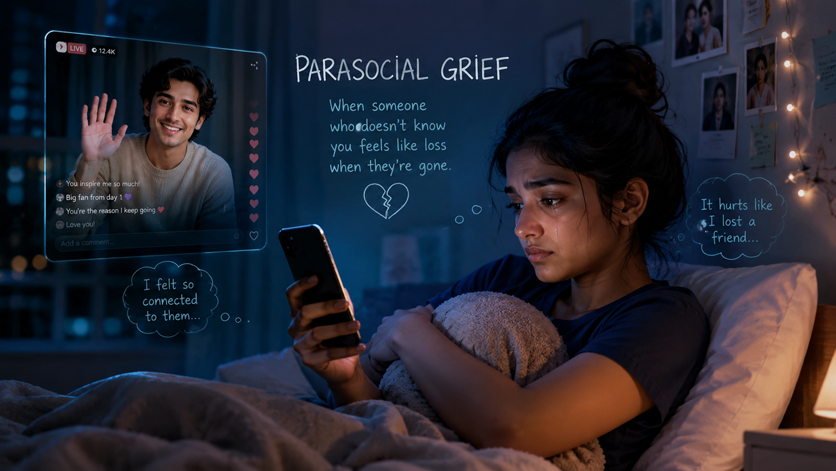
Parasocial Grief: Why Losing a Celebrity or Fictional Character Feels Like Losing a Friend
Introduction: You Didn’t Know Them. So Why Does It Hurt So Much?
Maybe it was when your favorite artist died and you cried for days. Maybe it was when a beloved fictional character was killed off and you felt genuinely bereft. Maybe it was when a YouTuber you’d watched for years stopped making content, and the absence felt surprisingly painful. And maybe you felt embarrassed about all of it.
At Prayatna Mentaverse, we want to offer something different: your grief is real. Your neurological experience of loss is identical to the grief you’d feel for someone you knew personally. Understanding why that’s true — rather than dismissing it — is the beginning of something more compassionate.
What Is a Parasocial Relationship?
The concept was first introduced by sociologists Donald Horton and Richard Wohl in 1956, observing that television audiences developed one-sided emotional bonds with TV personalities. Today, parasocial relationships — emotionally meaningful bonds with people or characters who don’t know you exist — are nearly universal. We form them with celebrities, YouTubers, podcasters, fictional characters, and social media influencers.
These relationships feel real because, in many neurologically meaningful ways, they are.
The Neuroscience: Why Your Brain Can’t Tell the Difference
The human brain’s social processing systems evolved to handle face-to-face relationships. They didn’t evolve for a world where a person’s face, voice, and emotional life can be transmitted to millions of strangers.
- Mirror neurons fire when we observe emotional experiences — when your favorite musician performs with raw vulnerability, your mirror neuron system responds whether they’re in the room or on a screen
- The medial prefrontal cortex (mPFC) activates similarly for people we know personally and people we feel parasocially connected to
- Oxytocin and dopamine are released during parasocial engagement, activating the same reward systems as a genuinely enjoyable interaction with a friend
When the relationship ends — through death, cancellation, or a show ending — the brain experiences something neurologically identical to relationship loss.
When Parasocial Grief Is a Normal Response
Mourning a celebrity death is a legitimate grief experience. Research published in OMEGA – Journal of Death and Dying found that the intensity of parasocial grief correlated with the depth of the parasocial relationship — just as real grief correlates with closeness. Genuine grief responses include shock and disbelief, sadness, difficulty concentrating, a desire to talk about the person, and a period of consuming old content.
The Complicated Grief of Fictional Character Loss
When you mourn a fictional character, you are mourning the narrative relationship you had with them, a version of yourself who was reading or watching, and the meanings you made from their story. A character who helped you understand yourself, survive something, or feel less alone has done something real for you. Their loss is real.
Healthy Ways to Process Parasocial Grief
- Name it without shame — calling your experience grief and treating it accordingly is the first step
- Find community — fan communities in grief are often remarkably healing
- Create something — fan art, writing, and playlist curation are legitimate grief rituals
- Reflect on what the relationship meant to you and what part of yourself it reflected back
When to Seek Support
At Prayatna Mentaverse, we sit with clients through grief that doesn’t fit conventional categories — gently and without judgment. If parasocial grief is significantly affecting your functioning, or you notice that your primary emotional bonds are parasocial, it may be worth exploring with a professional.
You are not embarrassing for grieving someone you never met. You are a human being with a nervous system that evolved to attach. Grieve accordingly.
#ParasocialGrief #CelebrityDeath #ParasocialRelationships #GriefAndLoss #DigitalMentalHealth #PrayatnaMentaverse
Related Posts

When Should Parents Seek Professional Help for Academic Avoidance?
When Should Parents Seek Professional Help for Academic Avoidance? “Not every...

How to Create Screen-Free Time for Kids: 10 Practical Tips
How to Create Screen-Free Time for Kids: 10 Practical Tips Introduction:...

Childhood Bullying vs Normal Conflict: Why Mislabeling Everyday Disagreements Can Harm Children
Childhood Bullying vs Normal Conflict: How to Tell the Difference...
The “Bed Rotting” Paradox: Self-Care or a Slow Slide Into Depression?
When Your Bed Becomes Both Sanctuary and Trap If you've scrolled TikTok in the...