
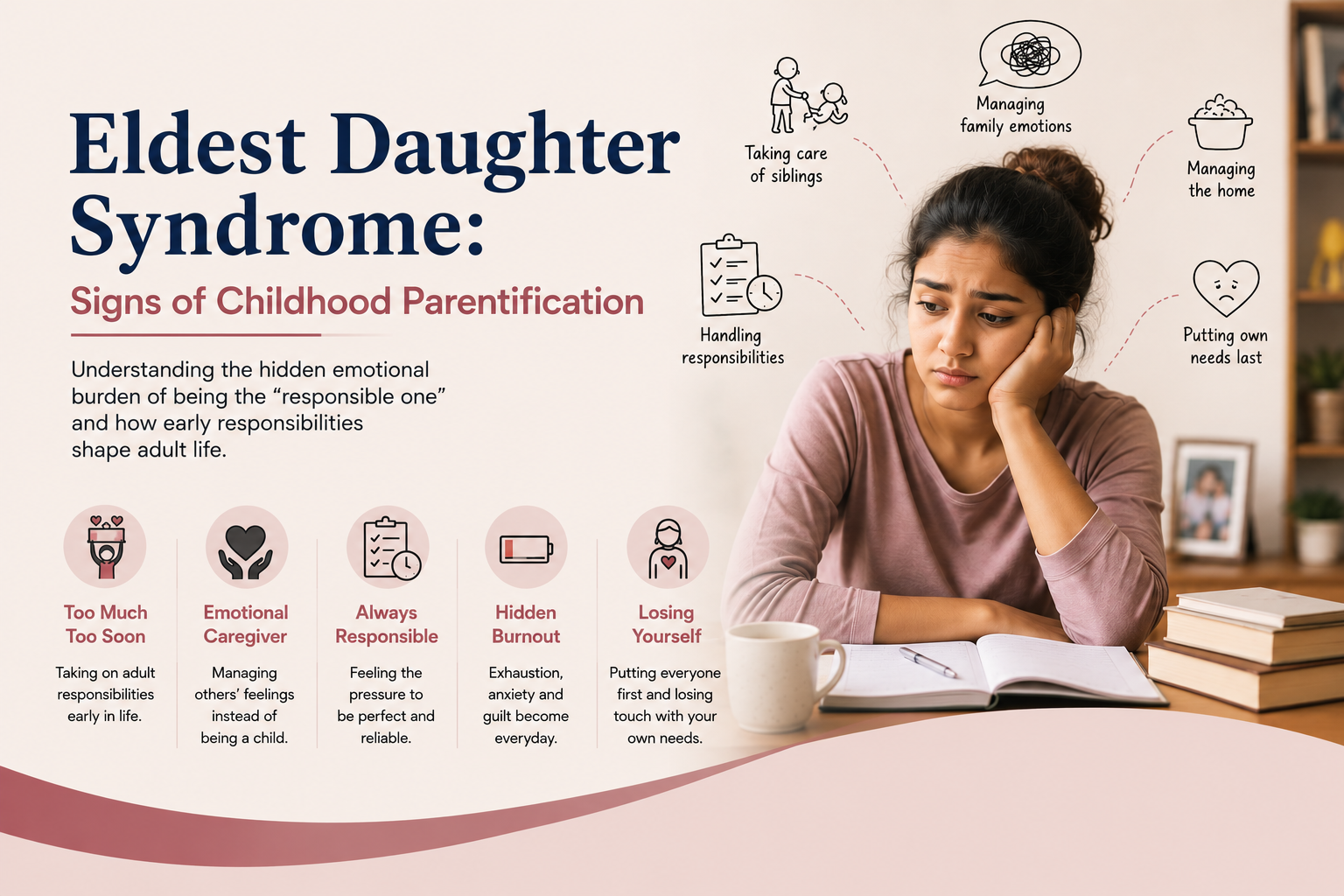
Eldest Daughter Syndrome: Signs of Childhood Parentification
Eldest Daughter Syndrome: Signs of Childhood Parentification
Introduction
Eldest Daughter Syndrome is becoming an increasingly recognised pattern in mental health conversations. Although it isn’t an official psychological diagnosis, many women describe growing up as the “responsible child”—taking care of siblings, managing family responsibilities, and putting everyone else’s needs before their own.
At Prayatna Counselling, we frequently work with adults who are experiencing anxiety, burnout, perfectionism, or difficulty setting boundaries, only to discover that these patterns began in childhood. Understanding Eldest Daughter Syndrome can help families recognise unhealthy expectations early and support children in healthier ways.
What Is Eldest Daughter Syndrome?
Eldest Daughter Syndrome refers to the emotional and practical responsibilities often placed on the oldest daughter within a family. In many households, particularly in cultures where family responsibility is highly valued, the eldest daughter is expected to mature quickly, help care for siblings, support parents emotionally, and become a role model from a very young age.
While responsibility itself isn’t harmful, problems arise when a child consistently carries responsibilities that are more appropriate for an adult.
This experience is closely connected to a psychological concept known as parentification.
What Is Eldest Daughter Syndrome?
Parentification occurs when a child takes on the role of a parent before they are emotionally or developmentally ready.
Mental health professionals generally describe two forms of parentification.
If childhood responsibilities are affecting your emotional wellbeing, our Individual Counselling services can help you understand these patterns and build healthier coping strategies.
Instrumental Parentification
The child regularly performs adult responsibilities such as:
- Looking after younger siblings
- Cooking meals
- Managing household chores
- Translating for parents
- Organising family responsibilities
Emotional Parentification
This occurs when the child becomes responsible for managing adults’ emotions.
Examples include:
- Comforting parents during conflicts
- Acting as a mediator between family members
- Becoming a parent’s confidant
- Feeling responsible for everyone’s happiness
- Suppressing their own emotions to avoid creating additional stress
Emotional parentification often leaves deeper psychological effects because the child’s own emotional needs remain unmet.
Why Eldest Daughter Syndrome Develops
Many eldest daughters grow up hearing phrases such as:
- “You’re the eldest—you should know better.”
- “Take care of your younger brother.”
- “Don’t upset your parents.”
- “You’re so mature for your age.”
While these comments are often intended as compliments, children may begin believing that love must be earned through responsibility and self-sacrifice.
Over time, they learn to prioritise everyone else’s needs before their own.
How Eldest Daughter Syndrome Affects the Developing Brain
Children’s brains are designed for exploration, learning, play, and emotional development—not adult caregiving.
When children experience prolonged stress from excessive responsibility, the nervous system adapts by becoming constantly alert.
Research suggests chronic childhood stress may contribute to:
- Hypervigilance
- Anxiety
- Perfectionism
- Difficulty relaxing
- Emotional suppression
- Increased stress responses
- Low self-worth
Instead of learning that adults provide safety, children begin believing they must become the safe person for everyone else.
According to the American Psychological Association (APA), prolonged childhood stress can affect emotional development, stress regulation, and long-term mental health.
Signs of Eldest Daughter Syndrome
While every family is different, some common signs include:
- Feeling responsible for everyone else’s emotions
- Difficulty asking for help
- Feeling guilty while resting
- Constant people-pleasing
- Fear of disappointing others
- Perfectionism
- Overthinking small mistakes
- Always putting others first
Many adults don’t realise these patterns began in childhood until they start therapy.
When Eldest Daughter Syndrome Becomes Harmful
Helping around the house or caring for younger siblings occasionally is a normal part of family life.
However, responsibility becomes unhealthy when a child:
- Consistently sacrifices their own childhood
- Feels emotionally responsible for parents
- Experiences chronic stress
- Cannot express their own needs
- Believes their worth depends on helping others
Healthy families teach responsibility while also allowing children to experience joy, play, mistakes, and emotional safety.
Continue reading: Healing from Parentification: Recovering from Eldest Daughter Syndrome (Part 2)
Related Posts

When Should Parents Seek Professional Help for Academic Avoidance?
When Should Parents Seek Professional Help for Academic Avoidance? “Not every...

Speech Delay vs. Late Talker: How to Know the Difference and When to Seek Therapy
🌱 Why Your Child’s Speech Milestones Matter Every child develops at their own...
Eldest Daughter Syndrome: Signs of Childhood Parentification
Eldest Daughter Syndrome: Signs of Childhood Parentification Introduction...

Rising Violence Among Gujarat’s Youth: Causes, Impacts, and Solutions
આજના સમયમાં કિશોરોમાં હિંસક વર્તનનું પ્રમાણ વધવાનું મુખ્ય કારણ તમે શું માનો છો?...