
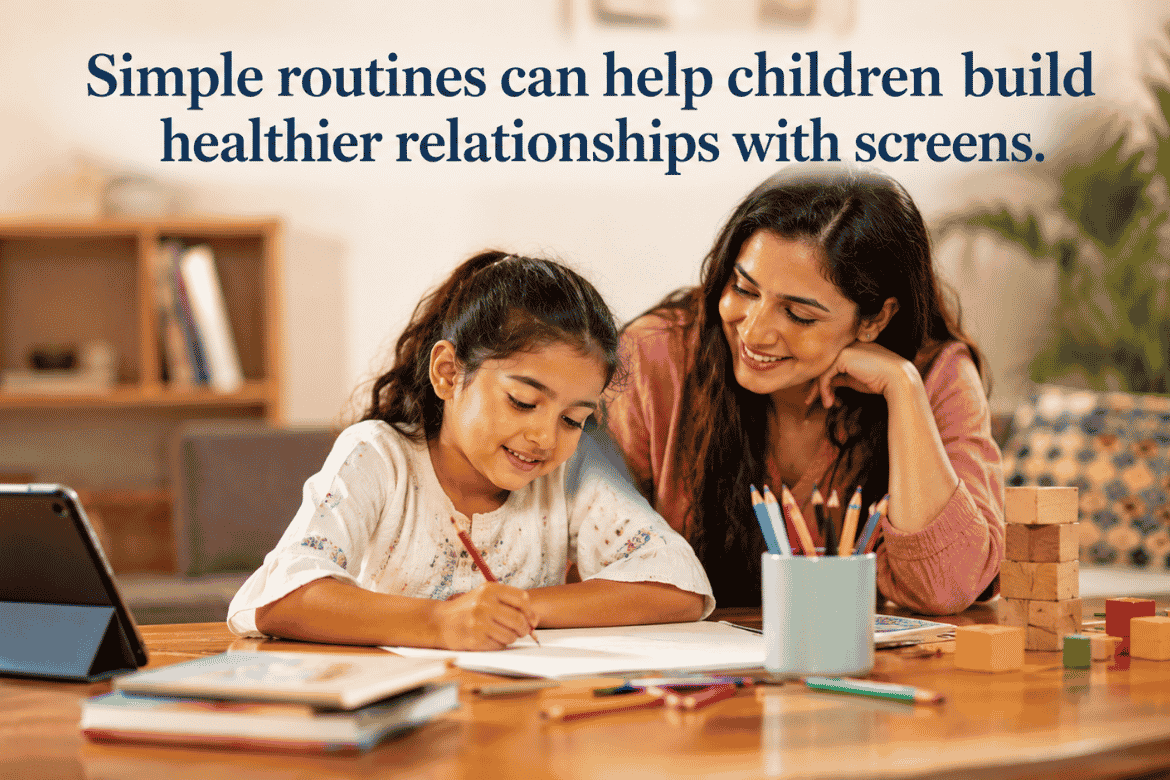
How to Create Screen-Free Time for Kids: 10 Practical Tips
How to Create Screen-Free Time for Kids: 10 Practical Tips
Introduction: Creating Screen-Free Time Without Constant Battles
Creating screen-free time for kids doesn’t have to mean taking every device away and declaring a technology ban.
In fact, sudden restrictions can sometimes turn screen use into a daily battle.
A more sustainable approach is to create predictable routines where screens have a place — but so do reading, outdoor play, creativity, family interaction, rest and boredom.
The goal is not:
“No screens.”
The goal is:
“Screens are one part of childhood, not the whole childhood.”
The American Academy of Pediatrics recommends creating family media plans that reflect each family’s routines and values, including screen-free zones, alternative activities and regular review of the plan as children grow.
1. Start With One Screen-Free Period
Don’t try to change everything at once.
Choose one predictable period.
For example:
After school → 30 minutes screen-free
or
Dinner → no phones or tablets
or
Before bedtime → screen-free routine
Once that becomes normal, you can gradually expand it.
Consistency is usually more useful than extreme restrictions that are difficult to maintain.
The American Academy of Pediatrics’ family media plan can also help parents create realistic and consistent technology boundaries at home.
2. Create Screen-Free Zones at Home
Some areas of the home can naturally become screen-free.
Consider:
- Dining table
- Bedroom during bedtime
- Family conversation areas
- Homework spaces
The American Academy of Pediatrics specifically recommends screen-free zones such as the dinner table, during homework and before bed.
This makes the rule easier for children to understand.
Instead of:
“You can’t use your phone right now.”
the rule becomes:
“We don’t use devices at the dinner table.”
It’s a family habit rather than a punishment.
3. Give Transition Warnings
One of the hardest moments for many families is:
“Turn it off NOW.”
A child who is deeply involved in a game or video may experience that sudden interruption as frustrating.
Instead, give warnings.
Try:
“You have 15 minutes left.”
Then:
“Five more minutes.”
Then:
“When this ends, we’re putting the tablet away.”
Predictability can make transitions easier.
The American Academy of Pediatrics notes that screen transitions can trigger strong emotional reactions and recommends strategies that support healthier technology routines.
4. Give Children Something to Move Toward
Removing a screen creates an empty space.
If you don’t know what will fill that space, the child will naturally ask:
“Now what?”
Prepare alternatives.
For example:
- Drawing
- Lego or building blocks
- Puzzles
- Reading
- Outdoor play
- Board games
- Crafting
- Music
- Pretend play
- Helping in the kitchen
- Gardening
The American Academy of Pediatrics recommends making room for reading, outdoor play, family games and hobbies within family media plans.
5. Create an “I’m Bored” Jar
This is one of the easiest strategies to try.
Take a jar.
Write simple activities on small pieces of paper.
Examples:
Creative ideas
- Draw a superhero
- Make a paper airplane
- Build a cardboard house
- Create a comic
Movement ideas
- Go outside
- Make an obstacle course
- Dance to three songs
- Play catch
Family ideas
- Play a board game
- Help make a snack
- Tell a funny story
- Do a puzzle together
When your child says:
“I’m bored!”
you can respond:
“Choose one.”
The American Academy of Pediatrics has also recommended the idea of an “I’m bored” jar as one practical way to help children move away from automatic screen use.
6. Don’t Over-Schedule the Replacement
This is important.
Parents sometimes remove screens and immediately replace them with:
- Tuition
- Classes
- Worksheets
- Activities
- Coaching
- Structured games
But children also need unstructured time.
If every minute is planned, children don’t get to practise deciding what they want to do.
Leave some empty space.
Then let the child fill it.
Unstructured activities can also provide opportunities for children to practise skills such as attention, planning, flexible thinking and self-regulation. The Harvard Center on the Developing Child’s resources on executive function explain how these skills develop through practice and interaction.
7. Make Creativity Easy to Access
If art supplies are hidden in a cupboard that requires adult help, children are less likely to use them independently.
Create an accessible activity area.
Keep things such as:
- Paper
- Colour pencils
- Crayons
- Clay
- Blocks
- Books
- Puzzles
- Cardboard
- Stickers
within reasonable reach.
The environment itself can encourage screen-free play.
8. Let Your Child Be Bored
This can be difficult for parents.
Your child says:
“I’m bored!”
You immediately hear:
“I need you to fix this.”
But you don’t always have to fix it.
Try:
“I know you’re bored. You can decide what you’d like to do.”
Then wait.
Your child may complain.
They may walk around.
They may say there is “nothing to do.”
And then suddenly:
They start drawing.
They build something.
They create a game.
They go outside.
They start talking to a sibling.
That transition is part of learning.
9. Model Healthy Screen Habits Yourself
Children notice what adults do.
If parents constantly check their phones during:
- Meals
- Conversations
- Waiting
- Driving
- Family time
children receive a message about how technology should be used.
Healthy digital habits need to include adults too.
The American Academy of Pediatrics recommends making a family media plan for every member of the family, including parents and caregivers.
Ask yourself:
“Would I want my child to copy my current phone habits?”
If the answer is uncomfortable, that’s useful information.
10. Build a Family Media Plan
Instead of making random rules every day, create a simple family agreement.
Decide together:
When can screens be used?
For example:
After homework.
After outdoor play.
During a specific leisure period.
Where are screens not used?
For example:
Dining table.
Bedrooms at bedtime.
During family conversations.
What happens when screen time ends?
The device goes to a charging location.
Another activity begins.
What content is allowed?
Age-appropriate content.
Educational or creative content.
Content parents are comfortable with.
The American Academy of Pediatrics recommends revisiting family media plans as children grow and their routines change.
What If My Child Gets Angry When the Screen Is Removed?
First, remember:
A strong reaction doesn’t automatically mean something is seriously wrong.
Transitions can be difficult.
Try to avoid turning every transition into a negotiation.
Instead:
- Give advance notice.
- Keep the boundary predictable.
- Stay calm.
- Acknowledge the emotion.
- Offer the next activity.
- Avoid lengthy arguments.
You can say:
“I know you want to keep playing. It’s difficult to stop when you’re having fun. The tablet is going away now. You can choose drawing or going outside.”
You’re acknowledging the feeling without changing the boundary.
What If My Child Says Every Other Child Has a Phone?
This is one of the most common parenting arguments.
Instead of responding:
“I don’t care what other children do.”
try:
“Different families have different rules. Our family has decided this is what works for us.”
Children may still disagree.
That’s okay.
Healthy boundaries don’t require children to agree with every decision.
What If Screens Are My Child’s Main Way to Calm Down?
This deserves a closer look.
Screens can become a powerful emotional regulation tool.
A child may learn:
“I’m upset → screen.”
“I’m anxious → game.”
“I’m angry → YouTube.”
“I’m bored → tablet.”
Digital entertainment can provide immediate distraction.
But children also need opportunities to develop other ways of managing uncomfortable feelings.
These may include:
- Talking
- Movement
- Breathing
- Creative activities
- Connection
- Quiet time
- Problem-solving
- Sensory activities
The objective isn’t to take away every coping tool.
It is to help children develop more than one.
When Screen Use May Need Professional Support
Parents should consider professional guidance when screen use is consistently associated with significant difficulties such as:
- Major disruption to sleep
- Persistent conflict at home
- Withdrawal from other activities
- Difficulty functioning without a device
- Significant emotional or behavioural changes
- School difficulties
- Social withdrawal
- Strong and persistent distress around screen limits
These signs do not automatically mean a child has a clinical disorder.
They simply suggest that it may be helpful to understand what is happening underneath the behaviour.
Prayatna Counselling’s child services include behavioural therapy, occupational therapy, speech therapy, remedial education and early intervention.
What If Screen Use Is Not the Real Problem?
Sometimes the screen is the easiest place to see the problem.
But the underlying issue may be something else.
A child might use screens excessively because they are:
- Lonely
- Anxious
- Struggling academically
- Having difficulty making friends
- Overwhelmed
- Bored
- Avoiding difficult emotions
- Experiencing family stress
So instead of asking only:
“How do I get my child off the screen?”
ask:
“What does my child get from the screen?”
That question can lead to a much more useful conversation.
A Simple 7-Day Screen-Free Challenge
You don’t need to completely redesign your family’s lifestyle.
Try this for seven days.
Day 1
Create one screen-free meal.
Day 2
Add 30 minutes of screen-free play.
Day 3
Create an “I’m bored” jar.
Day 4
Make one room a screen-free zone.
Day 5
Spend 30 minutes outdoors together.
Day 6
Have a family game or creative activity.
Day 7
Review what worked and create your family media plan.
The goal isn’t perfection.
The goal is awareness and balance.
How Prayatna Counselling Supports Children and Families
Prayatna Counselling provides support across child development, behavioural needs, emotional wellbeing and early intervention.
Our services include:
- Behavioural Therapy
- Occupational Therapy
- Speech Therapy
- Remedial Education
- Early Intervention
Explore our Child Services:
You can also learn about our Early Intervention Services:
If you want to understand our broader counselling and psychological services, visit:
https://prayatnacounselling.com/
Conclusion: Balance, Not Bans
Healthy screen habits don’t require a technology-free childhood.
Children can enjoy technology.
They can play games.
They can watch videos.
They can use educational apps.
They can explore digital creativity.
But they also need something technology cannot completely replace:
Real-world childhood.
They need movement.
They need relationships.
They need conversation.
They need creativity.
They need independent play.
They need quiet.
And sometimes:
They need to be bored.
The goal of screen-free time for kids isn’t to remove technology.
It is to make sure there is still enough space for childhood to happen.
Frequently Asked Questions
How do I reduce screen time without fighting with my child?
Start gradually. Create predictable screen-free periods, give transition warnings and provide appealing alternatives instead of relying only on restrictions.
What are good screen-free activities for kids?
Drawing, reading, outdoor play, puzzles, building, crafts, pretend play, board games, music and helping with age-appropriate household activities are good options.
Should I allow screens when my child is bored?
You don’t have to respond to every moment of boredom with a screen. Give your child an opportunity to decide what they want to do.
How can I make my child play independently?
Create an accessible environment with books, art materials, blocks, puzzles and open-ended toys. Start with short periods and gradually increase them.
What should I do if my child becomes angry when screen time ends?
Use predictable limits, advance warnings and calm transitions. Acknowledge the child’s frustration without automatically changing the boundary.
When should I consult a child psychologist?
If screen use is consistently affecting your child’s sleep, school, relationships, behaviour, emotional wellbeing or daily functioning, professional guidance may be useful.
Learn More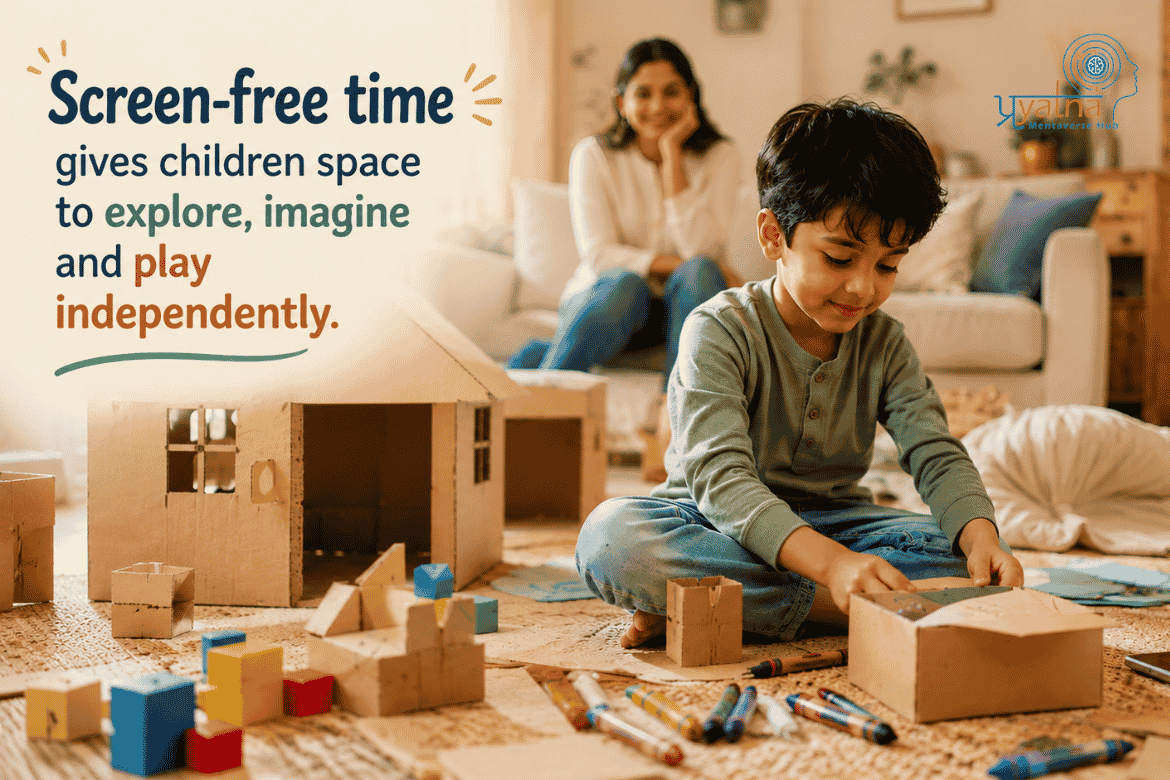
Screen-Free Time for Kids: Why Boredom Matters for Child Development
Screen-Free Time for Kids: Why Boredom Matters for Child Development
Introduction: The Uncomfortable Gift of Nothing to Do
“I’m bored.”
For many parents, those two words immediately trigger a search for something to keep the child occupied.
A toy.
A television show.
A game.
Or increasingly, a tablet or phone.
Children today have access to almost unlimited entertainment. Videos, games, apps and streaming platforms can fill almost every quiet moment.
But screen-free time for kids is not simply about reducing technology.
It is about creating space for something children also need: unstructured time.
When children are not being constantly entertained, they have an opportunity to decide what to do, create their own games, explore their surroundings, imagine new possibilities and learn how to tolerate moments when nothing exciting is happening.
At Prayatna Counselling, we believe healthy digital habits are not about declaring screens “bad.” They are about creating a balanced childhood where technology exists alongside play, relationships, movement, learning, creativity and rest.
What Does Screen-Free Time for Kids Actually Mean?
Screen-free time does not mean children should never use technology.
It means deliberately creating periods where screens are not the default source of entertainment or stimulation.
That could mean:
- Playing outdoors without a phone
- Drawing or colouring
- Reading a book
- Building with blocks
- Playing pretend
- Doing puzzles
- Talking with family
- Helping with simple household activities
- Exploring nature
- Making up a game
- Simply sitting and thinking
The goal isn’t to make childhood less enjoyable.
It is to give children different kinds of experiences.
The American Academy of Pediatrics recommends creating screen-free zones and making room for activities such as reading, outdoor play, family games and hobbies so screens do not crowd out other important experiences.
Why Is Boredom Important for Children?
Boredom is often treated like a problem.
A child says, “I’m bored,” and adults immediately feel responsible for fixing it.
But boredom can provide an important opportunity.
When there is no ready-made entertainment, children have to ask themselves:
“What can I do?”
That question can lead to creativity, exploration and independent decision-making.
Instead of receiving the next activity from a screen, the child has to generate an idea.
That difference matters.
Boredom Can Encourage Creativity
Imagine giving a child:
A cardboard box.
There is no single correct way to use it.
It could become:
- A car
- A house
- A spaceship
- A shop
- A robot
- A puppet theatre
- A treasure chest
The object hasn’t changed.
The child’s imagination has.
Unstructured play gives children opportunities to create their own stories, rules and possibilities rather than simply following a predetermined digital experience.
The American Academy of Pediatrics describes unstructured play and downtime as valuable opportunities for children to learn how to fill their own “blank canvas” rather than automatically turning to technology.
How Unstructured Play Supports Development
Children do not develop only when they are sitting in a classroom.
They develop while:
- Playing
- Talking
- Exploring
- Building
- Pretending
- Solving problems
- Negotiating with siblings
- Making mistakes
- Trying again
Harvard’s Center on the Developing Child explains that executive-function and self-regulation skills develop through interaction and practice. Activities and games can help children strengthen skills such as attention, working memory, planning and self-control.
This is why unstructured time should not automatically be considered “wasted time.”
It can be developmental time.
What Does Boredom Teach Children?
Creativity
Without a ready-made activity, children have to create possibilities themselves.
Problem-Solving
They need to decide what to do and how to make it work.
Self-Direction
Instead of waiting for someone else to provide entertainment, children begin learning:
“I can decide what I want to do.”
Frustration Tolerance
Boredom can feel uncomfortable.
Children gradually learn that discomfort does not always need an immediate solution.
Imagination
When there is less external stimulation, children have more opportunities to construct their own stories, games and worlds.
Is Technology the Problem?
Not necessarily.
Technology can provide valuable opportunities for:
- Education
- Creativity
- Communication
- Entertainment
- Social connection
The bigger question is:
What is the screen replacing?
For example:
Is screen use replacing sleep?
Is it replacing outdoor play?
Is it replacing family conversation?
Is it replacing reading?
Is it replacing independent play?
Is it replacing time to think?
This “what is it crowding out?” approach is more useful than simply treating every screen experience as harmful. The American Academy of Pediatrics encourages families to consider media within the context of the child’s overall routine and priorities.
The Child Who Is Never Bored
Consider a child whose every quiet moment is filled.
Waiting at a restaurant?
Phone.
Long car journey?
Tablet.
Feeling restless?
YouTube.
Finished homework?
Game.
Waiting for dinner?
Cartoon.
There may be nothing obviously wrong with any individual activity.
But when there is never an opportunity to experience an empty moment, the child gets fewer chances to practise creating their own stimulation.
The goal is not to eliminate entertainment.
The goal is to create balance.
The Paradox of the Over-Scheduled Child
Screens aren’t the only thing taking away unstructured time.
Many children have highly structured days:
- School
- Homework
- Tuition
- Sports
- Music
- Dance
- Coding
- Coaching
- Classes
These activities can be valuable.
But structured activities and unstructured play do different things.
Structured activities develop specific skills.
Unstructured time allows children to decide what to do with themselves.
Children need both.
Why “I’m Bored” Doesn’t Need an Immediate Solution
When your child says:
“I’m bored.”
you don’t necessarily have to respond with:
“Here, take the tablet.”
You could instead say:
“I know. What do you feel like doing?”
Or:
“Let’s see what you can create.”
The first response solves boredom for the child.
The second response gives the child an opportunity to solve it themselves.
That distinction can become increasingly important as children grow.
What Parents Can Do Today
You don’t need to completely change your family’s technology habits overnight.
Start with one small screen-free period.
For example:
30 minutes after school.
During that time, provide access to simple materials:
- Paper
- Crayons
- Books
- Blocks
- Puzzles
- Art supplies
- Outdoor space
Then step back.
You don’t need to direct every minute.
Let your child experiment.
When to Look More Closely at Screen Use
Screen enjoyment alone does not mean a child has a problem.
However, parents may want additional guidance if technology consistently interferes with:
- Sleep
- School
- Family relationships
- Physical activity
- Responsibilities
- Social interaction
- Mood
- Everyday functioning
Strong reactions during screen transitions can also become a recurring family challenge. The American Academy of Pediatrics recommends family media planning and predictable boundaries to support healthier digital habits.
If you’re concerned about your child’s development, behaviour or emotional wellbeing, professional guidance can help you understand the larger picture.
Prayatna Counselling provides child-focused services including behavioural therapy, occupational therapy, speech therapy, remedial education and early intervention support.
How Prayatna Counselling Can Help
At Prayatna Counselling, we support children and families across developmental, behavioural, emotional and learning needs.
Our child services include:
- Behavioural Therapy
- Occupational Therapy
- Speech Therapy
- Remedial Education
- Early Intervention
Learn more about our Child Services
Learn more about Early Intervention Services
Conclusion: Boredom Is Not the Enemy
Boredom isn’t necessarily something parents need to rescue children from.
Sometimes it is the space where creativity begins.
Sometimes it is where imagination appears.
Sometimes it is where children discover that they can entertain themselves.
And sometimes it is simply a quiet moment in a childhood filled with stimulation.
Screen-free time for kids isn’t about rejecting technology.
It is about making sure technology doesn’t replace the experiences children need for healthy development.
Give children time to play.
Give them time to explore.
Give them time to think.
And sometimes, let them be bored.
You may be surprised by what happens next.
FAQs
Is boredom good for children?
Boredom itself is not necessarily good or bad, but periods of unstructured time can give children opportunities to practise creativity, independence, problem-solving and self-regulation.
Should parents completely remove screens?
Not necessarily. Technology can have educational, creative and social benefits. The goal is a balanced routine where screens do not consistently crowd out sleep, play, relationships and physical activity.
What can children do instead of screens?
Children can draw, read, build, play outdoors, create stories, make crafts, play pretend, solve puzzles or invent their own games.
How much screen-free time should children have?
There is no single amount that works for every child. Families should consider age, development, sleep, school, physical activity and what screen use is replacing.

Healing from Parentification: Recovering from Eldest Daughter Syndrome
Healing from Parentification: Recovering from Eldest Daughter Syndrome
Introduction
Healing from parentification begins with recognising that the responsibilities you carried as a child were never meant to define your entire life. Many adults who grew up as the “responsible one” continue to put everyone else’s needs before their own, often without realising how deeply childhood experiences influence their present relationships, careers, and emotional wellbeing.
If you related to the signs discussed in our previous article on Eldest Daughter Syndrome, this guide explores the next step—understanding how healing is possible and why asking for support is not a sign of weakness but an act of self-care.
Read Part 1:
Eldest Daughter Syndrome: Signs of Childhood Parentification
How Childhood Parentification Shows Up in Adulthood
Children who grow up taking care of others often become adults who continue carrying emotional responsibilities that were never theirs to begin with.
Common signs include:
- Feeling responsible for everyone’s happiness
- Difficulty saying “no”
- Chronic guilt while resting
- Fear of disappointing others
- Perfectionism
- Overworking to prove your worth
- Avoiding conflict
- Feeling emotionally exhausted even when life appears stable
Many people believe these behaviours are simply part of their personality. In reality, they may be coping strategies developed during childhood.
Why People-Pleasing Becomes a Survival Strategy
Children quickly learn how to adapt to their environment.
If love, approval, or emotional safety depended on being helpful, mature, or selfless, the brain begins associating acceptance with self-sacrifice.
As adults, this often looks like:
- Always putting others first
- Ignoring personal needs
- Difficulty setting boundaries
- Feeling guilty after saying “no”
- Constantly seeking validation
These behaviours once helped you survive.
Today, they may prevent you from living authentically.
Healing from Parentification Eldest Daughter Syndrome, Requires Self-Compassion
One of the biggest misconceptions about healing is believing that recovery means blaming your parents.
In reality, many parents were themselves overwhelmed, unsupported, or repeating patterns learned from previous generations.
Healing from parentification is not about assigning blame.
It is about understanding your story with compassion while giving yourself permission to meet needs that were overlooked during childhood.
According to the American Psychological Association, self-compassion and healthy emotional regulation are strongly associated with improved psychological wellbeing and resilience.
Learning Healthy Boundaries
Boundaries are often uncomfortable for people who grew up believing their value came from helping others.
Healthy boundaries allow you to:
- Protect your emotional wellbeing
- Reduce burnout
- Build balanced relationships
- Respect your own needs
- Strengthen self-esteem
Setting boundaries does not make you selfish.
It allows relationships to become healthier and more authentic.
Reconnecting with Yourself
Many adults recovering from parentification struggle with one simple question:
“What do I actually want?”
Because childhood focused on meeting everyone else’s needs, personal interests, emotions, and dreams were often ignored.
Healing involves slowly reconnecting with yourself.
Ask yourself:
- What brings me joy?
- What makes me feel calm?
- What relationships feel safe?
- What am I doing because I truly want to?
- What expectations no longer belong to me?
Small moments of self-awareness gradually rebuild a stronger sense of identity.
How Therapy Helps
Healing from parentification often becomes easier with professional support.
Therapy provides a safe space to:
- Understand childhood family dynamics
- Process unresolved emotions
- Reduce guilt
- Build confidence
- Develop healthy boundaries
- Improve relationships
- Replace survival patterns with healthier coping strategies
At Prayatna Counselling, we provide compassionate, evidence-based counselling tailored to each individual’s life experiences and emotional needs.
If you’ve spent years taking care of everyone else, therapy offers an opportunity to finally care for yourself.
You Don’t Have to Carry Everything Alone
One of the most powerful parts of healing is recognising that your worth has never depended on how much you sacrifice.
You deserve:
- Rest without guilt
- Love without conditions
- Healthy relationships
- Emotional safety
- Time for yourself
- Support when life feels overwhelming
Healing does not erase your strength.
It simply allows you to carry it without carrying everyone else’s burdens too.
If you’re ready to begin your healing journey, our Individual Counselling services provide personalised support to help you understand childhood experiences and develop healthier emotional patterns.
Families who want to improve communication and break unhealthy relationship patterns may also benefit from our Family Counselling services.
Conclusion
Healing from parentification is a journey of rediscovering yourself after years of putting others first. The responsibilities you carried as a child may have shaped you, but they do not have to define your future.
By understanding your experiences, practising self-compassion, setting healthy boundaries, and seeking professional support when needed, it is possible to build a life that feels balanced, fulfilling, and emotionally healthy.
At Prayatna Counselling, we believe every individual deserves the opportunity to heal, grow, and experience relationships built on mutual care rather than obligation.
Frequently Asked Questions
What is parentification?
Parentification occurs when a child takes on emotional or practical responsibilities that are normally expected of an adult.
Can parentification affect adulthood?
Yes. Parentification can contribute to anxiety, perfectionism, burnout, people-pleasing, difficulty setting boundaries, and relationship challenges.
Is Eldest Daughter Syndrome a medical diagnosis?
No. Eldest Daughter Syndrome is not a clinical diagnosis, but it describes a common pattern experienced by many eldest daughters who carried excessive responsibilities during childhood.
Can therapy help people recover from parentification?
Yes. Therapy helps individuals understand childhood experiences, develop healthier coping strategies, improve boundaries, and build stronger emotional wellbeing.
Call to Action
Have you spent years taking care of everyone else while ignoring your own needs?
You don’t have to continue carrying that burden alone.
Book a confidential counselling session with Prayatna Counselling and begin your journey toward healing, self-compassion, and emotional freedom.
Learn More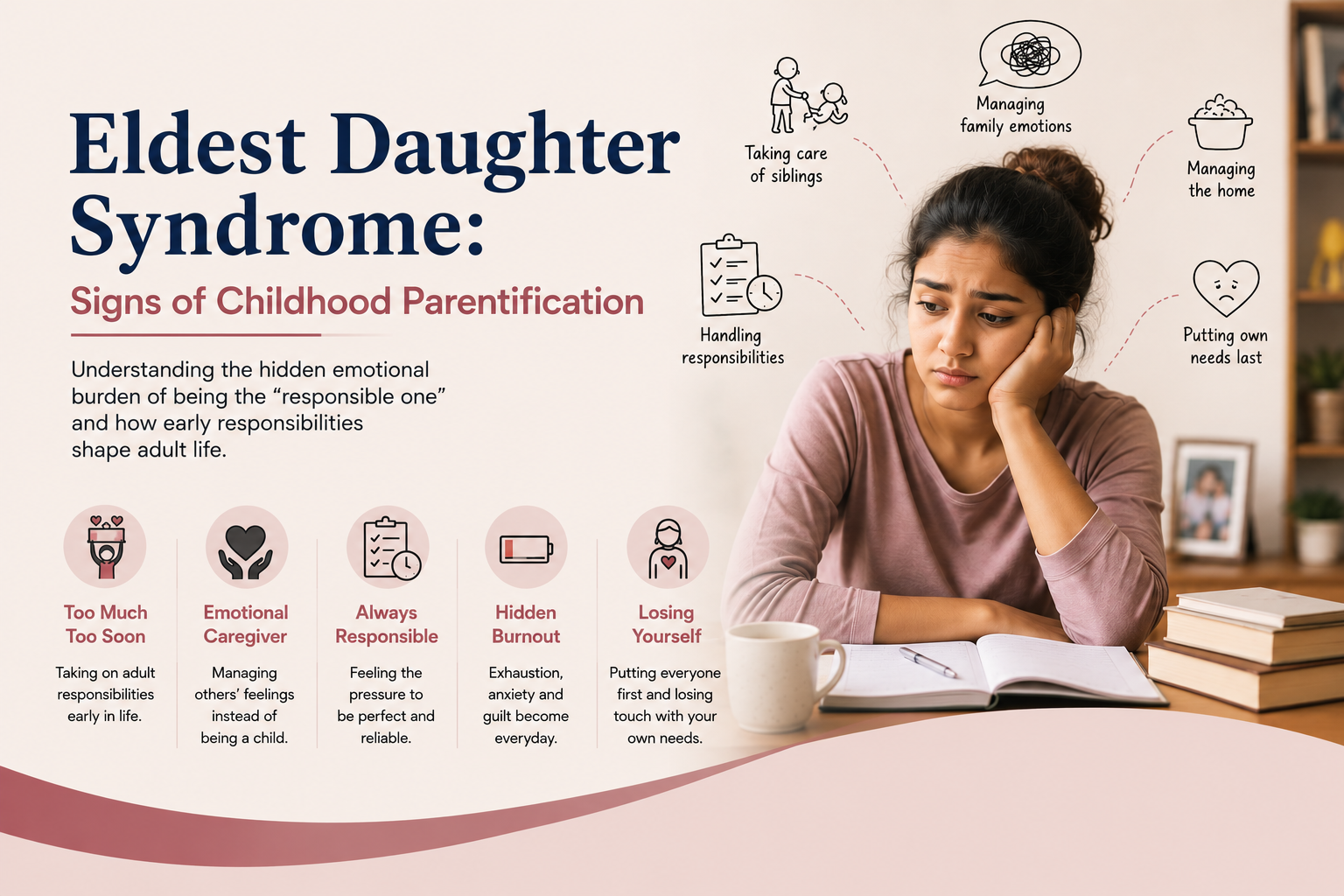
Eldest Daughter Syndrome: Signs of Childhood Parentification
Eldest Daughter Syndrome: Signs of Childhood Parentification
Introduction
Eldest Daughter Syndrome is becoming an increasingly recognised pattern in mental health conversations. Although it isn’t an official psychological diagnosis, many women describe growing up as the “responsible child”—taking care of siblings, managing family responsibilities, and putting everyone else’s needs before their own.
At Prayatna Counselling, we frequently work with adults who are experiencing anxiety, burnout, perfectionism, or difficulty setting boundaries, only to discover that these patterns began in childhood. Understanding Eldest Daughter Syndrome can help families recognise unhealthy expectations early and support children in healthier ways.
What Is Eldest Daughter Syndrome?
Eldest Daughter Syndrome refers to the emotional and practical responsibilities often placed on the oldest daughter within a family. In many households, particularly in cultures where family responsibility is highly valued, the eldest daughter is expected to mature quickly, help care for siblings, support parents emotionally, and become a role model from a very young age.
While responsibility itself isn’t harmful, problems arise when a child consistently carries responsibilities that are more appropriate for an adult.
This experience is closely connected to a psychological concept known as parentification.
What Is Eldest Daughter Syndrome?
Parentification occurs when a child takes on the role of a parent before they are emotionally or developmentally ready.
Mental health professionals generally describe two forms of parentification.
If childhood responsibilities are affecting your emotional wellbeing, our Individual Counselling services can help you understand these patterns and build healthier coping strategies.
Instrumental Parentification
The child regularly performs adult responsibilities such as:
- Looking after younger siblings
- Cooking meals
- Managing household chores
- Translating for parents
- Organising family responsibilities
Emotional Parentification
This occurs when the child becomes responsible for managing adults’ emotions.
Examples include:
- Comforting parents during conflicts
- Acting as a mediator between family members
- Becoming a parent’s confidant
- Feeling responsible for everyone’s happiness
- Suppressing their own emotions to avoid creating additional stress
Emotional parentification often leaves deeper psychological effects because the child’s own emotional needs remain unmet.
Why Eldest Daughter Syndrome Develops
Many eldest daughters grow up hearing phrases such as:
- “You’re the eldest—you should know better.”
- “Take care of your younger brother.”
- “Don’t upset your parents.”
- “You’re so mature for your age.”
While these comments are often intended as compliments, children may begin believing that love must be earned through responsibility and self-sacrifice.
Over time, they learn to prioritise everyone else’s needs before their own.
How Eldest Daughter Syndrome Affects the Developing Brain
Children’s brains are designed for exploration, learning, play, and emotional development—not adult caregiving.
When children experience prolonged stress from excessive responsibility, the nervous system adapts by becoming constantly alert.
Research suggests chronic childhood stress may contribute to:
- Hypervigilance
- Anxiety
- Perfectionism
- Difficulty relaxing
- Emotional suppression
- Increased stress responses
- Low self-worth
Instead of learning that adults provide safety, children begin believing they must become the safe person for everyone else.
According to the American Psychological Association (APA), prolonged childhood stress can affect emotional development, stress regulation, and long-term mental health.
Signs of Eldest Daughter Syndrome
While every family is different, some common signs include:
- Feeling responsible for everyone else’s emotions
- Difficulty asking for help
- Feeling guilty while resting
- Constant people-pleasing
- Fear of disappointing others
- Perfectionism
- Overthinking small mistakes
- Always putting others first
Many adults don’t realise these patterns began in childhood until they start therapy.
When Eldest Daughter Syndrome Becomes Harmful
Helping around the house or caring for younger siblings occasionally is a normal part of family life.
However, responsibility becomes unhealthy when a child:
- Consistently sacrifices their own childhood
- Feels emotionally responsible for parents
- Experiences chronic stress
- Cannot express their own needs
- Believes their worth depends on helping others
Healthy families teach responsibility while also allowing children to experience joy, play, mistakes, and emotional safety.
Continue reading: Healing from Parentification: Recovering from Eldest Daughter Syndrome (Part 2)
Learn More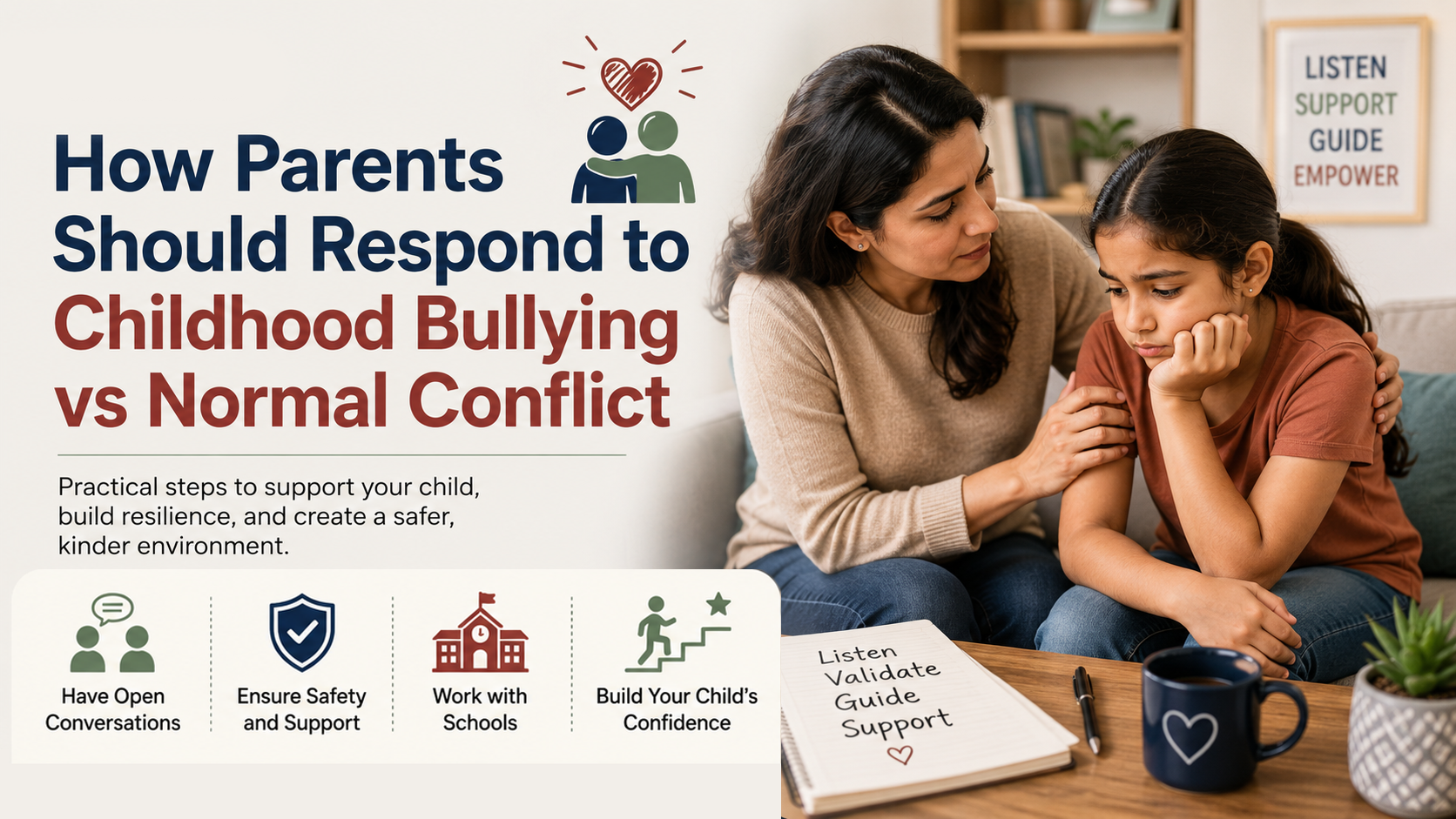
How to Respond to Childhood Bullying: A Parent’s Complete Guide
Respond to Childhood Bullying: A Parent’s Complete Guide
Introduction
Childhood bullying support begins with understanding your child’s emotional needs rather than reacting immediately. Respond to childhood bullying with calm, confidence, and the right support instead of reacting with fear or anger. Parents often struggle to know when to step in, when to encourage independence, and when professional help is needed. Learning how to respond to childhood bullying helps children feel emotionally safe while building resilience, communication skills, and healthy ways to navigate difficult relationships.
If you haven’t already, read our first guide, Childhood Bullying vs Normal Conflict: How to Tell the Difference, to understand when everyday disagreements become genuine bullying.
How to Respond to Childhood Bullying While Building Emotional Resilience
Effective childhood bullying support focuses on rebuilding confidence, emotional safety, and healthy communication. When your child tells you they are being bullied, your first reaction may be anger, fear, or a desire to solve the problem immediately. While these emotions are natural, children benefit most when parents respond with calm reassurance rather than panic.
Instead of asking:
“Who did this?”
Try asking:
- Can you tell me exactly what happened?
- Has this happened before?
- How did you feel?
- How did you respond?
- What do you think would help?
Listening first allows children to feel heard while giving parents a clearer understanding of the situation before taking action.
According to the Child Mind Institute, children benefit when parents remain calm, validate their feelings, and work collaboratively with schools rather than reacting impulsively.
Helping Children Build Emotional Resilience
One of the most important goals is not only to stop bullying but also to help children develop lifelong emotional resilience.
Parents can encourage children to:
- Speak confidently and respectfully.
- Identify trusted adults they can approach.
- Build healthy friendships.
- Practice assertive communication.
- Develop problem-solving skills.
- Understand that asking for help is a strength.
Children who feel emotionally supported are often better equipped to recover from difficult social situations.
If your child struggles with confidence, anxiety, or peer relationships, our Child Counselling services provide personalised support to strengthen emotional wellbeing and social skills.
When Schools Should Respond to Childhood Bullying
Parents, teachers, and counsellors should work together to provide consistent childhood bullying support. Parents should contact teachers or school authorities when bullying becomes repetitive, intentional, or begins affecting a child’s emotional wellbeing.
Schools should be informed if:
- The bullying continues despite your child’s efforts.
- Physical aggression occurs.
- Online or cyberbullying develops.
- Your child refuses to attend school.
- Academic performance declines.
- Emotional distress becomes noticeable.
Working together with teachers creates a stronger support system for the child while helping schools address bullying appropriately.
According to UNICEF, maintaining open communication between children, parents, and schools is one of the most effective ways to prevent bullying from escalating.
When to Seek Professional Help to Respond to Childhood Bullying
Sometimes the emotional impact of bullying continues even after the incidents stop.
Consider speaking with a child psychologist if your child experiences:
- Persistent anxiety
- School refusal
- Frequent crying
- Withdrawal from friends
- Panic before school
- Sleep disturbances
- Low self-esteem
- Ongoing fear of social situations
Professional counselling helps children process difficult experiences, rebuild confidence, and develop healthy coping strategies.
Our Family Counselling services also help parents better understand their child’s emotional needs while strengthening communication at home.
Respond to Childhood Bullying After the Incident
Recovery does not happen overnight.
Children need ongoing reassurance that:
- They are not to blame.
- Their feelings are valid.
- They can always ask for help.
- They are capable of building healthy friendships.
- Difficult experiences do not define who they are.
Simple daily conversations, quality family time, and consistent emotional support make a lasting difference in a child’s recovery.
The American Academy of Pediatrics recommends documenting repeated incidents, maintaining communication with schools, and seeking professional support when bullying begins affecting a child’s mental health or daily functioning.
Conclusion
Learning how to respond to childhood bullying is one of the most valuable skills parents can develop. Children don’t need adults to solve every problem—they need caring adults who listen, guide, protect, and empower them.
When parents respond with empathy, patience, and appropriate action, children become more resilient, emotionally secure, and confident in handling life’s challenges.
If you’re concerned about your child’s emotional wellbeing, the experienced psychologists at Prayatna Counselling are here to support you with compassionate, evidence-based care tailored to your family’s needs.
Book a Counselling Session
If your child is struggling with bullying, anxiety, confidence issues, or peer relationships, we’re here to help.
Book a Counselling Session:
https://prayatnacounselling.com/contact-us/
Frequently Asked Questions
How should parents respond to childhood bullying?
Parents should remain calm, listen carefully, validate their child’s feelings, gather accurate information, and work with schools when necessary.
Should children always fight back against bullying?
No. Children should be encouraged to stay safe, seek help from trusted adults, and use assertive communication rather than physical aggression.
When should I contact the school?
If bullying is repeated, intentional, or affecting your child’s emotional wellbeing or education, involve the school promptly.
Can counselling help children recover from bullying?
Yes. Child counselling helps children rebuild confidence, process emotions, improve coping skills, and strengthen resilience after bullying experiences.
Learn More