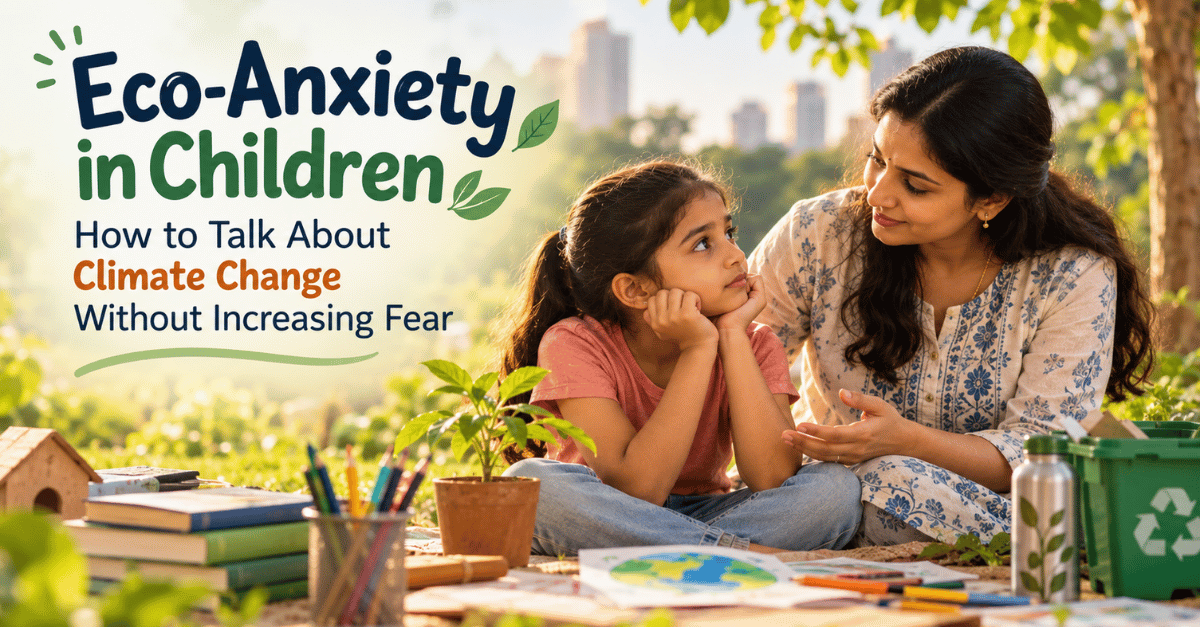
Eco-Anxiety in Children: How to Talk About Climate Change Without Increasing Fear
“Mummy, will our house flood?”
“Is the Earth going to die?”
“Why are adults ruining everything?”
These questions can be difficult for any parent to hear. When children learn about climate change, extreme weather, pollution, deforestation and the loss of wildlife, they may experience emotions that are hard to understand or express. For some children, concern about the environment can grow into persistent worry about their safety and the future.
This experience is often described as eco-anxiety in children, also known as climate anxiety. It does not automatically mean a child has a mental health disorder. Concern about the planet can be a natural response to a serious global issue. However, when that concern becomes overwhelming or begins affecting everyday life, children may need additional emotional support.
Parents, caregivers and teachers can help children understand climate change without leaving them feeling helpless. The goal is not to hide difficult realities or promise that everything will be perfect. It is to create space for honest conversations, emotional reassurance, age-appropriate information and practical action.
In this guide, we explore what eco-anxiety means, how it may appear in children, and how families can respond with empathy, realistic hope and healthy coping strategies.
What Is Eco-Anxiety in Children?
Eco-anxiety refers to emotional distress associated with environmental problems and concerns about the future of the planet. Children may feel worried about rising temperatures, floods, droughts, wildfires, pollution, disappearing wildlife or the possibility of future environmental disasters.
These feelings may develop after a child experiences an extreme weather event, watches distressing news, encounters frightening information online or hears adults discussing the climate crisis. A child does not need to experience a disaster personally to feel worried about one.
The UNICEF guide to climate anxiety explains that climate-related distress can involve fear, worry, stress, helplessness and uncertainty. Such emotions should be taken seriously, while recognising that experiencing them does not, by itself, mean a child has a mental health condition.
Some children may ask repeated questions about the future. Others may become upset when they see images of damaged forests or animals affected by pollution. Teenagers may express anger, frustration or disappointment about how adults and institutions are responding to environmental challenges.
The important distinction is how the child is coping. Occasional worry can be part of learning about the world. Persistent distress that interferes with sleep, school, friendships, family life or normal activities deserves closer attention.
Why Are Children Vulnerable to Climate-Related Worry?
Children are still developing their emotional regulation, ability to evaluate information and understanding of long-term risks. They may recognise that a problem is serious without having the context needed to understand its likelihood, scale or available solutions.
Several factors can make climate-related concerns more difficult for children to manage.
1. They May Struggle to Separate Possibility from Immediacy
A child who hears that some places are experiencing severe floods may wonder whether their own home will flood tomorrow. Younger children may find it difficult to distinguish between an event happening somewhere in the world and an immediate danger to their family.
2. They May Feel Powerless
Children depend on adults and wider systems to make many decisions that affect their environment. They cannot independently change public policy, redesign cities or control industrial emissions. Understanding a large problem without knowing what they can realistically do may create feelings of helplessness.
3. News and Social Media Can Make the Problem Feel Constant
Repeated exposure to dramatic headlines, disaster footage, alarming predictions and emotionally charged social media posts can make environmental threats feel immediate and unavoidable. Even when information is accurate, the way it is presented may overwhelm a child who lacks the context to process it.
4. They May Absorb Adult Anxiety
Children notice adults’ expressions, conversations and reactions. If parents regularly express panic or hopelessness about the future, children may interpret those reactions as evidence that danger is unavoidable.
The American Psychological Association’s report on climate change and children’s mental health discusses how environmental changes and related stressors can affect the wellbeing of children and young people. Supportive relationships, community resilience and access to mental health care are important parts of the response.
Signs of Eco-Anxiety in Children Parents Should Notice
Eco-anxiety does not look the same in every child. Some children talk openly about their fears, while others express distress through behaviour, physical complaints or changes in their usual routines.
Possible signs include:
- Repeatedly asking whether the planet will become unsafe or whether their family will be harmed by a natural disaster.
- Having nightmares or difficulty sleeping after hearing about climate change or extreme weather.
- Becoming unusually upset by news about pollution, animals, forests or environmental destruction.
- Expressing hopelessness about the future or saying that nothing will improve.
- Feeling excessive guilt about everyday choices, such as using plastic, travelling or eating particular foods.
- Avoiding conversations, lessons or activities that remind them of environmental problems.
- Struggling to concentrate on schoolwork because of persistent worries about the planet.
- Showing changes in mood, irritability, withdrawal or a greater need for reassurance.
These signs do not prove that a child is experiencing eco-anxiety. They can have many causes, and the context, duration and impact of the behaviour matter. Parents should look for persistent changes rather than interpreting one question or one difficult day as a problem.
If a child continues to express fear over several days or weeks, or if the worry starts affecting daily functioning, consider discussing the situation with a qualified child mental health professional.
What Parents Should Avoid When Discussing Climate Change
Wanting to protect children is natural. However, certain responses can unintentionally increase their distress or make them less willing to share their concerns.
1. Do Not Dismiss Their Feelings
Statements such as “You are too young to worry about this” or “Stop thinking about it” may make a child feel that their emotions are unreasonable. They may stop asking questions without actually feeling less afraid.
Instead, acknowledge what they are experiencing. You do not need to agree with every conclusion your child reaches to show that you understand their feelings.
2. Avoid Sharing Frightening Details They Cannot Process
Children need truthful information, but they do not need every alarming statistic, worst-case projection or graphic image. Give them enough information to answer their questions without overwhelming them.
3. Do Not Make Promises You Cannot Guarantee
Saying “Nothing bad will ever happen” may provide temporary reassurance, but it is a promise no adult can make. A more helpful response is to explain what is known, what people are doing to reduce risks and how your family prepares for challenges when necessary.
4. Avoid Modelling Constant Panic
Adults are allowed to feel worried, angry or sad about environmental issues. The aim is not to hide every emotion. Instead, show children that difficult feelings can be acknowledged and managed without assuming that the future is hopeless.
5. Do Not Turn Environmental Action into a Source of Guilt
Children should not feel personally responsible for solving climate change. Avoid suggesting that a child’s individual choices determine the future of the planet. Explain that personal habits can help, while meaningful progress also depends on communities, organisations, governments and wider systems.
How to Talk About Eco-Anxiety in Children: 5 Helpful Strategies
1. Listen Before You Explain
When your child asks a frightening question, pause before offering facts or solutions. Try to understand what they have heard, what they believe it means and what they are most afraid of.
You could ask:
- “What made you think about this today?”
- “What have you heard about climate change?”
- “Which part worries you the most?”
- “Would you like me to explain it, or would you prefer to tell me how you feel first?”
These questions encourage conversation instead of turning it into a lecture. They also help you identify whether your child is reacting to a specific event, something they watched online or a more general fear about the future.
2. Validate the Emotion Without Increasing the Fear
Validation means recognising a child’s emotional experience. It does not mean confirming that their worst fear will come true.
If your child says, “I am scared that the Earth will be destroyed,” you might respond:
“I can understand why that sounds frightening. Climate change is a real problem, and many people are working to address it. You do not have to figure it all out by yourself. We can learn about it together, and I am here to talk whenever you feel worried.”
This response acknowledges the concern, avoids false promises and reminds the child that they have support.
3. Offer Honest, Age-Appropriate Information
A child’s age, understanding and emotional readiness should guide the conversation. Keep explanations clear and answer the question they actually asked.
For a younger child, you might explain that the Earth is experiencing environmental changes and that people are working on ways to protect nature and reduce harm.
For a school-age child, you can explain that climate change creates serious challenges but that solutions include cleaner energy, protecting forests, reducing pollution and preparing communities for extreme weather.
Teenagers may want to explore scientific evidence, environmental inequalities, public policy or youth-led climate movements in greater depth. Invite questions and help them evaluate information from reliable sources.
Avoid overwhelming children with information they have not asked for. You can always return to the discussion as their understanding develops.
4. Turn Helplessness into Meaningful, Manageable Action
Children may feel more capable when they can participate in practical activities. Choose actions that suit their age and interests, and make it clear that no single child is responsible for solving a global problem.
Ideas include:
- Planting and caring for a tree or small garden.
- Learning how to sort household waste and recycle appropriately.
- Reducing unnecessary waste and reusing materials for creative projects.
- Taking part in a neighbourhood clean-up with adult supervision.
- Learning about local birds, plants and wildlife.
- Joining an age-appropriate school or community environmental activity.
- Discussing environmental ideas with classmates and family members.
The aim is not to create a long list of responsibilities. It is to help children experience participation, connection and a sense of contribution.
The American Psychological Association’s article on moving from climate anxiety to climate action explores ways that meaningful involvement, social connection and coping strategies can help young people navigate climate-related distress.
5. Help Children Recognise What Is Still Good and Meaningful
Hope does not require pretending that environmental challenges do not exist. It can come from recognising that people care, communities can cooperate, scientific knowledge continues to develop and practical efforts can make a difference.
Encourage your child to notice positive experiences alongside difficult news. Spend time with family, enjoy outdoor activities, appreciate local wildlife or learn about people working on environmental solutions.
When children understand that worry and hope can exist together, they can begin to see environmental concern as something they can respond to rather than something that must control their lives.
Age-Appropriate Ways to Discuss Climate Change
Children of different ages need different levels of detail and support. These suggestions are starting points, not rigid rules. Always consider the individual child’s temperament, experiences and questions.
Young Children: Keep It Simple and Reassuring
Young children generally benefit from short, concrete explanations and a strong sense of safety. Avoid graphic disaster footage, complicated statistics and distant worst-case scenarios.
Explain environmental topics through familiar examples, such as caring for plants, saving water or keeping local spaces clean. If a child fears that a disaster will happen immediately, gently clarify what is known about their current situation and follow appropriate local safety guidance where relevant.
Children Aged 7–12: Explain the Problem and Introduce Solutions
School-age children may be ready for a clearer explanation of how climate change affects weather, ecosystems and communities. Answer their questions honestly and introduce examples of people working on solutions.
Let the child choose an activity that interests them rather than making environmental action feel like homework. Check how they are feeling after discussions or exposure to news.
Teenagers: Respect Their Questions and Encourage Balanced Engagement
Teenagers may have more complex concerns about the future, responsibility, fairness and whether institutions are doing enough. Avoid dismissing these questions as dramatic or idealistic.
Discuss reliable evidence, different solutions and the limits of individual action. Encourage constructive participation, healthy peer connections and time away from distressing news. Teenagers should also be able to rest, enjoy their interests and plan their futures without feeling guilty for doing so.
Why Spending Time in Nature Can Help
Nature connection can give children opportunities for curiosity, enjoyment, movement and connection with the world around them. A walk in a park, gardening, birdwatching or spending time outdoors with a trusted adult can create space away from a constant stream of worrying information.
These activities are not a cure for persistent anxiety, and children should never be pressured to feel better simply because they are outdoors. Instead, nature can be one part of a broader approach to emotional wellbeing.
Try simple activities such as:
- Taking a relaxed family walk and noticing plants, birds or insects.
- Growing herbs or vegetables in pots or a garden.
- Drawing a favourite outdoor place.
- Visiting a local green space without turning the outing into an environmental lesson.
- Practising slow breathing while sitting in a quiet, comfortable outdoor setting.
The goal is to help children experience nature as a source of interest, connection and enjoyment, rather than only as something threatened by environmental change.
Managing Climate News and Social Media Exposure
Children may encounter climate-related content through television, online videos, social media, school discussions or conversations between adults. Some content may be informative, while other material may be sensationalised, repetitive or unsuitable for their age.
Rather than banning every discussion of climate change, help children develop healthy media habits.
- Check what they are seeing: Ask about the videos, posts or news stories that have worried them.
- Choose reliable information: Use age-appropriate sources that explain evidence and context instead of relying on alarming headlines.
- Avoid repeated distressing footage: Do not leave graphic or frightening disaster coverage playing continuously around children.
- Set healthy boundaries: Create screen-free periods, especially around bedtime, if news or social media is affecting sleep or mood.
- Talk about uncertainty: Explain that predictions describe possible outcomes and that risks can change depending on what people do.
- Stay available: Invite children to ask questions when something they see online frightens or confuses them.
For further guidance, parents can consult UNICEF’s advice for helping children cope with climate anxiety.
How Schools and Teachers Can Support Children
Schools can help children learn about environmental issues while making room for their emotional responses. A lesson about climate change should not leave a child feeling that disaster is inevitable or that they are powerless to respond.
Teachers and school counsellors can support students by:
- Presenting accurate, age-appropriate information with context.
- Making classroom discussions respectful and welcoming to questions.
- Recognising that students may have different personal experiences of heat, floods, droughts or other environmental events.
- Offering constructive projects that encourage cooperation without placing the burden of solving climate change on children.
- Teaching emotional skills such as identifying feelings, asking for help and using healthy coping strategies.
- Communicating with parents when a child’s distress appears persistent or affects learning and participation.
- Following the school’s safeguarding and referral procedures when additional support is needed.
Climate education and emotional wellbeing can work together. Children can learn about difficult realities while also developing the skills to think critically, collaborate with others and manage uncertainty.
When Should Parents Seek Professional Support?
Not every child who worries about climate change needs counselling. Many benefit from calm conversations, trusted relationships, appropriate information and opportunities to take manageable action.
Professional support may be helpful when climate-related worries persist, intensify or begin to interfere with a child’s everyday life.
Consider seeking advice from a qualified child mental health professional if your child:
- Has recurring fears or nightmares that disrupt sleep.
- Struggles to concentrate at school because of environmental worries.
- Withdraws from friends, family activities or interests they previously enjoyed.
- Experiences ongoing sadness, irritability, panic or distress linked to climate concerns.
- Frequently seeks reassurance but remains overwhelmed by fear.
- Finds it difficult to carry out normal routines because of persistent worries about the future.
A child counsellor can help a child understand their feelings, develop coping strategies and find ways to manage uncertainty. Parents may also benefit from guidance on how to respond supportively at home.
If distress is severe, symptoms are rapidly worsening or there are concerns about a child’s immediate safety, seek urgent professional assistance through appropriate local services.
You can explore the child services offered by Prayatna Mentaverse to learn more about support for children’s emotional and developmental needs.
How Prayatna Mentaverse Can Help
Children need a supportive environment in which they can express difficult feelings without being judged, dismissed or overwhelmed. When worries begin affecting everyday life, professional guidance can help families understand what the child is experiencing and identify suitable next steps.
Prayatna Mentaverse provides counselling and mental wellbeing support for children, teenagers, adults and families. Depending on an individual’s needs, support may include exploring emotions, strengthening coping skills, improving family communication and helping caregivers respond to a child’s concerns.
When discussing eco-anxiety, the aim is not to convince children that their concerns are unimportant. It is to help them process those concerns in a healthy way, maintain their daily routines and understand that they do not have to manage difficult feelings alone.
Parents who are unsure how to approach a child’s climate-related worries can seek professional guidance to understand the child’s needs and decide whether further support would be appropriate.
Learn more about Prayatna Mentaverse:
Visit our website or explore our
child support services.
Frequently Asked Questions About Eco-Anxiety in Children
1. What is eco-anxiety in children?
Eco-anxiety in children refers to worry, fear, sadness or distress associated with environmental problems and climate change. These feelings can be understandable responses to environmental concerns. Additional support may be needed if the distress persists or interferes with everyday life.
2. Is climate anxiety a mental health disorder?
Climate anxiety is not automatically a mental health disorder. It can be a natural emotional response to concerns about the environment. A qualified professional can help assess the situation if a child’s distress becomes persistent, intense or disruptive.
3. How should I respond when my child asks whether the Earth will be destroyed?
Stay calm, acknowledge the fear and ask what your child has heard. Explain that climate change is a serious challenge, but avoid presenting the future as already decided. Offer age-appropriate information, discuss practical solutions and reassure your child that trusted adults are available to help them.
4. Can social media increase eco-anxiety in children?
Repeated exposure to frightening headlines, disaster footage or alarming posts can increase distress for some children. Help them use reliable sources, take breaks from upsetting content and discuss anything that worries or confuses them.
5. What activities can help children cope with climate anxiety?
Activities may include spending enjoyable time in nature, gardening, learning about local wildlife, participating in age-appropriate community projects and talking with trusted adults. These activities can support connection and a sense of contribution, but persistent distress may require additional help.
6. When should I take my child to a counsellor for eco-anxiety?
Consider seeking professional advice when climate-related worries regularly affect sleep, school, friendships, family life or normal activities. A child counsellor can help assess the child’s needs and support the family in developing appropriate coping strategies.
7. Should parents hide climate change news from children?
Parents do not necessarily need to hide climate change information. Instead, share information in a way that suits the child’s age and emotional readiness. Avoid unnecessary exposure to graphic or repetitive distressing content, answer questions honestly and make time for emotional support.
Final Thoughts: Help Children Find Support, Not Fear
Children deserve honest conversations about the world they are growing up in. They also deserve the reassurance that they are not responsible for solving every problem they learn about.
When eco-anxiety in children is met with listening, age-appropriate information, meaningful connection and practical support, families can help children navigate environmental concerns without allowing fear to dominate everyday life.
You do not need to have every answer. Start by listening, asking what your child is worried about and making it clear that they can return to the conversation whenever they need to.
If climate-related worries are affecting your child’s wellbeing, consider seeking guidance from a qualified professional. With the right support, children can learn to acknowledge difficult emotions, care about the planet and continue to participate in the ordinary experiences that make childhood meaningful.
Every mind deserves care. Every child deserves to be heard.
Connect with Prayatna Mentaverse to learn more about counselling and mental wellbeing support.