
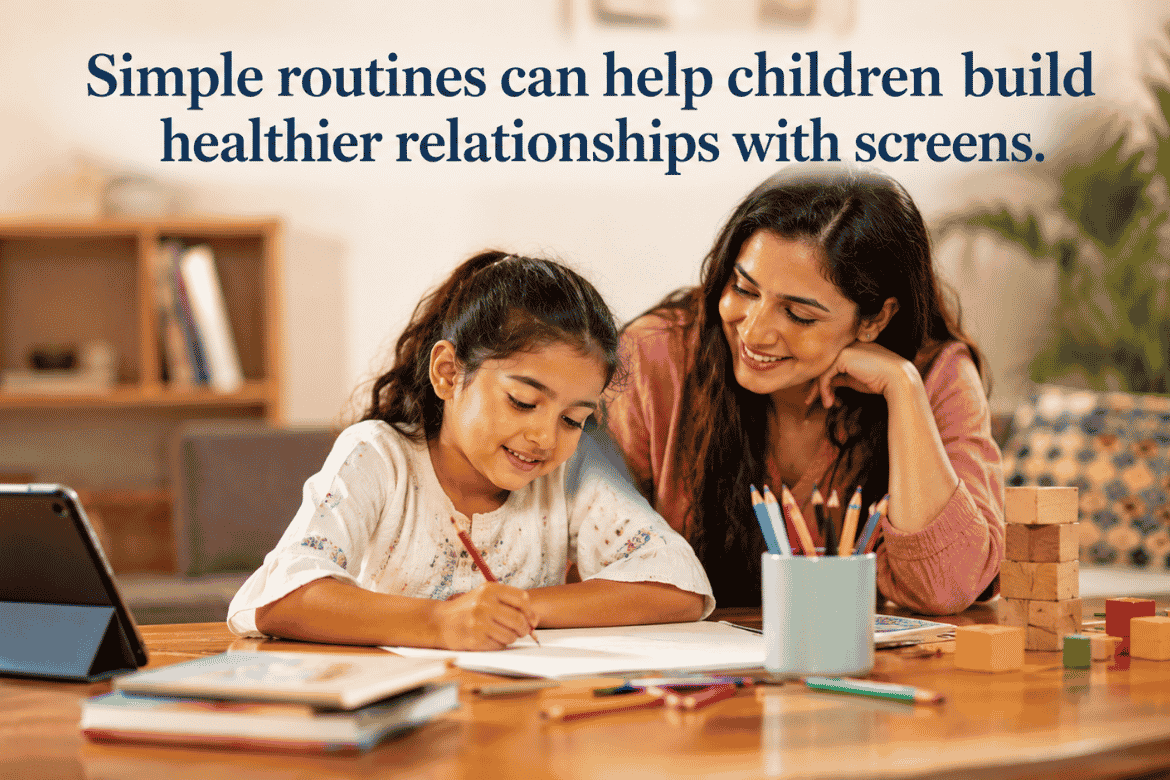
How to Create Screen-Free Time for Kids: 10 Practical Tips
How to Create Screen-Free Time for Kids: 10 Practical Tips
Introduction: Creating Screen-Free Time Without Constant Battles
Creating screen-free time for kids doesn’t have to mean taking every device away and declaring a technology ban.
In fact, sudden restrictions can sometimes turn screen use into a daily battle.
A more sustainable approach is to create predictable routines where screens have a place — but so do reading, outdoor play, creativity, family interaction, rest and boredom.
The goal is not:
“No screens.”
The goal is:
“Screens are one part of childhood, not the whole childhood.”
The American Academy of Pediatrics recommends creating family media plans that reflect each family’s routines and values, including screen-free zones, alternative activities and regular review of the plan as children grow.
1. Start With One Screen-Free Period
Don’t try to change everything at once.
Choose one predictable period.
For example:
After school → 30 minutes screen-free
or
Dinner → no phones or tablets
or
Before bedtime → screen-free routine
Once that becomes normal, you can gradually expand it.
Consistency is usually more useful than extreme restrictions that are difficult to maintain.
The American Academy of Pediatrics’ family media plan can also help parents create realistic and consistent technology boundaries at home.
2. Create Screen-Free Zones at Home
Some areas of the home can naturally become screen-free.
Consider:
- Dining table
- Bedroom during bedtime
- Family conversation areas
- Homework spaces
The American Academy of Pediatrics specifically recommends screen-free zones such as the dinner table, during homework and before bed.
This makes the rule easier for children to understand.
Instead of:
“You can’t use your phone right now.”
the rule becomes:
“We don’t use devices at the dinner table.”
It’s a family habit rather than a punishment.
3. Give Transition Warnings
One of the hardest moments for many families is:
“Turn it off NOW.”
A child who is deeply involved in a game or video may experience that sudden interruption as frustrating.
Instead, give warnings.
Try:
“You have 15 minutes left.”
Then:
“Five more minutes.”
Then:
“When this ends, we’re putting the tablet away.”
Predictability can make transitions easier.
The American Academy of Pediatrics notes that screen transitions can trigger strong emotional reactions and recommends strategies that support healthier technology routines.
4. Give Children Something to Move Toward
Removing a screen creates an empty space.
If you don’t know what will fill that space, the child will naturally ask:
“Now what?”
Prepare alternatives.
For example:
- Drawing
- Lego or building blocks
- Puzzles
- Reading
- Outdoor play
- Board games
- Crafting
- Music
- Pretend play
- Helping in the kitchen
- Gardening
The American Academy of Pediatrics recommends making room for reading, outdoor play, family games and hobbies within family media plans.
5. Create an “I’m Bored” Jar
This is one of the easiest strategies to try.
Take a jar.
Write simple activities on small pieces of paper.
Examples:
Creative ideas
- Draw a superhero
- Make a paper airplane
- Build a cardboard house
- Create a comic
Movement ideas
- Go outside
- Make an obstacle course
- Dance to three songs
- Play catch
Family ideas
- Play a board game
- Help make a snack
- Tell a funny story
- Do a puzzle together
When your child says:
“I’m bored!”
you can respond:
“Choose one.”
The American Academy of Pediatrics has also recommended the idea of an “I’m bored” jar as one practical way to help children move away from automatic screen use.
6. Don’t Over-Schedule the Replacement
This is important.
Parents sometimes remove screens and immediately replace them with:
- Tuition
- Classes
- Worksheets
- Activities
- Coaching
- Structured games
But children also need unstructured time.
If every minute is planned, children don’t get to practise deciding what they want to do.
Leave some empty space.
Then let the child fill it.
Unstructured activities can also provide opportunities for children to practise skills such as attention, planning, flexible thinking and self-regulation. The Harvard Center on the Developing Child’s resources on executive function explain how these skills develop through practice and interaction.
7. Make Creativity Easy to Access
If art supplies are hidden in a cupboard that requires adult help, children are less likely to use them independently.
Create an accessible activity area.
Keep things such as:
- Paper
- Colour pencils
- Crayons
- Clay
- Blocks
- Books
- Puzzles
- Cardboard
- Stickers
within reasonable reach.
The environment itself can encourage screen-free play.
8. Let Your Child Be Bored
This can be difficult for parents.
Your child says:
“I’m bored!”
You immediately hear:
“I need you to fix this.”
But you don’t always have to fix it.
Try:
“I know you’re bored. You can decide what you’d like to do.”
Then wait.
Your child may complain.
They may walk around.
They may say there is “nothing to do.”
And then suddenly:
They start drawing.
They build something.
They create a game.
They go outside.
They start talking to a sibling.
That transition is part of learning.
9. Model Healthy Screen Habits Yourself
Children notice what adults do.
If parents constantly check their phones during:
- Meals
- Conversations
- Waiting
- Driving
- Family time
children receive a message about how technology should be used.
Healthy digital habits need to include adults too.
The American Academy of Pediatrics recommends making a family media plan for every member of the family, including parents and caregivers.
Ask yourself:
“Would I want my child to copy my current phone habits?”
If the answer is uncomfortable, that’s useful information.
10. Build a Family Media Plan
Instead of making random rules every day, create a simple family agreement.
Decide together:
When can screens be used?
For example:
After homework.
After outdoor play.
During a specific leisure period.
Where are screens not used?
For example:
Dining table.
Bedrooms at bedtime.
During family conversations.
What happens when screen time ends?
The device goes to a charging location.
Another activity begins.
What content is allowed?
Age-appropriate content.
Educational or creative content.
Content parents are comfortable with.
The American Academy of Pediatrics recommends revisiting family media plans as children grow and their routines change.
What If My Child Gets Angry When the Screen Is Removed?
First, remember:
A strong reaction doesn’t automatically mean something is seriously wrong.
Transitions can be difficult.
Try to avoid turning every transition into a negotiation.
Instead:
- Give advance notice.
- Keep the boundary predictable.
- Stay calm.
- Acknowledge the emotion.
- Offer the next activity.
- Avoid lengthy arguments.
You can say:
“I know you want to keep playing. It’s difficult to stop when you’re having fun. The tablet is going away now. You can choose drawing or going outside.”
You’re acknowledging the feeling without changing the boundary.
What If My Child Says Every Other Child Has a Phone?
This is one of the most common parenting arguments.
Instead of responding:
“I don’t care what other children do.”
try:
“Different families have different rules. Our family has decided this is what works for us.”
Children may still disagree.
That’s okay.
Healthy boundaries don’t require children to agree with every decision.
What If Screens Are My Child’s Main Way to Calm Down?
This deserves a closer look.
Screens can become a powerful emotional regulation tool.
A child may learn:
“I’m upset → screen.”
“I’m anxious → game.”
“I’m angry → YouTube.”
“I’m bored → tablet.”
Digital entertainment can provide immediate distraction.
But children also need opportunities to develop other ways of managing uncomfortable feelings.
These may include:
- Talking
- Movement
- Breathing
- Creative activities
- Connection
- Quiet time
- Problem-solving
- Sensory activities
The objective isn’t to take away every coping tool.
It is to help children develop more than one.
When Screen Use May Need Professional Support
Parents should consider professional guidance when screen use is consistently associated with significant difficulties such as:
- Major disruption to sleep
- Persistent conflict at home
- Withdrawal from other activities
- Difficulty functioning without a device
- Significant emotional or behavioural changes
- School difficulties
- Social withdrawal
- Strong and persistent distress around screen limits
These signs do not automatically mean a child has a clinical disorder.
They simply suggest that it may be helpful to understand what is happening underneath the behaviour.
Prayatna Counselling’s child services include behavioural therapy, occupational therapy, speech therapy, remedial education and early intervention.
What If Screen Use Is Not the Real Problem?
Sometimes the screen is the easiest place to see the problem.
But the underlying issue may be something else.
A child might use screens excessively because they are:
- Lonely
- Anxious
- Struggling academically
- Having difficulty making friends
- Overwhelmed
- Bored
- Avoiding difficult emotions
- Experiencing family stress
So instead of asking only:
“How do I get my child off the screen?”
ask:
“What does my child get from the screen?”
That question can lead to a much more useful conversation.
A Simple 7-Day Screen-Free Challenge
You don’t need to completely redesign your family’s lifestyle.
Try this for seven days.
Day 1
Create one screen-free meal.
Day 2
Add 30 minutes of screen-free play.
Day 3
Create an “I’m bored” jar.
Day 4
Make one room a screen-free zone.
Day 5
Spend 30 minutes outdoors together.
Day 6
Have a family game or creative activity.
Day 7
Review what worked and create your family media plan.
The goal isn’t perfection.
The goal is awareness and balance.
How Prayatna Counselling Supports Children and Families
Prayatna Counselling provides support across child development, behavioural needs, emotional wellbeing and early intervention.
Our services include:
- Behavioural Therapy
- Occupational Therapy
- Speech Therapy
- Remedial Education
- Early Intervention
Explore our Child Services:
You can also learn about our Early Intervention Services:
If you want to understand our broader counselling and psychological services, visit:
https://prayatnacounselling.com/
Conclusion: Balance, Not Bans
Healthy screen habits don’t require a technology-free childhood.
Children can enjoy technology.
They can play games.
They can watch videos.
They can use educational apps.
They can explore digital creativity.
But they also need something technology cannot completely replace:
Real-world childhood.
They need movement.
They need relationships.
They need conversation.
They need creativity.
They need independent play.
They need quiet.
And sometimes:
They need to be bored.
The goal of screen-free time for kids isn’t to remove technology.
It is to make sure there is still enough space for childhood to happen.
Frequently Asked Questions
How do I reduce screen time without fighting with my child?
Start gradually. Create predictable screen-free periods, give transition warnings and provide appealing alternatives instead of relying only on restrictions.
What are good screen-free activities for kids?
Drawing, reading, outdoor play, puzzles, building, crafts, pretend play, board games, music and helping with age-appropriate household activities are good options.
Should I allow screens when my child is bored?
You don’t have to respond to every moment of boredom with a screen. Give your child an opportunity to decide what they want to do.
How can I make my child play independently?
Create an accessible environment with books, art materials, blocks, puzzles and open-ended toys. Start with short periods and gradually increase them.
What should I do if my child becomes angry when screen time ends?
Use predictable limits, advance warnings and calm transitions. Acknowledge the child’s frustration without automatically changing the boundary.
When should I consult a child psychologist?
If screen use is consistently affecting your child’s sleep, school, relationships, behaviour, emotional wellbeing or daily functioning, professional guidance may be useful.
Learn More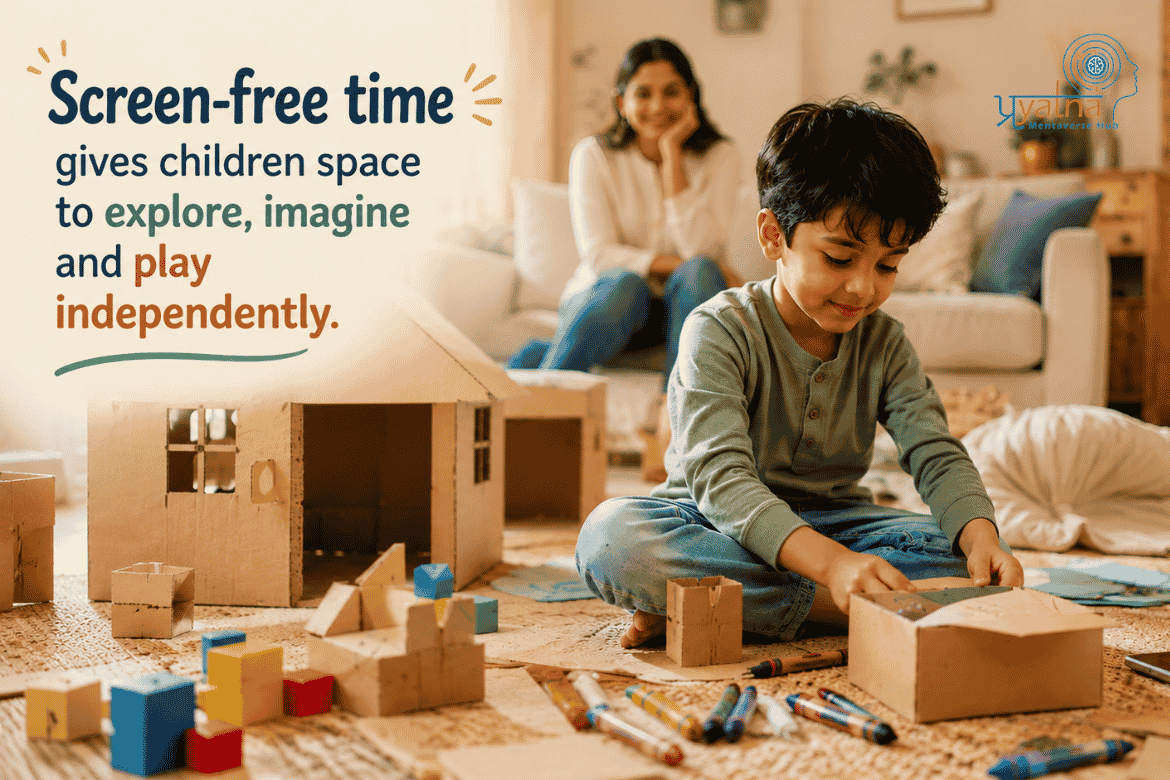
Screen-Free Time for Kids: Why Boredom Matters for Child Development
Screen-Free Time for Kids: Why Boredom Matters for Child Development
Introduction: The Uncomfortable Gift of Nothing to Do
“I’m bored.”
For many parents, those two words immediately trigger a search for something to keep the child occupied.
A toy.
A television show.
A game.
Or increasingly, a tablet or phone.
Children today have access to almost unlimited entertainment. Videos, games, apps and streaming platforms can fill almost every quiet moment.
But screen-free time for kids is not simply about reducing technology.
It is about creating space for something children also need: unstructured time.
When children are not being constantly entertained, they have an opportunity to decide what to do, create their own games, explore their surroundings, imagine new possibilities and learn how to tolerate moments when nothing exciting is happening.
At Prayatna Counselling, we believe healthy digital habits are not about declaring screens “bad.” They are about creating a balanced childhood where technology exists alongside play, relationships, movement, learning, creativity and rest.
What Does Screen-Free Time for Kids Actually Mean?
Screen-free time does not mean children should never use technology.
It means deliberately creating periods where screens are not the default source of entertainment or stimulation.
That could mean:
- Playing outdoors without a phone
- Drawing or colouring
- Reading a book
- Building with blocks
- Playing pretend
- Doing puzzles
- Talking with family
- Helping with simple household activities
- Exploring nature
- Making up a game
- Simply sitting and thinking
The goal isn’t to make childhood less enjoyable.
It is to give children different kinds of experiences.
The American Academy of Pediatrics recommends creating screen-free zones and making room for activities such as reading, outdoor play, family games and hobbies so screens do not crowd out other important experiences.
Why Is Boredom Important for Children?
Boredom is often treated like a problem.
A child says, “I’m bored,” and adults immediately feel responsible for fixing it.
But boredom can provide an important opportunity.
When there is no ready-made entertainment, children have to ask themselves:
“What can I do?”
That question can lead to creativity, exploration and independent decision-making.
Instead of receiving the next activity from a screen, the child has to generate an idea.
That difference matters.
Boredom Can Encourage Creativity
Imagine giving a child:
A cardboard box.
There is no single correct way to use it.
It could become:
- A car
- A house
- A spaceship
- A shop
- A robot
- A puppet theatre
- A treasure chest
The object hasn’t changed.
The child’s imagination has.
Unstructured play gives children opportunities to create their own stories, rules and possibilities rather than simply following a predetermined digital experience.
The American Academy of Pediatrics describes unstructured play and downtime as valuable opportunities for children to learn how to fill their own “blank canvas” rather than automatically turning to technology.
How Unstructured Play Supports Development
Children do not develop only when they are sitting in a classroom.
They develop while:
- Playing
- Talking
- Exploring
- Building
- Pretending
- Solving problems
- Negotiating with siblings
- Making mistakes
- Trying again
Harvard’s Center on the Developing Child explains that executive-function and self-regulation skills develop through interaction and practice. Activities and games can help children strengthen skills such as attention, working memory, planning and self-control.
This is why unstructured time should not automatically be considered “wasted time.”
It can be developmental time.
What Does Boredom Teach Children?
Creativity
Without a ready-made activity, children have to create possibilities themselves.
Problem-Solving
They need to decide what to do and how to make it work.
Self-Direction
Instead of waiting for someone else to provide entertainment, children begin learning:
“I can decide what I want to do.”
Frustration Tolerance
Boredom can feel uncomfortable.
Children gradually learn that discomfort does not always need an immediate solution.
Imagination
When there is less external stimulation, children have more opportunities to construct their own stories, games and worlds.
Is Technology the Problem?
Not necessarily.
Technology can provide valuable opportunities for:
- Education
- Creativity
- Communication
- Entertainment
- Social connection
The bigger question is:
What is the screen replacing?
For example:
Is screen use replacing sleep?
Is it replacing outdoor play?
Is it replacing family conversation?
Is it replacing reading?
Is it replacing independent play?
Is it replacing time to think?
This “what is it crowding out?” approach is more useful than simply treating every screen experience as harmful. The American Academy of Pediatrics encourages families to consider media within the context of the child’s overall routine and priorities.
The Child Who Is Never Bored
Consider a child whose every quiet moment is filled.
Waiting at a restaurant?
Phone.
Long car journey?
Tablet.
Feeling restless?
YouTube.
Finished homework?
Game.
Waiting for dinner?
Cartoon.
There may be nothing obviously wrong with any individual activity.
But when there is never an opportunity to experience an empty moment, the child gets fewer chances to practise creating their own stimulation.
The goal is not to eliminate entertainment.
The goal is to create balance.
The Paradox of the Over-Scheduled Child
Screens aren’t the only thing taking away unstructured time.
Many children have highly structured days:
- School
- Homework
- Tuition
- Sports
- Music
- Dance
- Coding
- Coaching
- Classes
These activities can be valuable.
But structured activities and unstructured play do different things.
Structured activities develop specific skills.
Unstructured time allows children to decide what to do with themselves.
Children need both.
Why “I’m Bored” Doesn’t Need an Immediate Solution
When your child says:
“I’m bored.”
you don’t necessarily have to respond with:
“Here, take the tablet.”
You could instead say:
“I know. What do you feel like doing?”
Or:
“Let’s see what you can create.”
The first response solves boredom for the child.
The second response gives the child an opportunity to solve it themselves.
That distinction can become increasingly important as children grow.
What Parents Can Do Today
You don’t need to completely change your family’s technology habits overnight.
Start with one small screen-free period.
For example:
30 minutes after school.
During that time, provide access to simple materials:
- Paper
- Crayons
- Books
- Blocks
- Puzzles
- Art supplies
- Outdoor space
Then step back.
You don’t need to direct every minute.
Let your child experiment.
When to Look More Closely at Screen Use
Screen enjoyment alone does not mean a child has a problem.
However, parents may want additional guidance if technology consistently interferes with:
- Sleep
- School
- Family relationships
- Physical activity
- Responsibilities
- Social interaction
- Mood
- Everyday functioning
Strong reactions during screen transitions can also become a recurring family challenge. The American Academy of Pediatrics recommends family media planning and predictable boundaries to support healthier digital habits.
If you’re concerned about your child’s development, behaviour or emotional wellbeing, professional guidance can help you understand the larger picture.
Prayatna Counselling provides child-focused services including behavioural therapy, occupational therapy, speech therapy, remedial education and early intervention support.
How Prayatna Counselling Can Help
At Prayatna Counselling, we support children and families across developmental, behavioural, emotional and learning needs.
Our child services include:
- Behavioural Therapy
- Occupational Therapy
- Speech Therapy
- Remedial Education
- Early Intervention
Learn more about our Child Services
Learn more about Early Intervention Services
Conclusion: Boredom Is Not the Enemy
Boredom isn’t necessarily something parents need to rescue children from.
Sometimes it is the space where creativity begins.
Sometimes it is where imagination appears.
Sometimes it is where children discover that they can entertain themselves.
And sometimes it is simply a quiet moment in a childhood filled with stimulation.
Screen-free time for kids isn’t about rejecting technology.
It is about making sure technology doesn’t replace the experiences children need for healthy development.
Give children time to play.
Give them time to explore.
Give them time to think.
And sometimes, let them be bored.
You may be surprised by what happens next.
FAQs
Is boredom good for children?
Boredom itself is not necessarily good or bad, but periods of unstructured time can give children opportunities to practise creativity, independence, problem-solving and self-regulation.
Should parents completely remove screens?
Not necessarily. Technology can have educational, creative and social benefits. The goal is a balanced routine where screens do not consistently crowd out sleep, play, relationships and physical activity.
What can children do instead of screens?
Children can draw, read, build, play outdoors, create stories, make crafts, play pretend, solve puzzles or invent their own games.
How much screen-free time should children have?
There is no single amount that works for every child. Families should consider age, development, sleep, school, physical activity and what screen use is replacing.