
Screen-Free Time for Kids: Why Boredom Matters for Child Development
Screen-Free Time for Kids: Why Boredom Matters for Child Development
Introduction: The Uncomfortable Gift of Nothing to Do
“I’m bored.”
For many parents, those two words immediately trigger a search for something to keep the child occupied.
A toy.
A television show.
A game.
Or increasingly, a tablet or phone.
Children today have access to almost unlimited entertainment. Videos, games, apps and streaming platforms can fill almost every quiet moment.
But screen-free time for kids is not simply about reducing technology.
It is about creating space for something children also need: unstructured time.
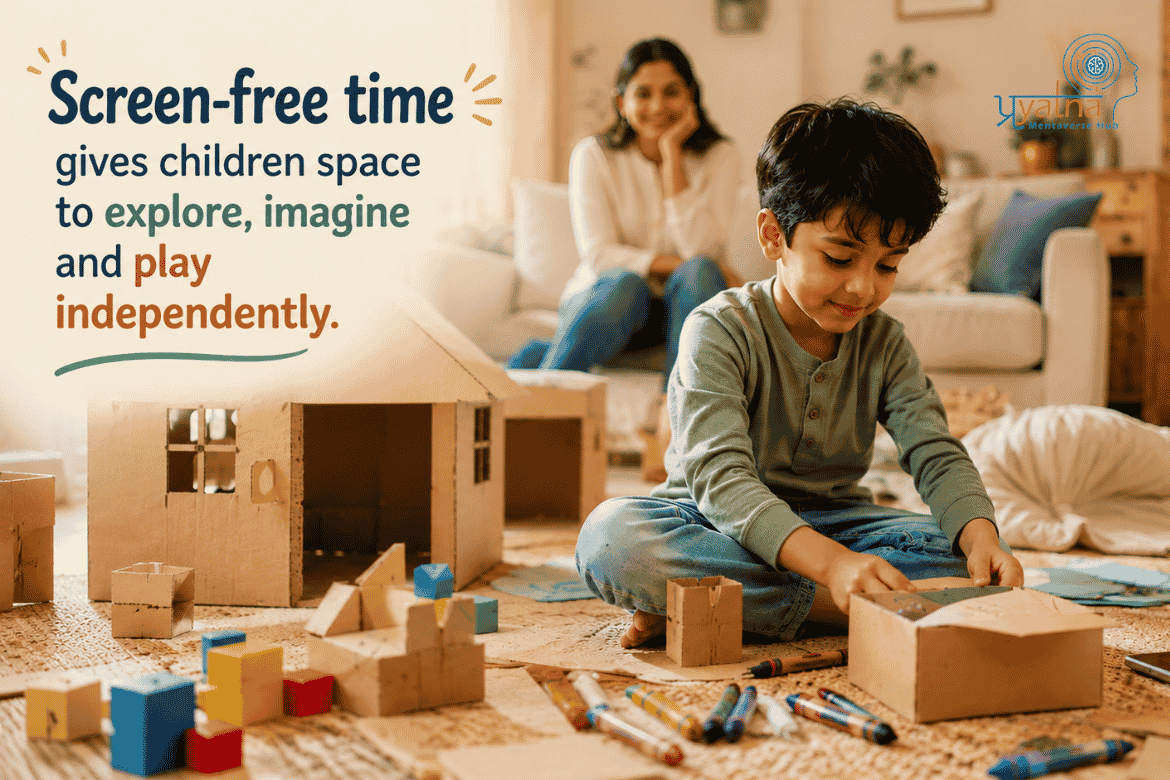
When children are not being constantly entertained, they have an opportunity to decide what to do, create their own games, explore their surroundings, imagine new possibilities and learn how to tolerate moments when nothing exciting is happening.
At Prayatna Counselling, we believe healthy digital habits are not about declaring screens “bad.” They are about creating a balanced childhood where technology exists alongside play, relationships, movement, learning, creativity and rest.
What Does Screen-Free Time for Kids Actually Mean?
Screen-free time does not mean children should never use technology.
It means deliberately creating periods where screens are not the default source of entertainment or stimulation.
That could mean:
- Playing outdoors without a phone
- Drawing or colouring
- Reading a book
- Building with blocks
- Playing pretend
- Doing puzzles
- Talking with family
- Helping with simple household activities
- Exploring nature
- Making up a game
- Simply sitting and thinking
The goal isn’t to make childhood less enjoyable.
It is to give children different kinds of experiences.
The American Academy of Pediatrics recommends creating screen-free zones and making room for activities such as reading, outdoor play, family games and hobbies so screens do not crowd out other important experiences.
Why Is Boredom Important for Children?
Boredom is often treated like a problem.
A child says, “I’m bored,” and adults immediately feel responsible for fixing it.
But boredom can provide an important opportunity.
When there is no ready-made entertainment, children have to ask themselves:
“What can I do?”
That question can lead to creativity, exploration and independent decision-making.
Instead of receiving the next activity from a screen, the child has to generate an idea.
That difference matters.
Boredom Can Encourage Creativity
Imagine giving a child:
A cardboard box.
There is no single correct way to use it.
It could become:
- A car
- A house
- A spaceship
- A shop
- A robot
- A puppet theatre
- A treasure chest
The object hasn’t changed.
The child’s imagination has.
Unstructured play gives children opportunities to create their own stories, rules and possibilities rather than simply following a predetermined digital experience.
The American Academy of Pediatrics describes unstructured play and downtime as valuable opportunities for children to learn how to fill their own “blank canvas” rather than automatically turning to technology.
How Unstructured Play Supports Development
Children do not develop only when they are sitting in a classroom.
They develop while:
- Playing
- Talking
- Exploring
- Building
- Pretending
- Solving problems
- Negotiating with siblings
- Making mistakes
- Trying again
Harvard’s Center on the Developing Child explains that executive-function and self-regulation skills develop through interaction and practice. Activities and games can help children strengthen skills such as attention, working memory, planning and self-control.
This is why unstructured time should not automatically be considered “wasted time.”
It can be developmental time.
What Does Boredom Teach Children?
Creativity
Without a ready-made activity, children have to create possibilities themselves.
Problem-Solving
They need to decide what to do and how to make it work.
Self-Direction
Instead of waiting for someone else to provide entertainment, children begin learning:
“I can decide what I want to do.”
Frustration Tolerance
Boredom can feel uncomfortable.
Children gradually learn that discomfort does not always need an immediate solution.
Imagination
When there is less external stimulation, children have more opportunities to construct their own stories, games and worlds.
Is Technology the Problem?
Not necessarily.
Technology can provide valuable opportunities for:
- Education
- Creativity
- Communication
- Entertainment
- Social connection
The bigger question is:
What is the screen replacing?
For example:
Is screen use replacing sleep?
Is it replacing outdoor play?
Is it replacing family conversation?
Is it replacing reading?
Is it replacing independent play?
Is it replacing time to think?
This “what is it crowding out?” approach is more useful than simply treating every screen experience as harmful. The American Academy of Pediatrics encourages families to consider media within the context of the child’s overall routine and priorities.
The Child Who Is Never Bored
Consider a child whose every quiet moment is filled.
Waiting at a restaurant?
Phone.
Long car journey?
Tablet.
Feeling restless?
YouTube.
Finished homework?
Game.
Waiting for dinner?
Cartoon.
There may be nothing obviously wrong with any individual activity.
But when there is never an opportunity to experience an empty moment, the child gets fewer chances to practise creating their own stimulation.
The goal is not to eliminate entertainment.
The goal is to create balance.
The Paradox of the Over-Scheduled Child
Screens aren’t the only thing taking away unstructured time.
Many children have highly structured days:
- School
- Homework
- Tuition
- Sports
- Music
- Dance
- Coding
- Coaching
- Classes
These activities can be valuable.
But structured activities and unstructured play do different things.
Structured activities develop specific skills.
Unstructured time allows children to decide what to do with themselves.
Children need both.
Why “I’m Bored” Doesn’t Need an Immediate Solution
When your child says:
“I’m bored.”
you don’t necessarily have to respond with:
“Here, take the tablet.”
You could instead say:
“I know. What do you feel like doing?”
Or:
“Let’s see what you can create.”
The first response solves boredom for the child.
The second response gives the child an opportunity to solve it themselves.
That distinction can become increasingly important as children grow.
What Parents Can Do Today
You don’t need to completely change your family’s technology habits overnight.
Start with one small screen-free period.
For example:
30 minutes after school.
During that time, provide access to simple materials:
- Paper
- Crayons
- Books
- Blocks
- Puzzles
- Art supplies
- Outdoor space
Then step back.
You don’t need to direct every minute.
Let your child experiment.
When to Look More Closely at Screen Use
Screen enjoyment alone does not mean a child has a problem.
However, parents may want additional guidance if technology consistently interferes with:
- Sleep
- School
- Family relationships
- Physical activity
- Responsibilities
- Social interaction
- Mood
- Everyday functioning
Strong reactions during screen transitions can also become a recurring family challenge. The American Academy of Pediatrics recommends family media planning and predictable boundaries to support healthier digital habits.
If you’re concerned about your child’s development, behaviour or emotional wellbeing, professional guidance can help you understand the larger picture.
Prayatna Counselling provides child-focused services including behavioural therapy, occupational therapy, speech therapy, remedial education and early intervention support.
How Prayatna Counselling Can Help
At Prayatna Counselling, we support children and families across developmental, behavioural, emotional and learning needs.
Our child services include:
- Behavioural Therapy
- Occupational Therapy
- Speech Therapy
- Remedial Education
- Early Intervention
Learn more about our Child Services
Learn more about Early Intervention Services
Conclusion: Boredom Is Not the Enemy
Boredom isn’t necessarily something parents need to rescue children from.
Sometimes it is the space where creativity begins.
Sometimes it is where imagination appears.
Sometimes it is where children discover that they can entertain themselves.
And sometimes it is simply a quiet moment in a childhood filled with stimulation.
Screen-free time for kids isn’t about rejecting technology.
It is about making sure technology doesn’t replace the experiences children need for healthy development.
Give children time to play.
Give them time to explore.
Give them time to think.
And sometimes, let them be bored.
You may be surprised by what happens next.
FAQs
Is boredom good for children?
Boredom itself is not necessarily good or bad, but periods of unstructured time can give children opportunities to practise creativity, independence, problem-solving and self-regulation.
Should parents completely remove screens?
Not necessarily. Technology can have educational, creative and social benefits. The goal is a balanced routine where screens do not consistently crowd out sleep, play, relationships and physical activity.
What can children do instead of screens?
Children can draw, read, build, play outdoors, create stories, make crafts, play pretend, solve puzzles or invent their own games.
How much screen-free time should children have?
There is no single amount that works for every child. Families should consider age, development, sleep, school, physical activity and what screen use is replacing.
Related Posts

Ghosting Mental Health: How Ghosting, Orbiting & Breadcrumbing Affect Emotional Wellbeing
Introduction: The Relationship Status Nobody Warned You About There's a specific...

Why Am I Attracting Narcissistic Partners?
If You Keep Ending Up With Narcissistic Partners, It’s Not a Coincidence Many...
Snapchat Dysmorphia: How AR Filters Are Rewiring How Young People See Themselves
Introduction: The Face You See in the Mirror Isn't Yours Anymore There is a face...
Childhood Bullying vs Normal Conflict: Why Mislabeling Everyday Disagreements Can Harm Children
Childhood Bullying vs Normal Conflict: How to Tell the Difference...