
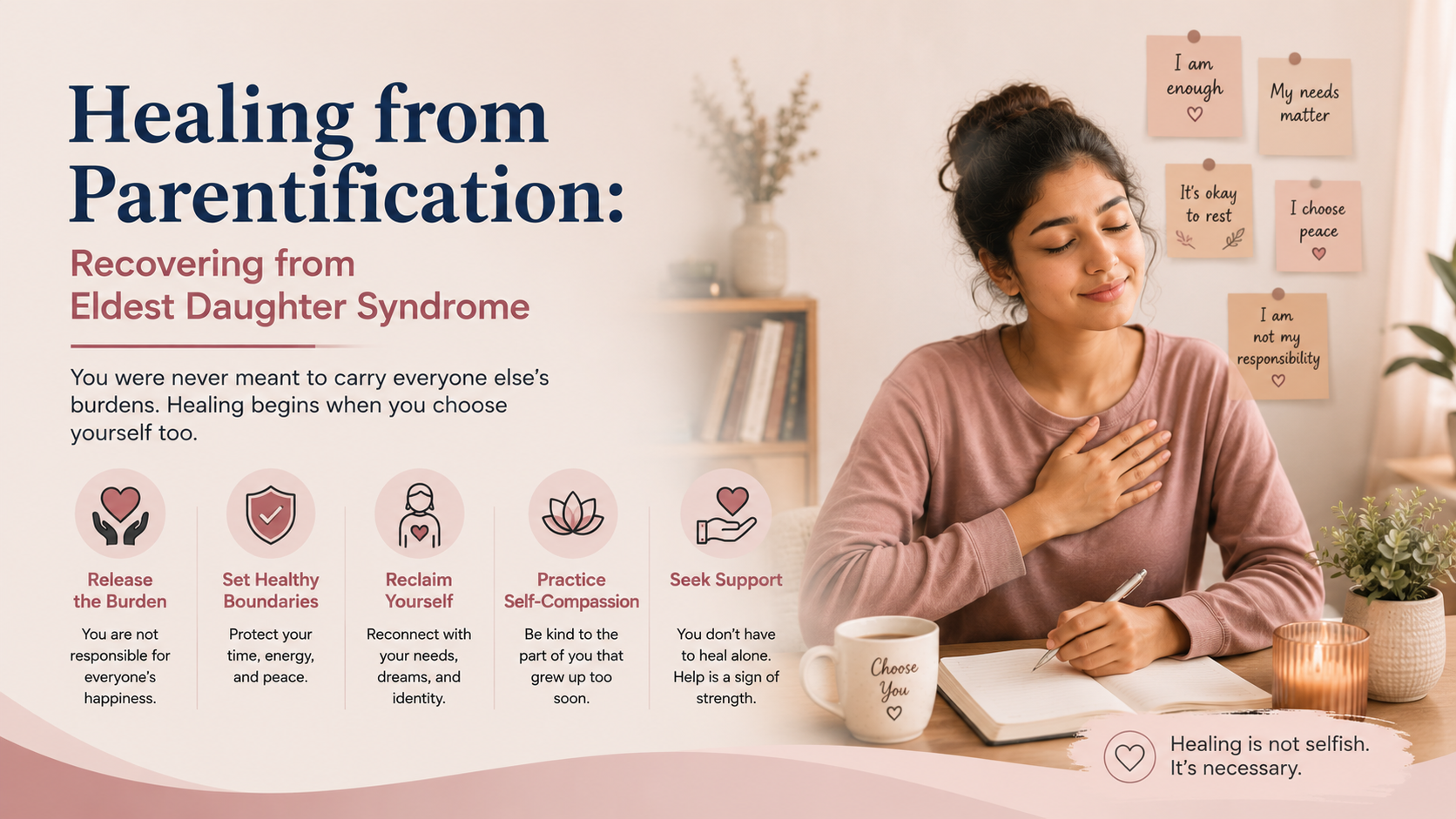
Healing from Parentification: Recovering from Eldest Daughter Syndrome
Healing from Parentification: Recovering from Eldest Daughter Syndrome
Introduction
Healing from parentification begins with recognising that the responsibilities you carried as a child were never meant to define your entire life. Many adults who grew up as the “responsible one” continue to put everyone else’s needs before their own, often without realising how deeply childhood experiences influence their present relationships, careers, and emotional wellbeing.
If you related to the signs discussed in our previous article on Eldest Daughter Syndrome, this guide explores the next step—understanding how healing is possible and why asking for support is not a sign of weakness but an act of self-care.
Read Part 1:
Eldest Daughter Syndrome: Signs of Childhood Parentification
How Childhood Parentification Shows Up in Adulthood
Children who grow up taking care of others often become adults who continue carrying emotional responsibilities that were never theirs to begin with.
Common signs include:
- Feeling responsible for everyone’s happiness
- Difficulty saying “no”
- Chronic guilt while resting
- Fear of disappointing others
- Perfectionism
- Overworking to prove your worth
- Avoiding conflict
- Feeling emotionally exhausted even when life appears stable
Many people believe these behaviours are simply part of their personality. In reality, they may be coping strategies developed during childhood.
Why People-Pleasing Becomes a Survival Strategy
Children quickly learn how to adapt to their environment.
If love, approval, or emotional safety depended on being helpful, mature, or selfless, the brain begins associating acceptance with self-sacrifice.
As adults, this often looks like:
- Always putting others first
- Ignoring personal needs
- Difficulty setting boundaries
- Feeling guilty after saying “no”
- Constantly seeking validation
These behaviours once helped you survive.
Today, they may prevent you from living authentically.
Healing from Parentification Eldest Daughter Syndrome, Requires Self-Compassion
One of the biggest misconceptions about healing is believing that recovery means blaming your parents.
In reality, many parents were themselves overwhelmed, unsupported, or repeating patterns learned from previous generations.
Healing from parentification is not about assigning blame.
It is about understanding your story with compassion while giving yourself permission to meet needs that were overlooked during childhood.
According to the American Psychological Association, self-compassion and healthy emotional regulation are strongly associated with improved psychological wellbeing and resilience.
Learning Healthy Boundaries
Boundaries are often uncomfortable for people who grew up believing their value came from helping others.
Healthy boundaries allow you to:
- Protect your emotional wellbeing
- Reduce burnout
- Build balanced relationships
- Respect your own needs
- Strengthen self-esteem
Setting boundaries does not make you selfish.
It allows relationships to become healthier and more authentic.
Reconnecting with Yourself
Many adults recovering from parentification struggle with one simple question:
“What do I actually want?”
Because childhood focused on meeting everyone else’s needs, personal interests, emotions, and dreams were often ignored.
Healing involves slowly reconnecting with yourself.
Ask yourself:
- What brings me joy?
- What makes me feel calm?
- What relationships feel safe?
- What am I doing because I truly want to?
- What expectations no longer belong to me?
Small moments of self-awareness gradually rebuild a stronger sense of identity.
How Therapy Helps
Healing from parentification often becomes easier with professional support.
Therapy provides a safe space to:
- Understand childhood family dynamics
- Process unresolved emotions
- Reduce guilt
- Build confidence
- Develop healthy boundaries
- Improve relationships
- Replace survival patterns with healthier coping strategies
At Prayatna Counselling, we provide compassionate, evidence-based counselling tailored to each individual’s life experiences and emotional needs.
If you’ve spent years taking care of everyone else, therapy offers an opportunity to finally care for yourself.
You Don’t Have to Carry Everything Alone
One of the most powerful parts of healing is recognising that your worth has never depended on how much you sacrifice.
You deserve:
- Rest without guilt
- Love without conditions
- Healthy relationships
- Emotional safety
- Time for yourself
- Support when life feels overwhelming
Healing does not erase your strength.
It simply allows you to carry it without carrying everyone else’s burdens too.
If you’re ready to begin your healing journey, our Individual Counselling services provide personalised support to help you understand childhood experiences and develop healthier emotional patterns.
Families who want to improve communication and break unhealthy relationship patterns may also benefit from our Family Counselling services.
Conclusion
Healing from parentification is a journey of rediscovering yourself after years of putting others first. The responsibilities you carried as a child may have shaped you, but they do not have to define your future.
By understanding your experiences, practising self-compassion, setting healthy boundaries, and seeking professional support when needed, it is possible to build a life that feels balanced, fulfilling, and emotionally healthy.
At Prayatna Counselling, we believe every individual deserves the opportunity to heal, grow, and experience relationships built on mutual care rather than obligation.
Frequently Asked Questions
What is parentification?
Parentification occurs when a child takes on emotional or practical responsibilities that are normally expected of an adult.
Can parentification affect adulthood?
Yes. Parentification can contribute to anxiety, perfectionism, burnout, people-pleasing, difficulty setting boundaries, and relationship challenges.
Is Eldest Daughter Syndrome a medical diagnosis?
No. Eldest Daughter Syndrome is not a clinical diagnosis, but it describes a common pattern experienced by many eldest daughters who carried excessive responsibilities during childhood.
Can therapy help people recover from parentification?
Yes. Therapy helps individuals understand childhood experiences, develop healthier coping strategies, improve boundaries, and build stronger emotional wellbeing.
Call to Action
Have you spent years taking care of everyone else while ignoring your own needs?
You don’t have to continue carrying that burden alone.
Book a confidential counselling session with Prayatna Counselling and begin your journey toward healing, self-compassion, and emotional freedom.
Related Posts

Healing from Parentification: Recovering from Eldest Daughter Syndrome
Healing from Parentification: Recovering from Eldest Daughter Syndrome...

How to Create Screen-Free Time for Kids: 10 Practical Tips
How to Create Screen-Free Time for Kids: 10 Practical Tips Introduction:...

When Should Parents Seek Professional Help for Academic Avoidance?
When Should Parents Seek Professional Help for Academic Avoidance? “Not every...

Rising Violence Among Gujarat’s Youth: Causes, Impacts, and Solutions
આજના સમયમાં કિશોરોમાં હિંસક વર્તનનું પ્રમાણ વધવાનું મુખ્ય કારણ તમે શું માનો છો?...