
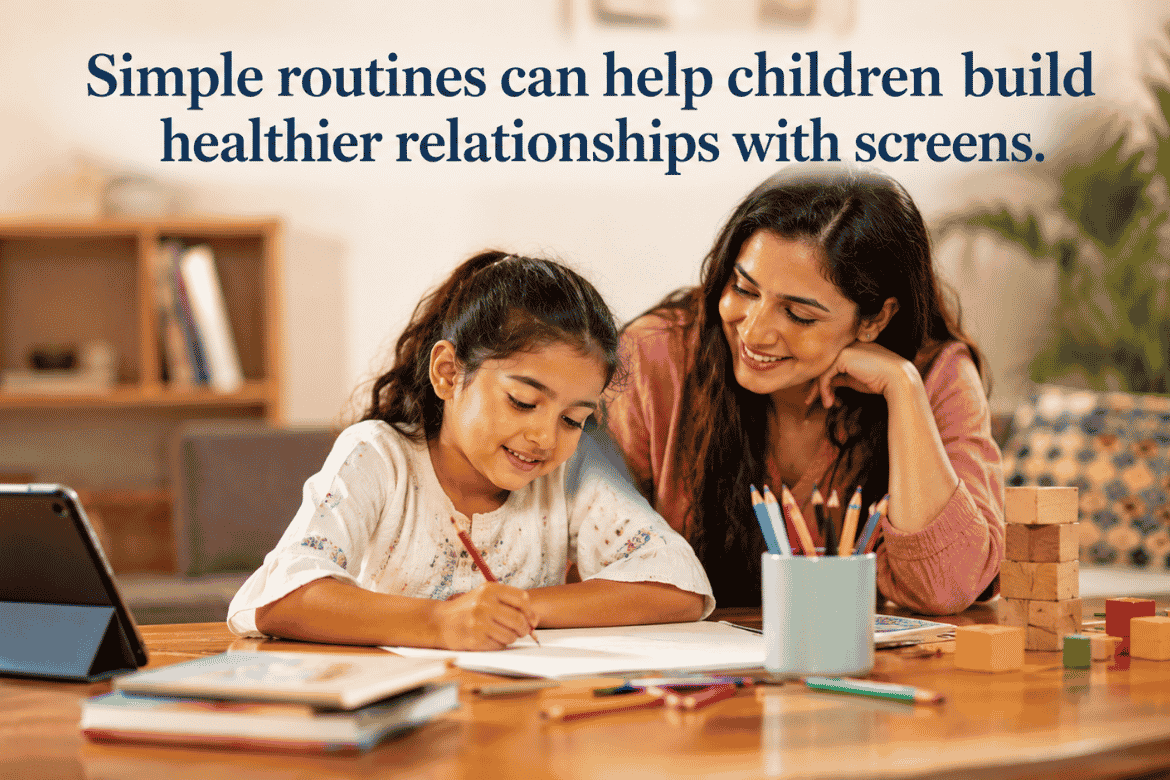
How to Create Screen-Free Time for Kids: 10 Practical Tips
How to Create Screen-Free Time for Kids: 10 Practical Tips
Introduction: Creating Screen-Free Time Without Constant Battles
Creating screen-free time for kids doesn’t have to mean taking every device away and declaring a technology ban.
In fact, sudden restrictions can sometimes turn screen use into a daily battle.
A more sustainable approach is to create predictable routines where screens have a place — but so do reading, outdoor play, creativity, family interaction, rest and boredom.
The goal is not:
“No screens.”
The goal is:
“Screens are one part of childhood, not the whole childhood.”
The American Academy of Pediatrics recommends creating family media plans that reflect each family’s routines and values, including screen-free zones, alternative activities and regular review of the plan as children grow.
1. Start With One Screen-Free Period
Don’t try to change everything at once.
Choose one predictable period.
For example:
After school → 30 minutes screen-free
or
Dinner → no phones or tablets
or
Before bedtime → screen-free routine
Once that becomes normal, you can gradually expand it.
Consistency is usually more useful than extreme restrictions that are difficult to maintain.
The American Academy of Pediatrics’ family media plan can also help parents create realistic and consistent technology boundaries at home.
2. Create Screen-Free Zones at Home
Some areas of the home can naturally become screen-free.
Consider:
- Dining table
- Bedroom during bedtime
- Family conversation areas
- Homework spaces
The American Academy of Pediatrics specifically recommends screen-free zones such as the dinner table, during homework and before bed.
This makes the rule easier for children to understand.
Instead of:
“You can’t use your phone right now.”
the rule becomes:
“We don’t use devices at the dinner table.”
It’s a family habit rather than a punishment.
3. Give Transition Warnings
One of the hardest moments for many families is:
“Turn it off NOW.”
A child who is deeply involved in a game or video may experience that sudden interruption as frustrating.
Instead, give warnings.
Try:
“You have 15 minutes left.”
Then:
“Five more minutes.”
Then:
“When this ends, we’re putting the tablet away.”
Predictability can make transitions easier.
The American Academy of Pediatrics notes that screen transitions can trigger strong emotional reactions and recommends strategies that support healthier technology routines.
4. Give Children Something to Move Toward
Removing a screen creates an empty space.
If you don’t know what will fill that space, the child will naturally ask:
“Now what?”
Prepare alternatives.
For example:
- Drawing
- Lego or building blocks
- Puzzles
- Reading
- Outdoor play
- Board games
- Crafting
- Music
- Pretend play
- Helping in the kitchen
- Gardening
The American Academy of Pediatrics recommends making room for reading, outdoor play, family games and hobbies within family media plans.
5. Create an “I’m Bored” Jar
This is one of the easiest strategies to try.
Take a jar.
Write simple activities on small pieces of paper.
Examples:
Creative ideas
- Draw a superhero
- Make a paper airplane
- Build a cardboard house
- Create a comic
Movement ideas
- Go outside
- Make an obstacle course
- Dance to three songs
- Play catch
Family ideas
- Play a board game
- Help make a snack
- Tell a funny story
- Do a puzzle together
When your child says:
“I’m bored!”
you can respond:
“Choose one.”
The American Academy of Pediatrics has also recommended the idea of an “I’m bored” jar as one practical way to help children move away from automatic screen use.
6. Don’t Over-Schedule the Replacement
This is important.
Parents sometimes remove screens and immediately replace them with:
- Tuition
- Classes
- Worksheets
- Activities
- Coaching
- Structured games
But children also need unstructured time.
If every minute is planned, children don’t get to practise deciding what they want to do.
Leave some empty space.
Then let the child fill it.
Unstructured activities can also provide opportunities for children to practise skills such as attention, planning, flexible thinking and self-regulation. The Harvard Center on the Developing Child’s resources on executive function explain how these skills develop through practice and interaction.
7. Make Creativity Easy to Access
If art supplies are hidden in a cupboard that requires adult help, children are less likely to use them independently.
Create an accessible activity area.
Keep things such as:
- Paper
- Colour pencils
- Crayons
- Clay
- Blocks
- Books
- Puzzles
- Cardboard
- Stickers
within reasonable reach.
The environment itself can encourage screen-free play.
8. Let Your Child Be Bored
This can be difficult for parents.
Your child says:
“I’m bored!”
You immediately hear:
“I need you to fix this.”
But you don’t always have to fix it.
Try:
“I know you’re bored. You can decide what you’d like to do.”
Then wait.
Your child may complain.
They may walk around.
They may say there is “nothing to do.”
And then suddenly:
They start drawing.
They build something.
They create a game.
They go outside.
They start talking to a sibling.
That transition is part of learning.
9. Model Healthy Screen Habits Yourself
Children notice what adults do.
If parents constantly check their phones during:
- Meals
- Conversations
- Waiting
- Driving
- Family time
children receive a message about how technology should be used.
Healthy digital habits need to include adults too.
The American Academy of Pediatrics recommends making a family media plan for every member of the family, including parents and caregivers.
Ask yourself:
“Would I want my child to copy my current phone habits?”
If the answer is uncomfortable, that’s useful information.
10. Build a Family Media Plan
Instead of making random rules every day, create a simple family agreement.
Decide together:
When can screens be used?
For example:
After homework.
After outdoor play.
During a specific leisure period.
Where are screens not used?
For example:
Dining table.
Bedrooms at bedtime.
During family conversations.
What happens when screen time ends?
The device goes to a charging location.
Another activity begins.
What content is allowed?
Age-appropriate content.
Educational or creative content.
Content parents are comfortable with.
The American Academy of Pediatrics recommends revisiting family media plans as children grow and their routines change.
What If My Child Gets Angry When the Screen Is Removed?
First, remember:
A strong reaction doesn’t automatically mean something is seriously wrong.
Transitions can be difficult.
Try to avoid turning every transition into a negotiation.
Instead:
- Give advance notice.
- Keep the boundary predictable.
- Stay calm.
- Acknowledge the emotion.
- Offer the next activity.
- Avoid lengthy arguments.
You can say:
“I know you want to keep playing. It’s difficult to stop when you’re having fun. The tablet is going away now. You can choose drawing or going outside.”
You’re acknowledging the feeling without changing the boundary.
What If My Child Says Every Other Child Has a Phone?
This is one of the most common parenting arguments.
Instead of responding:
“I don’t care what other children do.”
try:
“Different families have different rules. Our family has decided this is what works for us.”
Children may still disagree.
That’s okay.
Healthy boundaries don’t require children to agree with every decision.
What If Screens Are My Child’s Main Way to Calm Down?
This deserves a closer look.
Screens can become a powerful emotional regulation tool.
A child may learn:
“I’m upset → screen.”
“I’m anxious → game.”
“I’m angry → YouTube.”
“I’m bored → tablet.”
Digital entertainment can provide immediate distraction.
But children also need opportunities to develop other ways of managing uncomfortable feelings.
These may include:
- Talking
- Movement
- Breathing
- Creative activities
- Connection
- Quiet time
- Problem-solving
- Sensory activities
The objective isn’t to take away every coping tool.
It is to help children develop more than one.
When Screen Use May Need Professional Support
Parents should consider professional guidance when screen use is consistently associated with significant difficulties such as:
- Major disruption to sleep
- Persistent conflict at home
- Withdrawal from other activities
- Difficulty functioning without a device
- Significant emotional or behavioural changes
- School difficulties
- Social withdrawal
- Strong and persistent distress around screen limits
These signs do not automatically mean a child has a clinical disorder.
They simply suggest that it may be helpful to understand what is happening underneath the behaviour.
Prayatna Counselling’s child services include behavioural therapy, occupational therapy, speech therapy, remedial education and early intervention.
What If Screen Use Is Not the Real Problem?
Sometimes the screen is the easiest place to see the problem.
But the underlying issue may be something else.
A child might use screens excessively because they are:
- Lonely
- Anxious
- Struggling academically
- Having difficulty making friends
- Overwhelmed
- Bored
- Avoiding difficult emotions
- Experiencing family stress
So instead of asking only:
“How do I get my child off the screen?”
ask:
“What does my child get from the screen?”
That question can lead to a much more useful conversation.
A Simple 7-Day Screen-Free Challenge
You don’t need to completely redesign your family’s lifestyle.
Try this for seven days.
Day 1
Create one screen-free meal.
Day 2
Add 30 minutes of screen-free play.
Day 3
Create an “I’m bored” jar.
Day 4
Make one room a screen-free zone.
Day 5
Spend 30 minutes outdoors together.
Day 6
Have a family game or creative activity.
Day 7
Review what worked and create your family media plan.
The goal isn’t perfection.
The goal is awareness and balance.
How Prayatna Counselling Supports Children and Families
Prayatna Counselling provides support across child development, behavioural needs, emotional wellbeing and early intervention.
Our services include:
- Behavioural Therapy
- Occupational Therapy
- Speech Therapy
- Remedial Education
- Early Intervention
Explore our Child Services:
You can also learn about our Early Intervention Services:
If you want to understand our broader counselling and psychological services, visit:
https://prayatnacounselling.com/
Conclusion: Balance, Not Bans
Healthy screen habits don’t require a technology-free childhood.
Children can enjoy technology.
They can play games.
They can watch videos.
They can use educational apps.
They can explore digital creativity.
But they also need something technology cannot completely replace:
Real-world childhood.
They need movement.
They need relationships.
They need conversation.
They need creativity.
They need independent play.
They need quiet.
And sometimes:
They need to be bored.
The goal of screen-free time for kids isn’t to remove technology.
It is to make sure there is still enough space for childhood to happen.
Frequently Asked Questions
How do I reduce screen time without fighting with my child?
Start gradually. Create predictable screen-free periods, give transition warnings and provide appealing alternatives instead of relying only on restrictions.
What are good screen-free activities for kids?
Drawing, reading, outdoor play, puzzles, building, crafts, pretend play, board games, music and helping with age-appropriate household activities are good options.
Should I allow screens when my child is bored?
You don’t have to respond to every moment of boredom with a screen. Give your child an opportunity to decide what they want to do.
How can I make my child play independently?
Create an accessible environment with books, art materials, blocks, puzzles and open-ended toys. Start with short periods and gradually increase them.
What should I do if my child becomes angry when screen time ends?
Use predictable limits, advance warnings and calm transitions. Acknowledge the child’s frustration without automatically changing the boundary.
When should I consult a child psychologist?
If screen use is consistently affecting your child’s sleep, school, relationships, behaviour, emotional wellbeing or daily functioning, professional guidance may be useful.
Learn More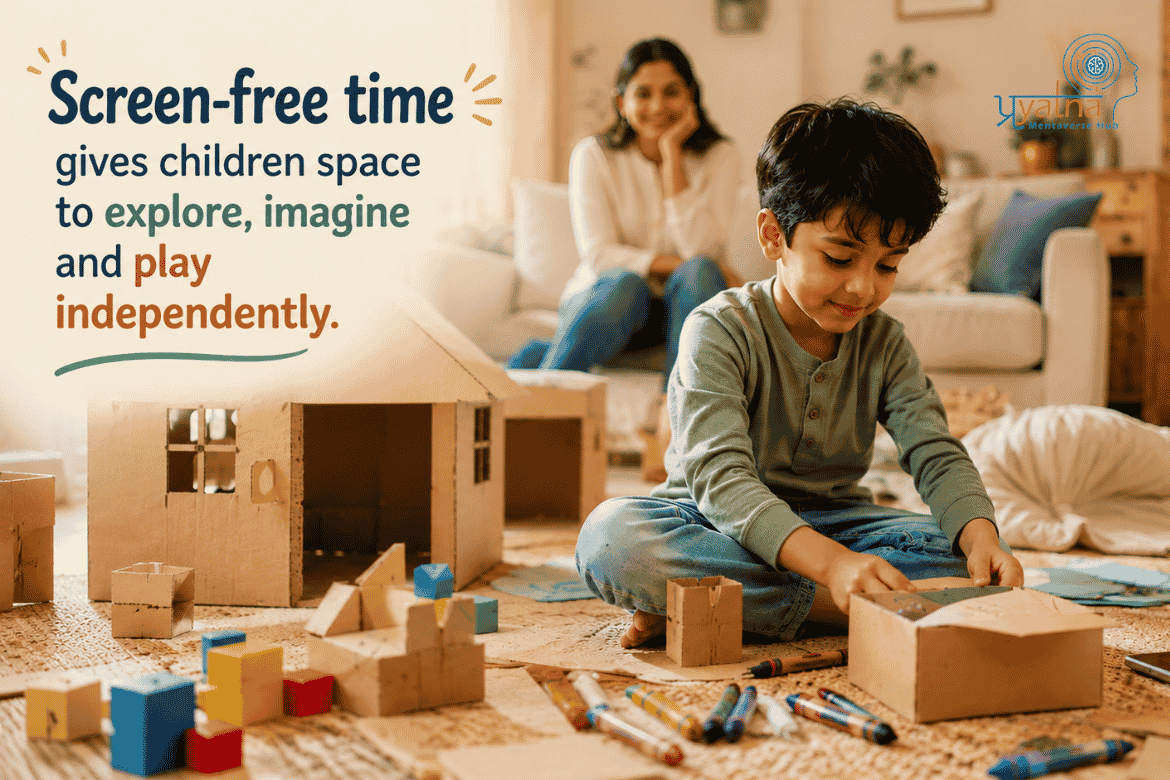
Screen-Free Time for Kids: Why Boredom Matters for Child Development
Screen-Free Time for Kids: Why Boredom Matters for Child Development
Introduction: The Uncomfortable Gift of Nothing to Do
“I’m bored.”
For many parents, those two words immediately trigger a search for something to keep the child occupied.
A toy.
A television show.
A game.
Or increasingly, a tablet or phone.
Children today have access to almost unlimited entertainment. Videos, games, apps and streaming platforms can fill almost every quiet moment.
But screen-free time for kids is not simply about reducing technology.
It is about creating space for something children also need: unstructured time.
When children are not being constantly entertained, they have an opportunity to decide what to do, create their own games, explore their surroundings, imagine new possibilities and learn how to tolerate moments when nothing exciting is happening.
At Prayatna Counselling, we believe healthy digital habits are not about declaring screens “bad.” They are about creating a balanced childhood where technology exists alongside play, relationships, movement, learning, creativity and rest.
What Does Screen-Free Time for Kids Actually Mean?
Screen-free time does not mean children should never use technology.
It means deliberately creating periods where screens are not the default source of entertainment or stimulation.
That could mean:
- Playing outdoors without a phone
- Drawing or colouring
- Reading a book
- Building with blocks
- Playing pretend
- Doing puzzles
- Talking with family
- Helping with simple household activities
- Exploring nature
- Making up a game
- Simply sitting and thinking
The goal isn’t to make childhood less enjoyable.
It is to give children different kinds of experiences.
The American Academy of Pediatrics recommends creating screen-free zones and making room for activities such as reading, outdoor play, family games and hobbies so screens do not crowd out other important experiences.
Why Is Boredom Important for Children?
Boredom is often treated like a problem.
A child says, “I’m bored,” and adults immediately feel responsible for fixing it.
But boredom can provide an important opportunity.
When there is no ready-made entertainment, children have to ask themselves:
“What can I do?”
That question can lead to creativity, exploration and independent decision-making.
Instead of receiving the next activity from a screen, the child has to generate an idea.
That difference matters.
Boredom Can Encourage Creativity
Imagine giving a child:
A cardboard box.
There is no single correct way to use it.
It could become:
- A car
- A house
- A spaceship
- A shop
- A robot
- A puppet theatre
- A treasure chest
The object hasn’t changed.
The child’s imagination has.
Unstructured play gives children opportunities to create their own stories, rules and possibilities rather than simply following a predetermined digital experience.
The American Academy of Pediatrics describes unstructured play and downtime as valuable opportunities for children to learn how to fill their own “blank canvas” rather than automatically turning to technology.
How Unstructured Play Supports Development
Children do not develop only when they are sitting in a classroom.
They develop while:
- Playing
- Talking
- Exploring
- Building
- Pretending
- Solving problems
- Negotiating with siblings
- Making mistakes
- Trying again
Harvard’s Center on the Developing Child explains that executive-function and self-regulation skills develop through interaction and practice. Activities and games can help children strengthen skills such as attention, working memory, planning and self-control.
This is why unstructured time should not automatically be considered “wasted time.”
It can be developmental time.
What Does Boredom Teach Children?
Creativity
Without a ready-made activity, children have to create possibilities themselves.
Problem-Solving
They need to decide what to do and how to make it work.
Self-Direction
Instead of waiting for someone else to provide entertainment, children begin learning:
“I can decide what I want to do.”
Frustration Tolerance
Boredom can feel uncomfortable.
Children gradually learn that discomfort does not always need an immediate solution.
Imagination
When there is less external stimulation, children have more opportunities to construct their own stories, games and worlds.
Is Technology the Problem?
Not necessarily.
Technology can provide valuable opportunities for:
- Education
- Creativity
- Communication
- Entertainment
- Social connection
The bigger question is:
What is the screen replacing?
For example:
Is screen use replacing sleep?
Is it replacing outdoor play?
Is it replacing family conversation?
Is it replacing reading?
Is it replacing independent play?
Is it replacing time to think?
This “what is it crowding out?” approach is more useful than simply treating every screen experience as harmful. The American Academy of Pediatrics encourages families to consider media within the context of the child’s overall routine and priorities.
The Child Who Is Never Bored
Consider a child whose every quiet moment is filled.
Waiting at a restaurant?
Phone.
Long car journey?
Tablet.
Feeling restless?
YouTube.
Finished homework?
Game.
Waiting for dinner?
Cartoon.
There may be nothing obviously wrong with any individual activity.
But when there is never an opportunity to experience an empty moment, the child gets fewer chances to practise creating their own stimulation.
The goal is not to eliminate entertainment.
The goal is to create balance.
The Paradox of the Over-Scheduled Child
Screens aren’t the only thing taking away unstructured time.
Many children have highly structured days:
- School
- Homework
- Tuition
- Sports
- Music
- Dance
- Coding
- Coaching
- Classes
These activities can be valuable.
But structured activities and unstructured play do different things.
Structured activities develop specific skills.
Unstructured time allows children to decide what to do with themselves.
Children need both.
Why “I’m Bored” Doesn’t Need an Immediate Solution
When your child says:
“I’m bored.”
you don’t necessarily have to respond with:
“Here, take the tablet.”
You could instead say:
“I know. What do you feel like doing?”
Or:
“Let’s see what you can create.”
The first response solves boredom for the child.
The second response gives the child an opportunity to solve it themselves.
That distinction can become increasingly important as children grow.
What Parents Can Do Today
You don’t need to completely change your family’s technology habits overnight.
Start with one small screen-free period.
For example:
30 minutes after school.
During that time, provide access to simple materials:
- Paper
- Crayons
- Books
- Blocks
- Puzzles
- Art supplies
- Outdoor space
Then step back.
You don’t need to direct every minute.
Let your child experiment.
When to Look More Closely at Screen Use
Screen enjoyment alone does not mean a child has a problem.
However, parents may want additional guidance if technology consistently interferes with:
- Sleep
- School
- Family relationships
- Physical activity
- Responsibilities
- Social interaction
- Mood
- Everyday functioning
Strong reactions during screen transitions can also become a recurring family challenge. The American Academy of Pediatrics recommends family media planning and predictable boundaries to support healthier digital habits.
If you’re concerned about your child’s development, behaviour or emotional wellbeing, professional guidance can help you understand the larger picture.
Prayatna Counselling provides child-focused services including behavioural therapy, occupational therapy, speech therapy, remedial education and early intervention support.
How Prayatna Counselling Can Help
At Prayatna Counselling, we support children and families across developmental, behavioural, emotional and learning needs.
Our child services include:
- Behavioural Therapy
- Occupational Therapy
- Speech Therapy
- Remedial Education
- Early Intervention
Learn more about our Child Services
Learn more about Early Intervention Services
Conclusion: Boredom Is Not the Enemy
Boredom isn’t necessarily something parents need to rescue children from.
Sometimes it is the space where creativity begins.
Sometimes it is where imagination appears.
Sometimes it is where children discover that they can entertain themselves.
And sometimes it is simply a quiet moment in a childhood filled with stimulation.
Screen-free time for kids isn’t about rejecting technology.
It is about making sure technology doesn’t replace the experiences children need for healthy development.
Give children time to play.
Give them time to explore.
Give them time to think.
And sometimes, let them be bored.
You may be surprised by what happens next.
FAQs
Is boredom good for children?
Boredom itself is not necessarily good or bad, but periods of unstructured time can give children opportunities to practise creativity, independence, problem-solving and self-regulation.
Should parents completely remove screens?
Not necessarily. Technology can have educational, creative and social benefits. The goal is a balanced routine where screens do not consistently crowd out sleep, play, relationships and physical activity.
What can children do instead of screens?
Children can draw, read, build, play outdoors, create stories, make crafts, play pretend, solve puzzles or invent their own games.
How much screen-free time should children have?
There is no single amount that works for every child. Families should consider age, development, sleep, school, physical activity and what screen use is replacing.

Healing from Parentification: Recovering from Eldest Daughter Syndrome
Healing from Parentification: Recovering from Eldest Daughter Syndrome
Introduction
Healing from parentification begins with recognising that the responsibilities you carried as a child were never meant to define your entire life. Many adults who grew up as the “responsible one” continue to put everyone else’s needs before their own, often without realising how deeply childhood experiences influence their present relationships, careers, and emotional wellbeing.
If you related to the signs discussed in our previous article on Eldest Daughter Syndrome, this guide explores the next step—understanding how healing is possible and why asking for support is not a sign of weakness but an act of self-care.
Read Part 1:
Eldest Daughter Syndrome: Signs of Childhood Parentification
How Childhood Parentification Shows Up in Adulthood
Children who grow up taking care of others often become adults who continue carrying emotional responsibilities that were never theirs to begin with.
Common signs include:
- Feeling responsible for everyone’s happiness
- Difficulty saying “no”
- Chronic guilt while resting
- Fear of disappointing others
- Perfectionism
- Overworking to prove your worth
- Avoiding conflict
- Feeling emotionally exhausted even when life appears stable
Many people believe these behaviours are simply part of their personality. In reality, they may be coping strategies developed during childhood.
Why People-Pleasing Becomes a Survival Strategy
Children quickly learn how to adapt to their environment.
If love, approval, or emotional safety depended on being helpful, mature, or selfless, the brain begins associating acceptance with self-sacrifice.
As adults, this often looks like:
- Always putting others first
- Ignoring personal needs
- Difficulty setting boundaries
- Feeling guilty after saying “no”
- Constantly seeking validation
These behaviours once helped you survive.
Today, they may prevent you from living authentically.
Healing from Parentification Eldest Daughter Syndrome, Requires Self-Compassion
One of the biggest misconceptions about healing is believing that recovery means blaming your parents.
In reality, many parents were themselves overwhelmed, unsupported, or repeating patterns learned from previous generations.
Healing from parentification is not about assigning blame.
It is about understanding your story with compassion while giving yourself permission to meet needs that were overlooked during childhood.
According to the American Psychological Association, self-compassion and healthy emotional regulation are strongly associated with improved psychological wellbeing and resilience.
Learning Healthy Boundaries
Boundaries are often uncomfortable for people who grew up believing their value came from helping others.
Healthy boundaries allow you to:
- Protect your emotional wellbeing
- Reduce burnout
- Build balanced relationships
- Respect your own needs
- Strengthen self-esteem
Setting boundaries does not make you selfish.
It allows relationships to become healthier and more authentic.
Reconnecting with Yourself
Many adults recovering from parentification struggle with one simple question:
“What do I actually want?”
Because childhood focused on meeting everyone else’s needs, personal interests, emotions, and dreams were often ignored.
Healing involves slowly reconnecting with yourself.
Ask yourself:
- What brings me joy?
- What makes me feel calm?
- What relationships feel safe?
- What am I doing because I truly want to?
- What expectations no longer belong to me?
Small moments of self-awareness gradually rebuild a stronger sense of identity.
How Therapy Helps
Healing from parentification often becomes easier with professional support.
Therapy provides a safe space to:
- Understand childhood family dynamics
- Process unresolved emotions
- Reduce guilt
- Build confidence
- Develop healthy boundaries
- Improve relationships
- Replace survival patterns with healthier coping strategies
At Prayatna Counselling, we provide compassionate, evidence-based counselling tailored to each individual’s life experiences and emotional needs.
If you’ve spent years taking care of everyone else, therapy offers an opportunity to finally care for yourself.
You Don’t Have to Carry Everything Alone
One of the most powerful parts of healing is recognising that your worth has never depended on how much you sacrifice.
You deserve:
- Rest without guilt
- Love without conditions
- Healthy relationships
- Emotional safety
- Time for yourself
- Support when life feels overwhelming
Healing does not erase your strength.
It simply allows you to carry it without carrying everyone else’s burdens too.
If you’re ready to begin your healing journey, our Individual Counselling services provide personalised support to help you understand childhood experiences and develop healthier emotional patterns.
Families who want to improve communication and break unhealthy relationship patterns may also benefit from our Family Counselling services.
Conclusion
Healing from parentification is a journey of rediscovering yourself after years of putting others first. The responsibilities you carried as a child may have shaped you, but they do not have to define your future.
By understanding your experiences, practising self-compassion, setting healthy boundaries, and seeking professional support when needed, it is possible to build a life that feels balanced, fulfilling, and emotionally healthy.
At Prayatna Counselling, we believe every individual deserves the opportunity to heal, grow, and experience relationships built on mutual care rather than obligation.
Frequently Asked Questions
What is parentification?
Parentification occurs when a child takes on emotional or practical responsibilities that are normally expected of an adult.
Can parentification affect adulthood?
Yes. Parentification can contribute to anxiety, perfectionism, burnout, people-pleasing, difficulty setting boundaries, and relationship challenges.
Is Eldest Daughter Syndrome a medical diagnosis?
No. Eldest Daughter Syndrome is not a clinical diagnosis, but it describes a common pattern experienced by many eldest daughters who carried excessive responsibilities during childhood.
Can therapy help people recover from parentification?
Yes. Therapy helps individuals understand childhood experiences, develop healthier coping strategies, improve boundaries, and build stronger emotional wellbeing.
Call to Action
Have you spent years taking care of everyone else while ignoring your own needs?
You don’t have to continue carrying that burden alone.
Book a confidential counselling session with Prayatna Counselling and begin your journey toward healing, self-compassion, and emotional freedom.
Learn More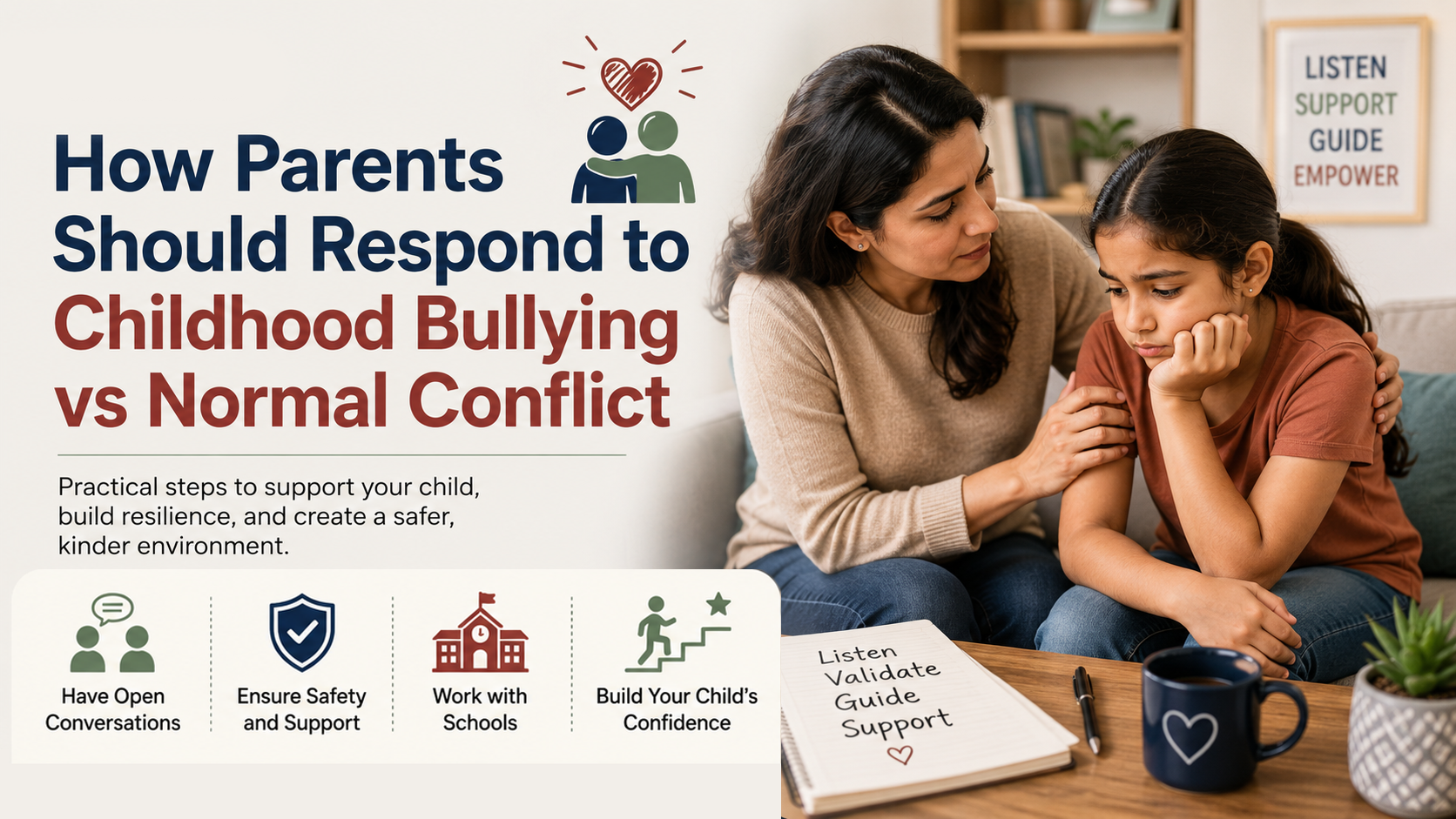
How to Respond to Childhood Bullying: A Parent’s Complete Guide
Respond to Childhood Bullying: A Parent’s Complete Guide
Introduction
Childhood bullying support begins with understanding your child’s emotional needs rather than reacting immediately. Respond to childhood bullying with calm, confidence, and the right support instead of reacting with fear or anger. Parents often struggle to know when to step in, when to encourage independence, and when professional help is needed. Learning how to respond to childhood bullying helps children feel emotionally safe while building resilience, communication skills, and healthy ways to navigate difficult relationships.
If you haven’t already, read our first guide, Childhood Bullying vs Normal Conflict: How to Tell the Difference, to understand when everyday disagreements become genuine bullying.
How to Respond to Childhood Bullying While Building Emotional Resilience
Effective childhood bullying support focuses on rebuilding confidence, emotional safety, and healthy communication. When your child tells you they are being bullied, your first reaction may be anger, fear, or a desire to solve the problem immediately. While these emotions are natural, children benefit most when parents respond with calm reassurance rather than panic.
Instead of asking:
“Who did this?”
Try asking:
- Can you tell me exactly what happened?
- Has this happened before?
- How did you feel?
- How did you respond?
- What do you think would help?
Listening first allows children to feel heard while giving parents a clearer understanding of the situation before taking action.
According to the Child Mind Institute, children benefit when parents remain calm, validate their feelings, and work collaboratively with schools rather than reacting impulsively.
Helping Children Build Emotional Resilience
One of the most important goals is not only to stop bullying but also to help children develop lifelong emotional resilience.
Parents can encourage children to:
- Speak confidently and respectfully.
- Identify trusted adults they can approach.
- Build healthy friendships.
- Practice assertive communication.
- Develop problem-solving skills.
- Understand that asking for help is a strength.
Children who feel emotionally supported are often better equipped to recover from difficult social situations.
If your child struggles with confidence, anxiety, or peer relationships, our Child Counselling services provide personalised support to strengthen emotional wellbeing and social skills.
When Schools Should Respond to Childhood Bullying
Parents, teachers, and counsellors should work together to provide consistent childhood bullying support. Parents should contact teachers or school authorities when bullying becomes repetitive, intentional, or begins affecting a child’s emotional wellbeing.
Schools should be informed if:
- The bullying continues despite your child’s efforts.
- Physical aggression occurs.
- Online or cyberbullying develops.
- Your child refuses to attend school.
- Academic performance declines.
- Emotional distress becomes noticeable.
Working together with teachers creates a stronger support system for the child while helping schools address bullying appropriately.
According to UNICEF, maintaining open communication between children, parents, and schools is one of the most effective ways to prevent bullying from escalating.
When to Seek Professional Help to Respond to Childhood Bullying
Sometimes the emotional impact of bullying continues even after the incidents stop.
Consider speaking with a child psychologist if your child experiences:
- Persistent anxiety
- School refusal
- Frequent crying
- Withdrawal from friends
- Panic before school
- Sleep disturbances
- Low self-esteem
- Ongoing fear of social situations
Professional counselling helps children process difficult experiences, rebuild confidence, and develop healthy coping strategies.
Our Family Counselling services also help parents better understand their child’s emotional needs while strengthening communication at home.
Respond to Childhood Bullying After the Incident
Recovery does not happen overnight.
Children need ongoing reassurance that:
- They are not to blame.
- Their feelings are valid.
- They can always ask for help.
- They are capable of building healthy friendships.
- Difficult experiences do not define who they are.
Simple daily conversations, quality family time, and consistent emotional support make a lasting difference in a child’s recovery.
The American Academy of Pediatrics recommends documenting repeated incidents, maintaining communication with schools, and seeking professional support when bullying begins affecting a child’s mental health or daily functioning.
Conclusion
Learning how to respond to childhood bullying is one of the most valuable skills parents can develop. Children don’t need adults to solve every problem—they need caring adults who listen, guide, protect, and empower them.
When parents respond with empathy, patience, and appropriate action, children become more resilient, emotionally secure, and confident in handling life’s challenges.
If you’re concerned about your child’s emotional wellbeing, the experienced psychologists at Prayatna Counselling are here to support you with compassionate, evidence-based care tailored to your family’s needs.
Book a Counselling Session
If your child is struggling with bullying, anxiety, confidence issues, or peer relationships, we’re here to help.
Book a Counselling Session:
https://prayatnacounselling.com/contact-us/
Frequently Asked Questions
How should parents respond to childhood bullying?
Parents should remain calm, listen carefully, validate their child’s feelings, gather accurate information, and work with schools when necessary.
Should children always fight back against bullying?
No. Children should be encouraged to stay safe, seek help from trusted adults, and use assertive communication rather than physical aggression.
When should I contact the school?
If bullying is repeated, intentional, or affecting your child’s emotional wellbeing or education, involve the school promptly.
Can counselling help children recover from bullying?
Yes. Child counselling helps children rebuild confidence, process emotions, improve coping skills, and strengthen resilience after bullying experiences.
Learn More
Childhood Bullying vs Normal Conflict: Why Mislabeling Everyday Disagreements Can Harm Children
Childhood Bullying vs Normal Conflict: How to Tell the Difference
Introduction
Childhood bullying vs normal conflict is one of the biggest challenges parents and teachers face today. Every disagreement between children can feel alarming, but not every hurtful interaction is bullying. Understanding the difference between childhood bullying vs normal conflict helps children build resilience, emotional intelligence, communication skills, and healthy relationships instead of depending on adults to solve every disagreement.
At Prayatna Counselling, we often meet parents who are unsure whether their child is experiencing bullying or simply navigating normal childhood disagreements. Knowing the distinction allows families to respond appropriately, support emotional growth, and protect children when genuine bullying occurs.
Many children experience disagreements while learning how to communicate, share, negotiate, and build friendships. These experiences are a natural part of growing up. However, recognising when everyday conflict crosses the line into bullying is essential for protecting a child’s emotional wellbeing without limiting their opportunity to develop resilience.
American Psychological Association’s guidance on bullying
Understanding Childhood Bullying vs Normal Conflict
Children naturally experience disagreements as they learn empathy, communication, and emotional regulation. These conflicts can be uncomfortable, but they often become valuable learning opportunities that help children grow into emotionally healthy adults.
Bullying, on the other hand, is a repeated pattern of intentional harm involving a power imbalance. Recognising the difference between childhood bullying vs normal conflict helps parents, teachers, and caregivers respond in ways that encourage emotional growth while ensuring children’s safety.
What Is Normal Childhood Conflict?
Normal conflict usually happens between children who have equal social or emotional power. These disagreements may involve arguments, misunderstandings, occasional teasing, or hurt feelings, but both children generally have an equal opportunity to express themselves, apologise, and repair the relationship.
Examples include:
- Friends arguing during a game.
- A child saying something hurtful in frustration.
- Disagreements about sharing toys or classroom activities.
- Temporary friendship misunderstandings.
- Occasional teasing without repeated targeting.
These everyday situations help children develop important life skills, including:
- Emotional regulation
- Problem-solving
- Communication
- Empathy
- Negotiation
- Healthy boundary-setting
Parents who immediately label every disagreement as bullying may unintentionally prevent children from developing these essential social and emotional skills.
What Is Childhood Bullying?
Unlike ordinary disagreements, childhood bullying follows a clear pattern recognised by psychologists, educators, and child development experts.
Bullying generally includes three defining characteristics.
1. Repeated Behaviour
The harmful behaviour occurs repeatedly over time rather than being a one-time disagreement.
2. Intentional Harm
The child deliberately attempts to hurt, intimidate, embarrass, threaten, or exclude another child.
3. Power Imbalance
One child has greater physical strength, popularity, social influence, age, or emotional power, making it difficult for the targeted child to defend themselves.
When all three elements are present, the situation requires adult intervention and structured support.
According to the American Psychological Association, bullying involves repeated aggressive behaviour intended to cause harm while involving an imbalance of power between children.
Why Misunderstanding Childhood Bullying vs Normal Conflict Can Be Harmful
Calling every disagreement bullying may seem like a protective response, but it can unintentionally affect children’s emotional development.
Children learn resilience by navigating manageable social challenges. When adults solve every disagreement immediately, children may begin believing they cannot handle difficult situations on their own. Over time, this can reduce confidence and independence.
On the other hand, ignoring genuine bullying can have serious emotional and psychological consequences.
Research shows that children who are guided through age-appropriate conflict develop stronger:
- Emotional resilience
- Social confidence
- Emotional intelligence
- Decision-making skills
- Conflict-resolution abilities
- Healthy interpersonal relationships
Finding the right balance between support and independence is one of the most valuable gifts parents can offer.
Signs Your Child May Be Experiencing Bullying
Parents should pay attention to recurring patterns rather than isolated disagreements.
Some warning signs include:
- Refusing to attend school
- Frequent headaches or stomach aches before school
- Sudden withdrawal from friends
- Loss of confidence
- Anxiety before social situations
- Damaged or missing belongings
- Unexplained injuries
- Changes in appetite or sleep
- Persistent sadness or irritability
- Declining academic performance
If these signs continue over time, they may indicate more than normal childhood conflict.
If your child is struggling emotionally because of school experiences, our Child Counselling services can help children develop confidence, emotional regulation, and healthy coping skills.
Learn what parents should do next in our guide How Parents Should Respond to Childhood Bullying vs Normal Conflict.
Learn More

Ghosting Mental Health: How Ghosting, Orbiting & Breadcrumbing Affect Emotional Wellbeing
Introduction: The Relationship Status Nobody Warned You About
There’s a specific kind of pain that didn’t have language until recently. It’s the feeling of being with someone who suddenly stops responding — not in a fight, not officially over, just… gone. You check their profile. The stories keep coming. They watched yours. None of this is a relationship. None of this is clearly over. It’s something in between — and that in-between space is doing something serious to our nervous systems.
Defining the Digital Dating Lexicon
Ghosting
The abrupt cessation of all communication with someone you’ve been romantically involved with, without explanation or acknowledgment. The conversation simply stops. The person is there — their social media is active — they’ve just chosen not to respond. Indefinitely.
Orbiting
A ghost who continues engaging with your social media content — watching stories, liking posts — without any direct communication. You’re broken up (or never started), but they won’t fully leave.
Breadcrumbing
Sending infrequent, low-commitment signals of interest — a sporadic text, a comment — designed to keep someone emotionally available without any real investment. Named after Hansel and Gretel’s trail: just enough to follow, never enough to arrive anywhere.
The Neuroscience of Ambiguity: Why Your Brain Hates This More Than Rejection
Evolutionary neuroscience offers a clarifying insight: the brain finds ambiguity more stressful than negative certainty. This is sometimes called the ambiguity aversion effect — a preference for known outcomes, even bad ones, over uncertain ones.
When a relationship definitively ends, the brain can begin the grief work of integrating loss. When a relationship is ghosted, the brain receives none of the closure signals it needs to begin that process. Research published in the Journal of Social and Personal Relationships found that people who experienced ghosting reported lower levels of belonging, control, and self-esteem compared to those who experienced explicit relationship endings.
Attachment Theory in the Age of the Algorithm
Digital dating, with its ghosting and breadcrumbing, is particularly brutal for anxious attachment styles — and research suggests it may be actively creating them. Variable reinforcement — behavior reinforced on an unpredictable schedule — is the hardest to extinguish. Casino slot machines operate on this principle. So does breadcrumbing.
The cumulative effect of multiple experiences of ghosting and ambiguity can shift someone’s attachment style over time — toward more anxiety, more hypervigilance, more defensive avoidance.
Why We Need Closure — And Why Ghosting Denies It
Closure refers to the cognitive and emotional process of reaching a definitive understanding of a relationship’s end. The brain’s default mode network reliably returns to unresolved emotional material. Unfinished relational narratives become intrusive thoughts — they recur because the brain hasn’t been given the information it needs to file them away.
Orbiting is arguably crueler: it actively signals continued presence (the ghost is watching your stories) without providing any of the information needed for integration. It keeps the wound open.
Reclaiming Your Nervous System
- Name what happened without minimizing it — ‘I was ghosted’ is a valid thing to say
- Resist the urge to re-open the loop — closure has to come from within, not from them
- Notice breadcrumbing for what it is — information about their capacity for intimacy, not your worth
- Build your own narrative completion through journaling, therapy, and deliberate meaning-making
- Re-examine your attachment patterns with a therapist if these experiences keep repeating
When to Seek Support
At Prayatna Mentaverse, we work with people navigating the psychological aftermath of modern digital relationships — the grief, the self-doubt, the erosion of trust, and the complicated feelings that come with relationships that didn’t end cleanly.
You are allowed to need a real ending. You are allowed to need to know you mattered. And if the person who ghosted you can’t give you that — a good therapist, a good community, and your own honest self-reflection can.
Learn More
Sustainable Board Prep: Study Hard Without Burning Out (Smart Strategy for Board Exams 2026)
Sustainable Board Prep: Study Hard Without Burning Out (Smart Strategy for Board Exams 2026)
Board exams are not a one-day test.
They are a 90-day mental marathon.
And marathons are not won by sprinting every day.
They are won by building sustainable systems.
If your Board Exam 2026 preparation feels intense but inconsistent — long hours, low retention, rising panic — it’s time to shift from pressure-based studying to strategy-based studying.
This guide will help you prepare effectively without burnout, anxiety, or last-minute panic.
Why Students Burn Out During Board Exam Preparation
Many students believe:
- More hours = more marks
- Less sleep = more success
- Constant studying = better results
But the reality is different.
Burnout happens when:
- Study hours are high but retention is low
- Panic increases despite preparation
- Sleep decreases
- Motivation drops suddenly
Burnout is not laziness.
It is mental exhaustion caused by poor strategy.
Sustainable board prep protects both performance and mental health.
1️⃣ Active Recall vs Passive Reading: The Smart Study Method
Most students prepare by re-reading notes repeatedly.
This creates false confidence.
When you read, your brain recognizes information.
But in exams, you need to retrieve information without seeing it.
Why Passive Reading Increases Exam Anxiety
- You feel productive while reading
- During exams, you cannot recall exact points
- Blank-outs increase panic
- Panic blocks memory access further
This cycle creates unnecessary exam stress.
What Is Active Recall?
Active recall means forcing your brain to retrieve information without looking.
Practical Active Recall Techniques:
✔ Close the book and write everything you remember
✔ Teach the topic aloud as if explaining to a friend
✔ Use flashcards
✔ Solve past year question papers without notes
✔ Practice mock tests under timed conditions
If you can recall it without seeing it, you truly know it.
Active recall improves:
- Memory retention
- Exam confidence
- Speed of writing
- Accuracy
This is one of the most powerful tools for sustainable board preparation.
2️⃣ The “Daily Three” Rule: Study Without Overwhelm
Burnout often comes from unrealistic daily targets.
Instead of saying:
“I will complete 5 chapters today.”
Use the Daily Three Goal System.
How It Works
Every day, set only three clear, achievable goals.
Example:
- Revise Electrostatics formulas
- Solve 20 Maths MCQs
- Write one English long answer
Why the Daily Three Rule Works
- Reduces overwhelm
- Builds consistency
- Creates daily achievement momentum
- Improves focus
- Prevents emotional exhaustion
Small wins daily are more powerful than rare big efforts.
Consistency beats intensity.
3️⃣ Physical Non-Negotiables: Your Brain Needs Biology
You cannot out-study a tired brain.
Board exam preparation is cognitive work.
Cognitive work requires biological support.
💤 Sleep: The Hidden Study Tool
- Memory consolidates during sleep
- Sleep deprivation reduces recall accuracy
- Late-night cramming increases anxiety
- Poor sleep reduces focus the next day
Students who sleep 7+ hours retain better than those who study late and feel exhausted.
Sleep is not wasted time.
It is memory-building time.
💧 Hydration: The Focus Booster
Even mild dehydration:
- Reduces concentration
- Slows processing speed
- Increases fatigue
Water improves alertness and mental clarity.
Think of sleep and hydration as study tools, not luxuries.
Sustainable Study vs Burnout Study
| Burnout Study | Sustainable Study |
|---|---|
| Long random hours | Structured time blocks |
| Passive reading | Active recall |
| No breaks | Planned short breaks |
| Late nights | Consistent sleep |
| Panic-based | Strategy-based |
Sustainable board prep builds:
- Confidence
- Emotional resilience
- Consistency
- Mental clarity
How to Study Like an Athlete
Athletes don’t train intensely every hour.
They follow:
- Structured practice
- Recovery time
- Nutrition
- Hydration
- Mental conditioning
Board exam preparation works the same way.
Study like an athlete.
Recover like an athlete.
Show up on exam day calm and confident.
Final Thought: Burnout Is Not a Badge of Honor
Sustainable board prep is not about studying more.
It is about studying smarter.
It is about protecting your mental energy.
It is about showing up consistently.
Burnout does not increase marks.
Consistency does.
Board exams test knowledge — not exhaustion.
Prepare with clarity.
Protect your mind.
Perform with confidence.
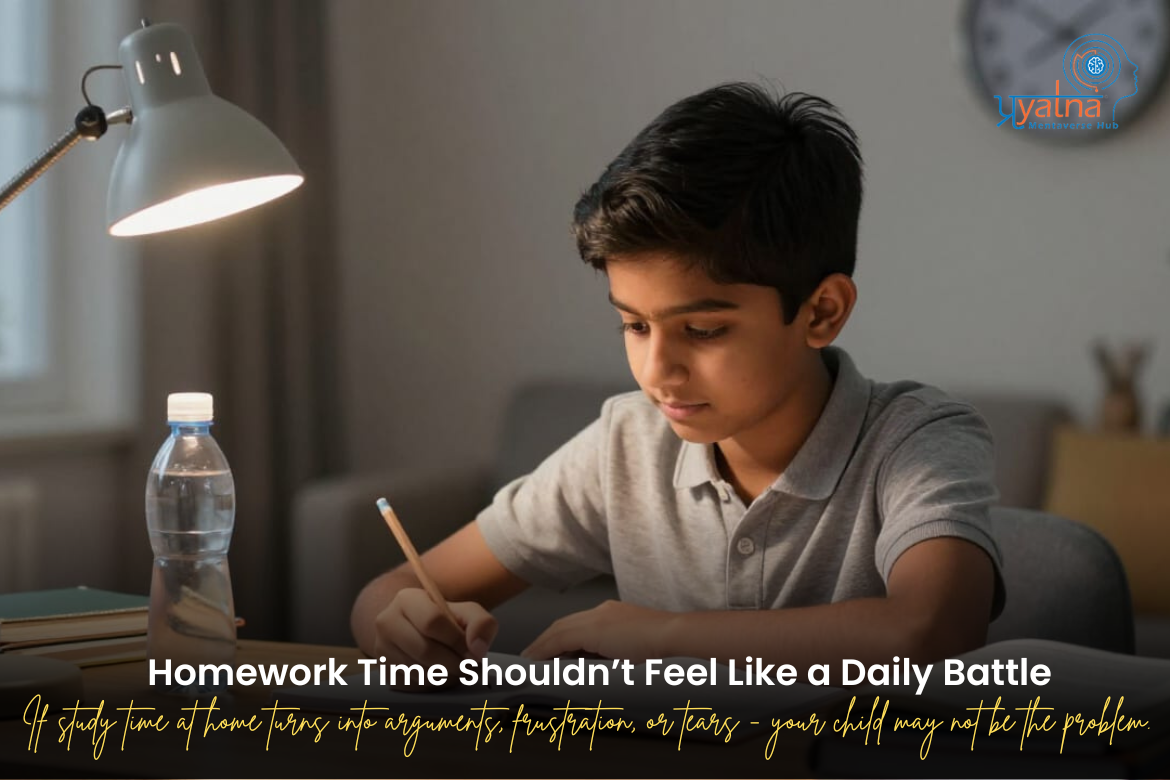
How to Build Study Habits Without Daily Fights: Practical Strategies for Parents
How to Build Study Habits Without Daily Fights: Practical Strategies for Parents
If homework time feels like a daily battlefield, the problem may not be your child — it may be the approach.
Many parents search for solutions to:
- “Why does my child avoid homework?”
- “How do I improve my child’s focus?”
- “Why is study time always a fight?”
The truth is:
Children rarely resist learning — they resist pressure.
Building strong study habits requires structure + emotional safety, not control.
Why Homework Turns Into a Power Struggle
When children delay homework, get distracted quickly, or argue during study time, parents naturally respond by pushing harder.
But pressure often creates:
- Resistance
- Emotional shutdown
- Reduced motivation
- Fear of failure
Instead of improving focus, strict control often increases homework battles.
Step 1: Create a Predictable Study Routine
Children thrive on routine.
Fix a simple, realistic daily study time — even 20 focused minutes is enough to start.
Consistency builds habit faster than long, forced hours.
Practical Tips:
- Same time daily (after snack or play)
- Same study space
- Clear start and end time
Predictability reduces negotiation and increases cooperation.
Step 2: Use the “Small Chunks” Method
Young brains struggle with long, uninterrupted study sessions.
Instead of:
❌ 1 hour continuous sitting
Try:
✅ 15–20 minutes study
✅ 5-minute movement break
✅ Repeat if needed
Planned breaks improve attention span and reduce mid-task arguments.
This method improves:
- Focus problems
- Homework resistance
- Emotional overwhelm
Step 3: Create a Distraction-Free Environment
Focus is environmental before it is mental.
Remove:
- TV noise
- Mobile phones
- Loud conversations
Keep:
- Clean desk
- Basic stationery ready
- Water nearby
A cluttered space creates a cluttered mind.
Step 4: Change Your Tone, Change the Outcome
Your tone influences your child’s nervous system.
Instead of:
❌ “Why are you so careless?”
❌ “How many times do I have to tell you?”
Say:
✅ “Let’s solve this together.”
✅ “What part feels difficult?”
When children feel judged, they shut down.
When they feel supported, they cooperate.
Step 5: Praise Effort, Not Just Results
Encouragement builds internal motivation.
Notice effort:
- “I saw you tried even though it was hard.”
- “You stayed focused for 15 minutes — that’s progress.”
Effort-based praise builds:
- Responsibility
- Confidence
- Growth mindset
Rewards may work short-term.
Recognition builds long-term study discipline.
Step 6: Check Emotional Readiness Before Academic Discipline
A child who is:
- Hungry
- Tired
- Overstimulated
- Emotionally overwhelmed
…cannot focus on studies.
Emotional regulation comes before academic success.
Ask yourself:
- Did they get enough rest?
- Did they eat properly?
- Have they had playtime?
Calm children learn better.
Why Structure Works Better Than Pressure
Building study habits is not about winning power struggles.
It’s about:
- Gradual responsibility
- Emotional safety
- Consistency over intensity
Small, steady steps create long-term discipline.
When to Seek Professional Guidance
Consider counselling support if:
- Homework battles happen daily
- Your child shows extreme avoidance
- There are signs of lack of focus or attention difficulty
- Emotional breakdowns happen during study time
Sometimes, underlying issues like attention challenges, learning difficulties, or emotional stress require expert guidance.
Final Takeaway
Consistency beats anger.
Calm communication beats control.
Small structured steps beat forced discipline.
Strong study habits are built slowly, respectfully, and emotionally safely.
Because the goal isn’t just good grades —
it’s raising responsible, confident learners.
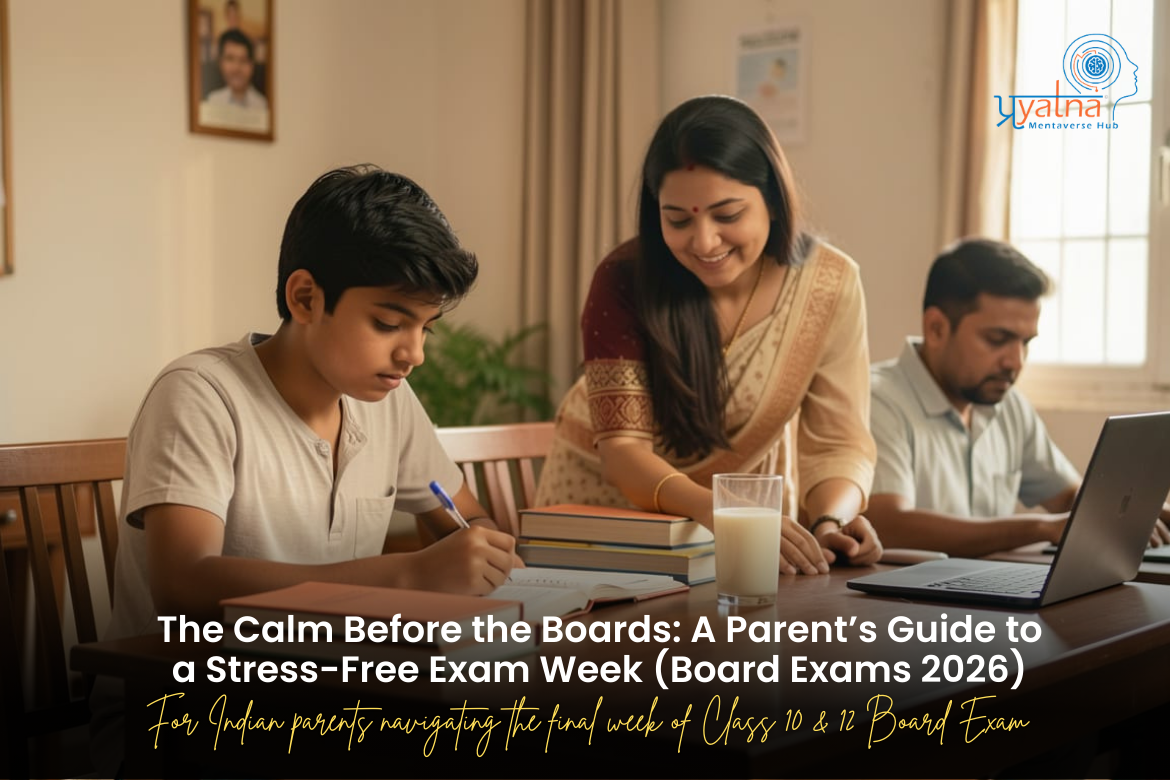
The Calm Before the Boards: A Parent’s Guide to a Stress-Free Exam Week (Board Exams 2026)
The Calm Before the Boards: A Parent’s Guide to a Stress-Free Exam Week (Board Exams 2026)
For Indian parents navigating the final week of Class 10 & 12 Board Exam 2026 preparation
February and March in Indian households often feel like a pressure cooker.
The TV volume drops.
Relatives whisper.
The dining table becomes a study station.
And every conversation ends with, “Kitna syllabus baaki hai?”
Board exams are important — no doubt.
But in the final 7 days of Board Exam 2026 preparation, your role changes.
You are no longer the Chief Academic Officer checking revisions.
You become the Chief Motivation Officer.
Because in the last week, emotional stability matters more than extra chapters.
Let’s understand how to reduce exam stress at home and avoid unnecessary parental pressure during exams.
Understanding the Final Week Psychology
By the final week, most students have:
- Completed major revisions
- Solved sample papers
- Followed a structured Board Exam 2026 preparation plan
At this stage, what they need most is:
- Confidence
- Calmness
- Sleep
- Emotional safety
Not new strategies.
Not panic.
Not comparison.
When stress increases, the brain’s prefrontal cortex (responsible for logic and recall) becomes less efficient. High anxiety reduces memory retrieval during exams.
This is why supporting your child during board exams is less about “more study” and more about “less stress.”
Words That Heal vs Words That Pressure
In the final week, your communication can:
✔ Strengthen confidence
OR
❌ Create silent anxiety
Let’s start with what not to say.
❌ What NOT to Say During Board Exam Week
1. “Sharma ji’s son studies 14 hours.”
Why this increases exam stress:
- Triggers comparison anxiety
- Reduces self-worth
- Shifts focus from self-improvement to competition
Comparison increases pressure, not performance.
2. “Your whole future depends on this paper.”
Why it harms:
- Creates catastrophic thinking
- Activates fear instead of focus
- Makes failure feel life-threatening
No single exam defines a life — but repeated messaging makes the brain believe it does.
3. “If you don’t score above 95%, what will people say?”
Why it harms:
- Links love with marks
- Encourages external validation
- Builds fear of embarrassment
Children start associating acceptance with performance.
4. “Are you sure you revised properly?”
Why it harms:
- Signals doubt
- Creates last-minute panic
- Weakens confidence
In the final week, reassurance is more powerful than interrogation.
✅ What to Say Instead: Positive Phrases for Students
Language reduces cortisol (stress hormone) and builds clarity.
Here’s what works better:
✔ “I’m proud of the effort you’re putting in.”
✔ “One exam cannot define your future.”
✔ “You’ve prepared well. Trust yourself.”
✔ “Focus on doing your best. Marks will follow.”
✔ “Stay calm. Read carefully. We’re with you.”
These phrases promote emotional resilience and exam confidence.
How to Reduce Exam Stress at Home (Without Saying Much)
Sometimes actions speak louder than advice.
1️⃣ Create a Calm Environment
- Keep TV volume low
- Avoid arguments
- Delay stressful discussions
- Limit negative news
A peaceful home lowers background anxiety.
2️⃣ Maintain Routine
- Ensure balanced meals
- Encourage proper sleep (no all-night studying)
- Light evening walks if possible
Sleep improves memory consolidation and recall.
3️⃣ Keep Comfort Ready
- Favorite light snacks
- Warm milk or herbal tea
- Ironed uniform ready
- Exam kit prepared
Small gestures signal emotional support.
4️⃣ Avoid Conflict This Week
This is NOT the week to:
- Discuss discipline
- Bring up old mistakes
- Talk about career pressure
- Compare with cousins
Protect emotional stability.
Your Role in Board Exam 2026 Preparation
In this final stretch:
You are not monitoring every answer.
You are managing:
- Emotional climate
- Confidence levels
- Parental pressure during exams
If your child feels nervous → you stay calm.
If they doubt themselves → you reassure.
If they feel tired → you encourage rest.
Your stability becomes their anchor.
The Big Picture: Beyond the Marksheet
Years from now, your child may not remember:
- Exact marks
- Exact rank
- Exact percentage
But they will remember:
- Whether home felt safe
- Whether they felt supported
- Whether love felt conditional
Children who feel emotionally secure perform better — not just in exams, but in life.
A marksheet is temporary.
Your relationship is permanent.
Quick Dos and Don’ts for Parents (Exam Week Checklist)
✅ DO:
- Use positive phrases for students
- Maintain calm household energy
- Encourage healthy sleep and food
- Offer reassurance daily
- Celebrate effort
❌ DON’T:
- Compare
- Threaten consequences
- Discuss marks publicly
- Bring career pressure now
- Panic more than your child
Final Thoughts: Calm Builds Performance
Board Exam 2026 preparation is intense — but it does not have to be traumatic.
When parents reduce exam stress at home, children perform with clarity instead of fear.
Your calm presence is the greatest gift you can give your child this week.
The marksheet will last a few years.
Your words will last a lifetime.
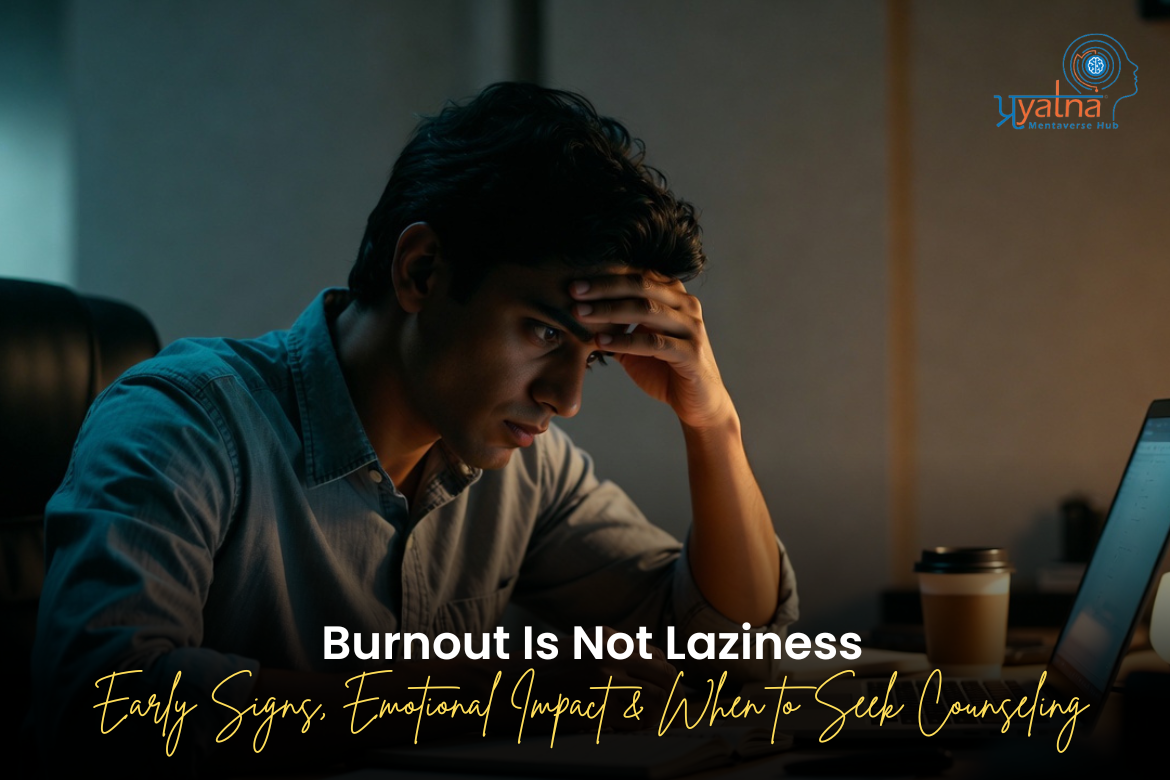
Burnout Is Not Laziness: Early Signs, Emotional Impact & When to Seek Counseling
Burnout Is Not Laziness: Early Signs, Emotional Impact & When to Seek Counseling
In today’s hustle culture, employees are taught to push harder, work longer, and stay productive at all costs.
But what happens when your mind and body can no longer keep up?
Many people mistake burnout for being lazy, unmotivated, or careless.
But burnout is not a lack of discipline — it is a stress response.
👉 Burnout is your body and mind saying:
“I’m overwhelmed, and I need help.”
What Is Burnout?
Burnout is a state of emotional, mental, and physical exhaustion caused by long-term, continuous stress — especially in workplaces where expectations are high and support is low.
It develops gradually and is often ignored until the symptoms become intense.
Unlike temporary tiredness, burnout doesn’t disappear after a weekend break.
Early Signs of Burnout (Often Confused with Laziness)
What it looks like to others vs. what’s actually happening:
| What Others Say | What’s Really Happening |
|---|---|
| “You’re losing motivation.” | You’re mentally exhausted |
| “You don’t care about work anymore.” | You’re emotionally drained |
| “You’re being lazy.” | You’re overwhelmed and depleted |
🚩 Common Early Warning Signs
-
Constant Fatigue & Low Energy
You feel tired even after adequate rest. -
Loss of Motivation
Tasks that once excited you now feel heavy or meaningless. -
Emotional Overload
Increased irritability, sensitivity, or feeling on edge without a clear reason. -
Reduced Performance
You know what needs to be done — but can’t push yourself to start. -
Withdrawal from Work or Family
Social interaction feels draining, so you isolate. -
Physical Symptoms
Headaches, stomach issues, body pain, or frequent illness.
🔍 Key distinction:
If you’re tired because you worked too much — it’s hard work.
If you’re tired even after resting — it’s burnout.
Emotional Impact of Burnout
Burnout doesn’t just affect productivity —
it affects how you see yourself.
You may start asking:
- “Why can’t I function like others?”
- “Why am I losing interest in everything?”
- “Am I failing?”
Internally, burnout can lead to:
- Emotional numbness
- Harsh negative self-talk
- Hopelessness
- Feeling disconnected from life
If left unaddressed, burnout often evolves into anxiety or depression.
Burnout vs Laziness — The Real Difference
Laziness = lack of willingness
Burnout = lack of capacity due to overload
People experiencing burnout want to perform well —
but their emotional and mental resources are already depleted.
This is why pushing harder doesn’t help.
Support does.
Workplace Stress & Employee Mental Health
Burnout is especially common in workplaces with:
- Long working hours
- Constant performance pressure
- Lack of recognition
- Poor work-life balance
That’s why many organisations now invest in Employee Assistance Programs (EAPs).
If you’re looking for EAP services in Ahmedabad, professional counselling can help:
- Reduce workplace stress
- Improve emotional resilience
- Support employee mental health
- Create healthier, sustainable work cultures
When Should You Seek Counseling?
Reach out for professional support if you experience:
- Persistent exhaustion for more than two weeks
- Sudden drop in work performance
- Emotional detachment from work or loved ones
- Difficulty getting out of bed to go to work
- Increasing guilt, self-blame, or hopelessness
How Counseling Helps with Burnout
Counselling doesn’t “push” you to do more —
it helps you recover capacity.
Through therapy, you learn:
- How to set healthy boundaries
- How to regulate emotions
- How to say no without guilt
- How to rebuild work-life balance
- How to regain focus, motivation, and purpose
You Can Recover from Burnout 🌱
Recovery is possible — and it starts with permission to pause.
Rest is not a reward.
Rest is a requirement.
Burnout doesn’t mean you’re weak.
It means you’ve been strong for too long without support.
Need Support?
Whether you are:
- An individual employee struggling with burnout
- Or an organisation looking to improve employee mental health
Prayatna Mentaverse Hub offers professional counselling and EAP services in Ahmedabad, specialising in:
- Workplace stress
- Emotional health
- Corporate mental wellness programs
📍 Prayatna Mentaverse Hub — Best Counseling Services in Ahmedabad
👉 Reach out today. Healing begins with the first conversation.