

Ghosting Mental Health: How Ghosting, Orbiting & Breadcrumbing Affect Emotional Wellbeing
Introduction: The Relationship Status Nobody Warned You About
There’s a specific kind of pain that didn’t have language until recently. It’s the feeling of being with someone who suddenly stops responding — not in a fight, not officially over, just… gone. You check their profile. The stories keep coming. They watched yours. None of this is a relationship. None of this is clearly over. It’s something in between — and that in-between space is doing something serious to our nervous systems.
Defining the Digital Dating Lexicon
Ghosting
The abrupt cessation of all communication with someone you’ve been romantically involved with, without explanation or acknowledgment. The conversation simply stops. The person is there — their social media is active — they’ve just chosen not to respond. Indefinitely.
Orbiting
A ghost who continues engaging with your social media content — watching stories, liking posts — without any direct communication. You’re broken up (or never started), but they won’t fully leave.
Breadcrumbing
Sending infrequent, low-commitment signals of interest — a sporadic text, a comment — designed to keep someone emotionally available without any real investment. Named after Hansel and Gretel’s trail: just enough to follow, never enough to arrive anywhere.
The Neuroscience of Ambiguity: Why Your Brain Hates This More Than Rejection
Evolutionary neuroscience offers a clarifying insight: the brain finds ambiguity more stressful than negative certainty. This is sometimes called the ambiguity aversion effect — a preference for known outcomes, even bad ones, over uncertain ones.
When a relationship definitively ends, the brain can begin the grief work of integrating loss. When a relationship is ghosted, the brain receives none of the closure signals it needs to begin that process. Research published in the Journal of Social and Personal Relationships found that people who experienced ghosting reported lower levels of belonging, control, and self-esteem compared to those who experienced explicit relationship endings.
Attachment Theory in the Age of the Algorithm
Digital dating, with its ghosting and breadcrumbing, is particularly brutal for anxious attachment styles — and research suggests it may be actively creating them. Variable reinforcement — behavior reinforced on an unpredictable schedule — is the hardest to extinguish. Casino slot machines operate on this principle. So does breadcrumbing.
The cumulative effect of multiple experiences of ghosting and ambiguity can shift someone’s attachment style over time — toward more anxiety, more hypervigilance, more defensive avoidance.
Why We Need Closure — And Why Ghosting Denies It
Closure refers to the cognitive and emotional process of reaching a definitive understanding of a relationship’s end. The brain’s default mode network reliably returns to unresolved emotional material. Unfinished relational narratives become intrusive thoughts — they recur because the brain hasn’t been given the information it needs to file them away.
Orbiting is arguably crueler: it actively signals continued presence (the ghost is watching your stories) without providing any of the information needed for integration. It keeps the wound open.
Reclaiming Your Nervous System
- Name what happened without minimizing it — ‘I was ghosted’ is a valid thing to say
- Resist the urge to re-open the loop — closure has to come from within, not from them
- Notice breadcrumbing for what it is — information about their capacity for intimacy, not your worth
- Build your own narrative completion through journaling, therapy, and deliberate meaning-making
- Re-examine your attachment patterns with a therapist if these experiences keep repeating
When to Seek Support
At Prayatna Mentaverse, we work with people navigating the psychological aftermath of modern digital relationships — the grief, the self-doubt, the erosion of trust, and the complicated feelings that come with relationships that didn’t end cleanly.
You are allowed to need a real ending. You are allowed to need to know you mattered. And if the person who ghosted you can’t give you that — a good therapist, a good community, and your own honest self-reflection can.
Learn More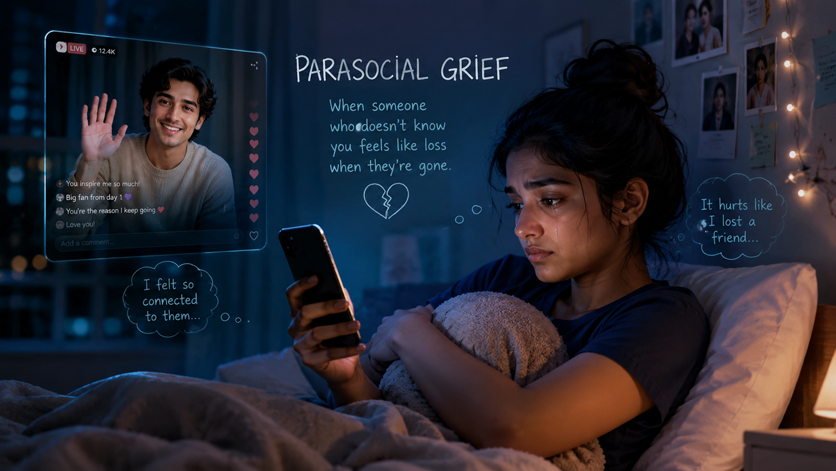
Parasocial Grief: Why Losing a Celebrity or Fictional Character Feels Like Losing a Friend
Introduction: You Didn’t Know Them. So Why Does It Hurt So Much?
Maybe it was when your favorite artist died and you cried for days. Maybe it was when a beloved fictional character was killed off and you felt genuinely bereft. Maybe it was when a YouTuber you’d watched for years stopped making content, and the absence felt surprisingly painful. And maybe you felt embarrassed about all of it.
At Prayatna Mentaverse, we want to offer something different: your grief is real. Your neurological experience of loss is identical to the grief you’d feel for someone you knew personally. Understanding why that’s true — rather than dismissing it — is the beginning of something more compassionate.
What Is a Parasocial Relationship?
The concept was first introduced by sociologists Donald Horton and Richard Wohl in 1956, observing that television audiences developed one-sided emotional bonds with TV personalities. Today, parasocial relationships — emotionally meaningful bonds with people or characters who don’t know you exist — are nearly universal. We form them with celebrities, YouTubers, podcasters, fictional characters, and social media influencers.
These relationships feel real because, in many neurologically meaningful ways, they are.
The Neuroscience: Why Your Brain Can’t Tell the Difference
The human brain’s social processing systems evolved to handle face-to-face relationships. They didn’t evolve for a world where a person’s face, voice, and emotional life can be transmitted to millions of strangers.
- Mirror neurons fire when we observe emotional experiences — when your favorite musician performs with raw vulnerability, your mirror neuron system responds whether they’re in the room or on a screen
- The medial prefrontal cortex (mPFC) activates similarly for people we know personally and people we feel parasocially connected to
- Oxytocin and dopamine are released during parasocial engagement, activating the same reward systems as a genuinely enjoyable interaction with a friend
When the relationship ends — through death, cancellation, or a show ending — the brain experiences something neurologically identical to relationship loss.
When Parasocial Grief Is a Normal Response
Mourning a celebrity death is a legitimate grief experience. Research published in OMEGA – Journal of Death and Dying found that the intensity of parasocial grief correlated with the depth of the parasocial relationship — just as real grief correlates with closeness. Genuine grief responses include shock and disbelief, sadness, difficulty concentrating, a desire to talk about the person, and a period of consuming old content.
The Complicated Grief of Fictional Character Loss
When you mourn a fictional character, you are mourning the narrative relationship you had with them, a version of yourself who was reading or watching, and the meanings you made from their story. A character who helped you understand yourself, survive something, or feel less alone has done something real for you. Their loss is real.
Healthy Ways to Process Parasocial Grief
- Name it without shame — calling your experience grief and treating it accordingly is the first step
- Find community — fan communities in grief are often remarkably healing
- Create something — fan art, writing, and playlist curation are legitimate grief rituals
- Reflect on what the relationship meant to you and what part of yourself it reflected back
When to Seek Support
At Prayatna Mentaverse, we sit with clients through grief that doesn’t fit conventional categories — gently and without judgment. If parasocial grief is significantly affecting your functioning, or you notice that your primary emotional bonds are parasocial, it may be worth exploring with a professional.
You are not embarrassing for grieving someone you never met. You are a human being with a nervous system that evolved to attach. Grieve accordingly.
#ParasocialGrief #CelebrityDeath #ParasocialRelationships #GriefAndLoss #DigitalMentalHealth #PrayatnaMentaverse
Learn More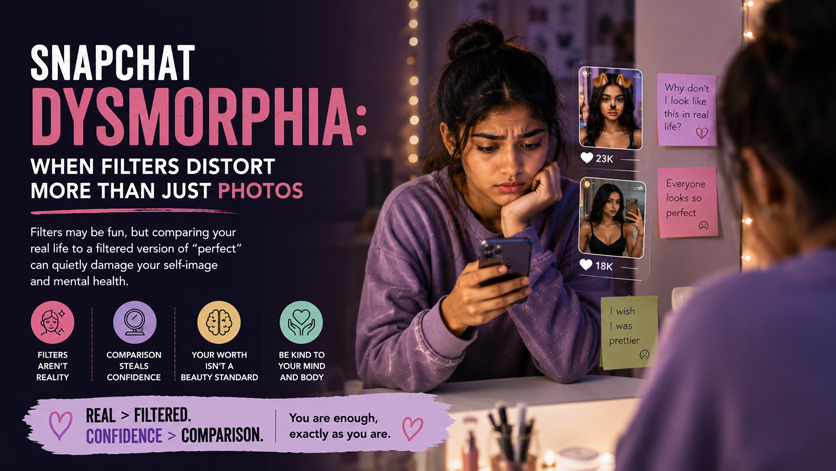
Snapchat Dysmorphia: How AR Filters Are Rewiring How Young People See Themselves
Introduction: The Face You See in the Mirror Isn’t Yours Anymore
There is a face that millions of young people are falling in love with. It has the same general features as their real face — but with softer skin, larger eyes, a slimmer jaw, a smaller nose, and the kind of symmetry that human faces almost never actually have. This face lives in the camera of their phone, constructed in real-time by an AR algorithm. And it’s slowly, fundamentally changing how they feel about their actual reflection.
What Is Snapchat Dysmorphia?
The term was coined by plastic surgeon Dr. Tijion Esho in 2018, after he noticed patients arriving at his clinic not with photos of celebrities they wanted to emulate — but with filtered photos of themselves. They wanted to look like their filtered selfie. In real life.
It exists on a spectrum — from mild preference for filtered images, to moderate avoidance of unfiltered photos, to severe distress and consideration of cosmetic procedures to ‘correct’ the gap.
The Developing Brain: Why This Matters More for Young People
Adolescence is the critical window for body image formation. During this period, the brain is actively constructing a stable self-concept — including a physical self-concept. Neural pruning, heightened social evaluation sensitivity, and extreme responsiveness to peer comparison make this the window where experiences have outsized, long-lasting effects.
If a significant portion of those experiences involve consistently seeing an altered, ‘improved’ version of your face — receiving positive reinforcement through likes and compliments — the brain begins to incorporate this altered image into its body schema. Over time, the actual unfiltered face may begin to feel foreign. Wrong. Like something that needs to be fixed.
The Personalized Impossibility Standard
When a magazine model is unattainably beautiful, there’s a psychological buffer — ‘that’s her, not me.’ When your own face, run through a beauty algorithm, looks like that, the message becomes: ‘This is what I could look like. This is what I should look like.’
The result is a personalized impossibility standard — a beauty benchmark uniquely calibrated to feel tantalizingly close and permanently out of reach. Research published in JAMA Facial Plastic Surgery found that social media filters are specifically associated with body dysmorphic disorder (BDD) symptoms.
New Forms of Body Image Distress
- Filter Withdrawal: Genuine distress when cameras don’t have filters available — at video calls, medical appointments
- Face Editing Compulsion: Spending hours editing photos before posting
- Mirror Avoidance or Overuse: Either avoiding mirrors or obsessively checking ‘problem areas’
- Cosmetic Procedure Requests at Younger Ages: Teenage patients requesting procedures based on filter aesthetics
What Parents Can Do
- Have the conversation explicitly — name what AR filters are doing
- Model unfiltered self-presentation
- Create filter-free family photo zones
- Watch for reluctance to be photographed or disproportionate appearance concerns
When to Seek Professional Help
At Prayatna Mentaverse, we work with young people experiencing body image distress driven by social media comparison and filter use. Consider reaching out if a young person is avoiding social situations due to appearance anxiety, showing interest in cosmetic procedures at a young age, or if appearance concerns are interfering with daily functioning.
Your face, as it actually is, is the face your body came with. No algorithm should be in the business of making you feel like that face isn’t enough.
Learn More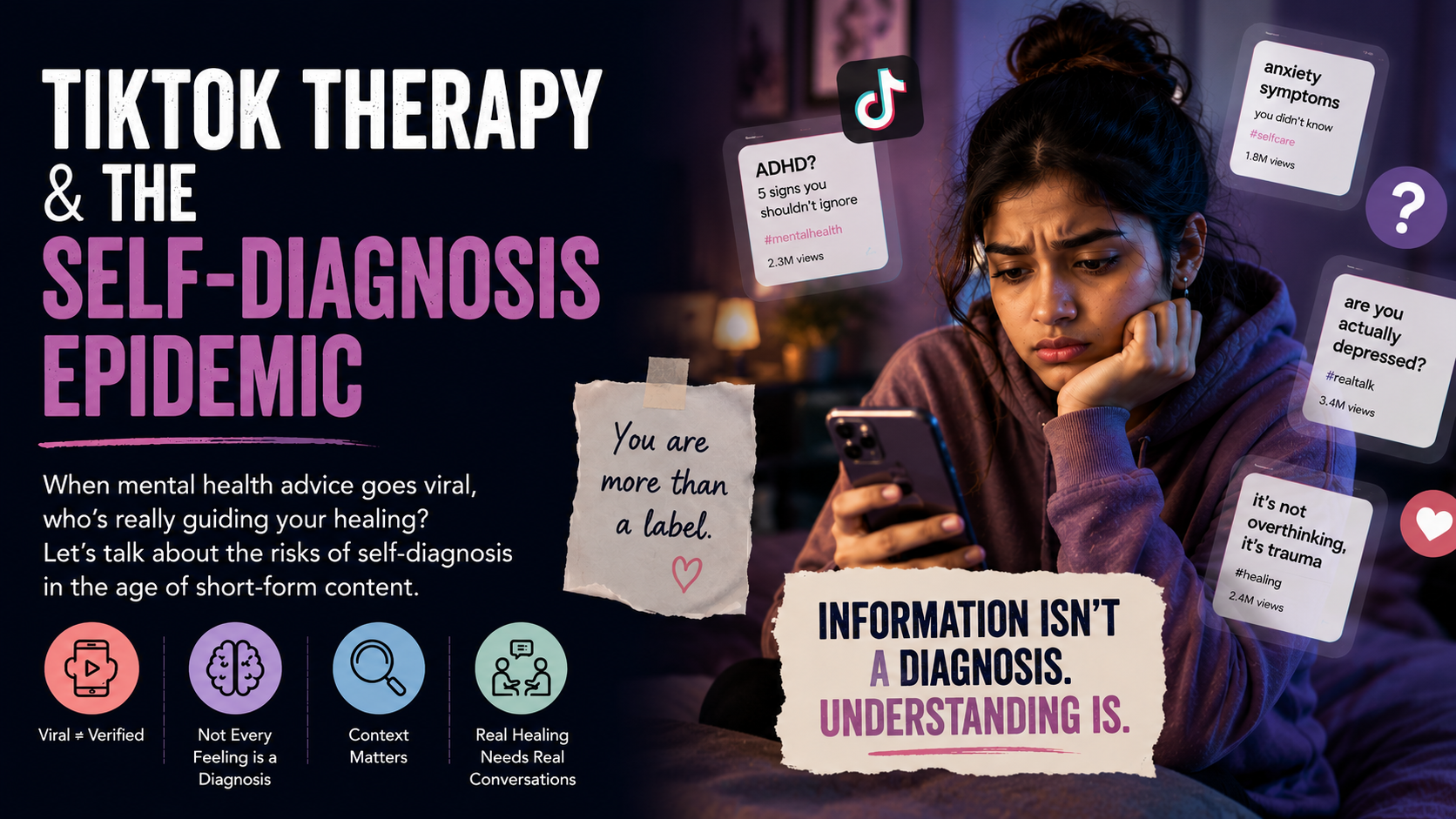
TikTok Therapy & The Self-Diagnosis Epidemic: Finding Your Label vs. Pathologizing Being Human
Introduction: When the Algorithm Becomes Your Therapist
‘Wait — that’s literally me.’ If you’ve ever watched a TikTok explaining ADHD symptoms and felt that electric recognition — the sudden, startling sense that someone finally described something you’ve lived with for years — you know the feeling. Millions of people have found language for their experiences through mental health content on social media.
This is genuinely meaningful. But Prayatna Mentaverse believes this conversation needs more nuance — because between ‘this content saved my life’ and ‘this content convinced me I have 12 disorders,’ there’s a critically important distinction worth understanding.
The Genuine Gift of Mental Health Language
Access to vocabulary is transformative. Many people — especially in communities where mental health is stigmatized — have spent years experiencing distress they couldn’t name. Finding language for what they experience can:
- Reduce shame (‘It’s not just me; this is a recognized experience’)
- Motivate seeking professional support
- Help people communicate their needs to loved ones
- Create community and reduce isolation
Where It Gets Complicated: The Pathologizing Problem
Pathologizing means interpreting normal human experiences through the lens of disorder. Mental health TikTok, for all its gifts, has a significant pathologizing problem. Consider these common framings:
- Forgetting your keys? ‘That’s your ADHD.’
- Feeling sad after a breakup? ‘That’s your anxious attachment.’
- Being introverted? ‘That’s probably autism.’
The challenge: all of these things can also just be… human. When every difficult emotion becomes a symptom and every behavioral tendency becomes a disorder, we lose the ability to tolerate the ordinary discomforts of being alive.
The Diagnostic Criteria Problem
Clinical diagnoses exist on continuums, and the criteria for most conditions involve significant impairment — meaning the symptoms interfere substantially with daily functioning. What social media often presents is a list of relatable experiences stripped of this clinical threshold.
A TikTok might show 10 signs of ADHD, most of which — losing focus sometimes, getting distracted, being disorganized occasionally — are things neurotypical people experience regularly. A licensed clinician goes through severity thresholds, duration requirements, and differential diagnosis. A 60-second video cannot.
The Identity Trap: When the Label Becomes the Self
One of the subtler risks of mental health TikTok is the way diagnostic labels can calcify into identity. When someone builds their entire self-concept around ‘I have ADHD, so I can’t do X,’ labels that were meant to explain can start to constrain. This is particularly significant for adolescents and young adults whose identities are still forming.
What Responsible Consumption Looks Like
- Follow clinicians, not just creators — look for licensed therapists sharing evidence-based content
- Treat it as a starting point, not a destination — let content lead you toward professional evaluation
- Notice the difference between resonance and diagnosis
- Be skeptical of content that pathologizes universally human experiences
When to Seek Professional Support
If you’ve been self-diagnosing online and are genuinely concerned, a professional evaluation is the most caring thing you can do for yourself. At Prayatna Mentaverse, we offer comprehensive mental health assessments and a compassionate approach to these modern challenges.
The goal isn’t a label. The goal is a life that feels livable, connected, and full.
#MentalHealthTikTok #SelfDiagnosis #ADHDTikTok #AnxietyAwareness #GenZMentalHealth #PrayatnaMentaverse
Learn More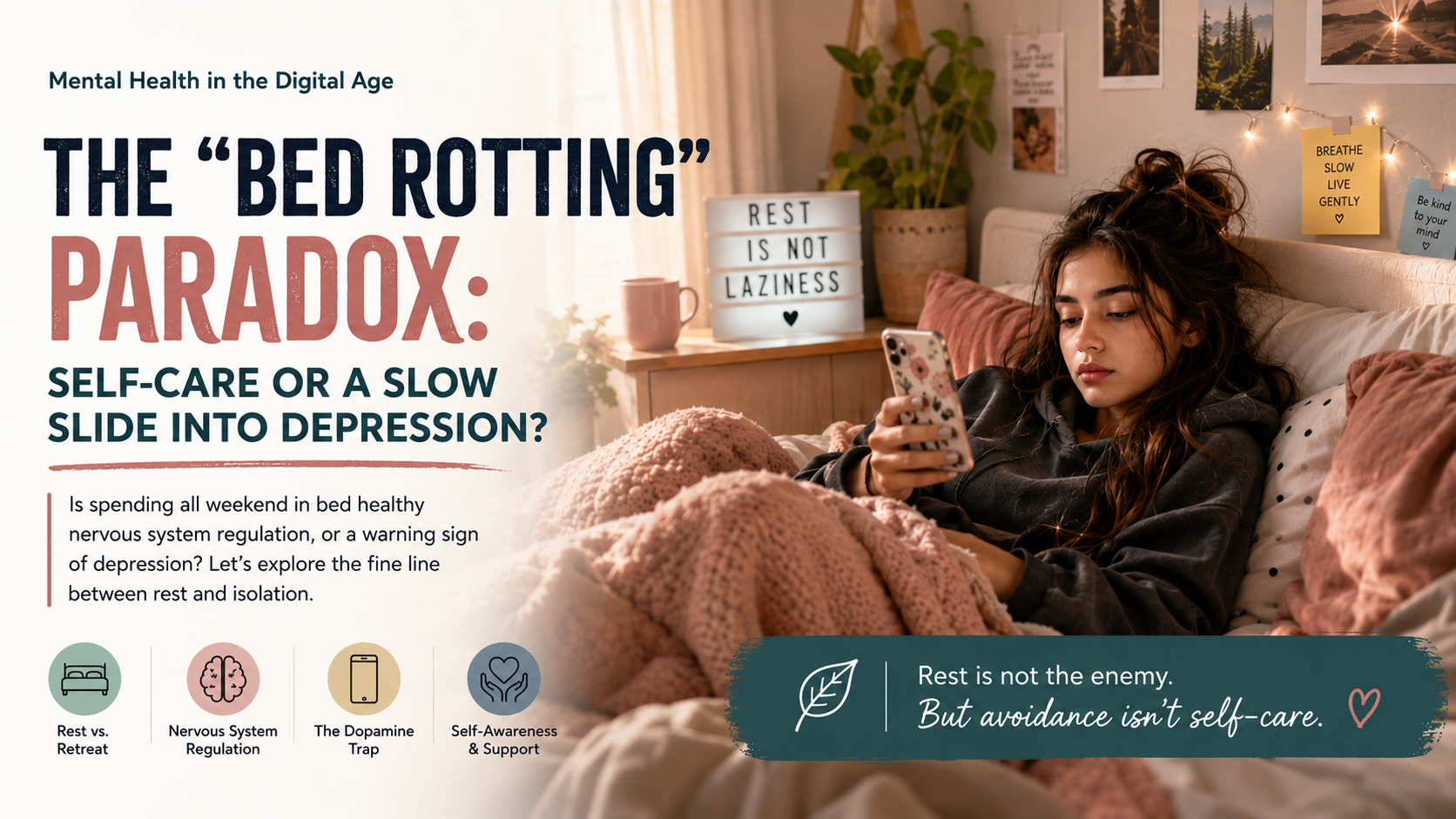
The “Bed Rotting” Paradox: Self-Care or a Slow Slide Into Depression?
When Your Bed Becomes Both Sanctuary and Trap
If you’ve scrolled TikTok in the past year, you’ve likely seen it — someone proudly declaring they spent the entire weekend in bed, unbothered, curtains drawn, doing absolutely nothing. The hashtag #BedRotting has accumulated hundreds of millions of views, and Gen Z has essentially canonized horizontal laziness as a wellness practice.
But here at Prayatna Mentaverse, we believe that between every viral trend and every lived human experience, there’s a conversation worth having. So let’s ask the real question: Is bed rotting a legitimate form of nervous system regulation — or is it a warning sign dressed up as self-care?
What Is ‘Bed Rotting,’ Exactly?
Bed rotting refers to the intentional practice of spending extended periods in bed — often an entire day or weekend — doing low-effort activities like scrolling your phone, watching shows, eating snacks, and sleeping on and off. Unlike traditional rest or sleep recovery, it’s characterized by a deliberate disengagement from productive or social obligations.
Proponents frame it as a radical act of rest in a hustle-obsessed culture. Critics call it avoidance behavior with a wellness rebrand. Both might be right.
The Science Behind Rest: When Doing Nothing Is Actually Something
To understand bed rotting, we first need to understand what genuine nervous system regulation looks like. Our autonomic nervous system operates in two primary modes:
- Sympathetic (fight-or-flight): Activated during stress, deadlines, social demands
- Parasympathetic (rest-and-digest): Activated during safety, calm, and recovery
For people running on chronic stress — and that’s most of us — dropping into parasympathetic mode is genuinely therapeutic. The body needs periods of low stimulation to repair, consolidate memory, regulate cortisol, and restore emotional resources.
Research in polyvagal theory, pioneered by Dr. Stephen Porges, confirms that the nervous system requires real downtime to regulate itself. In this context, a slow, undemanding day in bed is not laziness — it’s biology.
From Prayatna Mentaverse’s perspective: If you’ve had a week of social overwhelm, intense work pressure, or emotional strain, a day of deliberate, guilt-free rest is not just acceptable — it can be genuinely restorative.
When Rest Becomes Retreat: The Warning Signs
Here’s where the paradox deepens. For some people, bed rotting isn’t nervous system regulation — it’s nervous system avoidance. Consider the difference:
Restorative Rest
- You feel refreshed or lighter after
- It’s a choice, not a compulsion
- You re-engage with life relatively easily afterward
- It happens occasionally, typically after depletion
Depressive Withdrawal
- You feel worse, more sluggish, or guilty after
- Getting out of bed feels impossible, not optional
- The isolation is growing, not shrinking
- It’s becoming your default state, not an exception
Depression, particularly in its atypical presentations, often masquerades as fatigue, low motivation, and a desire for solitude. For young people especially, the cultural normalization of ‘not wanting to do anything’ can delay recognition of what’s actually a mood disorder requiring support.
The Dopamine Trap Hidden in the Duvet
There’s another layer to this conversation: what you’re doing in bed matters as much as being in bed. Passive scrolling, doomscrolling, and bingeing content while bed rotting activates the brain’s reward system in short, low-quality bursts. This isn’t the same as genuine rest — it keeps the nervous system slightly activated while preventing meaningful restoration.
Studies on passive social media use consistently link it to lower mood and increased anxiety. So a day of ‘bed rotting + TikTok’ may leave you more depleted than when you started, creating a cycle: you feel more tired, so you stay in bed longer, so you scroll more, so you feel worse.
Ask Yourself These 4 Questions
- Is this rest toward something (recovery, renewal), or rest away from something (life, people, responsibility)?
- Do I feel better or worse after these extended rest periods?
- Has this become my main coping mechanism?
- Am I canceling things I used to look forward to?
When to Reach Out
If bed rotting has shifted from occasional recharge to your primary way of navigating the world, it may be time to speak with a mental health professional. At Prayatna Mentaverse, our counselors specialize in exactly these kinds of nuanced, modern mental health challenges.
- Persistent low mood lasting more than two weeks
- Inability to feel pleasure in things you used to enjoy
- Increasing social withdrawal
- Difficulty meeting basic responsibilities
The goal isn’t productivity at all costs. The goal is a life you can re-enter after you’ve rested.
Learn More