
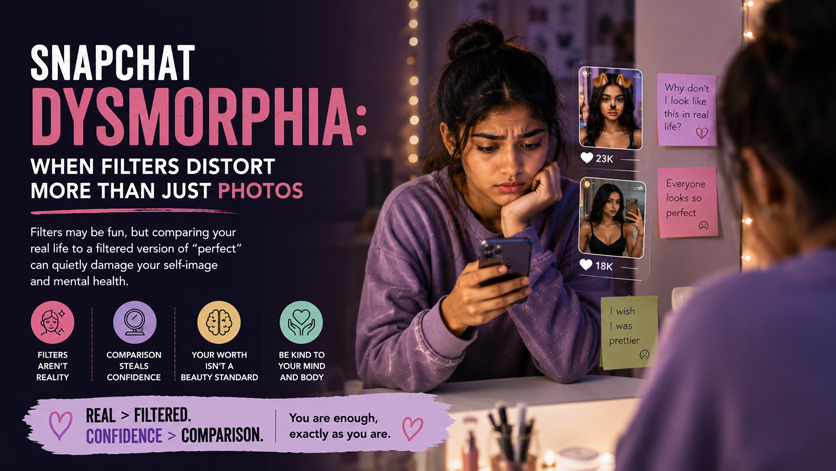
Snapchat Dysmorphia: How AR Filters Are Rewiring How Young People See Themselves
Introduction: The Face You See in the Mirror Isn’t Yours Anymore
There is a face that millions of young people are falling in love with. It has the same general features as their real face — but with softer skin, larger eyes, a slimmer jaw, a smaller nose, and the kind of symmetry that human faces almost never actually have. This face lives in the camera of their phone, constructed in real-time by an AR algorithm. And it’s slowly, fundamentally changing how they feel about their actual reflection.
What Is Snapchat Dysmorphia?
The term was coined by plastic surgeon Dr. Tijion Esho in 2018, after he noticed patients arriving at his clinic not with photos of celebrities they wanted to emulate — but with filtered photos of themselves. They wanted to look like their filtered selfie. In real life.
It exists on a spectrum — from mild preference for filtered images, to moderate avoidance of unfiltered photos, to severe distress and consideration of cosmetic procedures to ‘correct’ the gap.
The Developing Brain: Why This Matters More for Young People
Adolescence is the critical window for body image formation. During this period, the brain is actively constructing a stable self-concept — including a physical self-concept. Neural pruning, heightened social evaluation sensitivity, and extreme responsiveness to peer comparison make this the window where experiences have outsized, long-lasting effects.
If a significant portion of those experiences involve consistently seeing an altered, ‘improved’ version of your face — receiving positive reinforcement through likes and compliments — the brain begins to incorporate this altered image into its body schema. Over time, the actual unfiltered face may begin to feel foreign. Wrong. Like something that needs to be fixed.
The Personalized Impossibility Standard
When a magazine model is unattainably beautiful, there’s a psychological buffer — ‘that’s her, not me.’ When your own face, run through a beauty algorithm, looks like that, the message becomes: ‘This is what I could look like. This is what I should look like.’
The result is a personalized impossibility standard — a beauty benchmark uniquely calibrated to feel tantalizingly close and permanently out of reach. Research published in JAMA Facial Plastic Surgery found that social media filters are specifically associated with body dysmorphic disorder (BDD) symptoms.
New Forms of Body Image Distress
- Filter Withdrawal: Genuine distress when cameras don’t have filters available — at video calls, medical appointments
- Face Editing Compulsion: Spending hours editing photos before posting
- Mirror Avoidance or Overuse: Either avoiding mirrors or obsessively checking ‘problem areas’
- Cosmetic Procedure Requests at Younger Ages: Teenage patients requesting procedures based on filter aesthetics
What Parents Can Do
- Have the conversation explicitly — name what AR filters are doing
- Model unfiltered self-presentation
- Create filter-free family photo zones
- Watch for reluctance to be photographed or disproportionate appearance concerns
When to Seek Professional Help
At Prayatna Mentaverse, we work with young people experiencing body image distress driven by social media comparison and filter use. Consider reaching out if a young person is avoiding social situations due to appearance anxiety, showing interest in cosmetic procedures at a young age, or if appearance concerns are interfering with daily functioning.
Your face, as it actually is, is the face your body came with. No algorithm should be in the business of making you feel like that face isn’t enough.
Related Posts

How to Build Study Habits Without Daily Fights: Practical Strategies for Parents
How to Build Study Habits Without Daily Fights: Practical Strategies for Parents...
The “Bed Rotting” Paradox: Self-Care or a Slow Slide Into Depression?
When Your Bed Becomes Both Sanctuary and Trap If you've scrolled TikTok in the...
Eldest Daughter Syndrome: Signs of Childhood Parentification
Eldest Daughter Syndrome: Signs of Childhood Parentification Introduction...

Childhood Bullying vs Normal Conflict: Why Mislabeling Everyday Disagreements Can Harm Children
Childhood Bullying vs Normal Conflict: How to Tell the Difference...