

Ghosting Mental Health: How Ghosting, Orbiting & Breadcrumbing Affect Emotional Wellbeing
Introduction: The Relationship Status Nobody Warned You About
There’s a specific kind of pain that didn’t have language until recently. It’s the feeling of being with someone who suddenly stops responding — not in a fight, not officially over, just… gone. You check their profile. The stories keep coming. They watched yours. None of this is a relationship. None of this is clearly over. It’s something in between — and that in-between space is doing something serious to our nervous systems.
Defining the Digital Dating Lexicon
Ghosting
The abrupt cessation of all communication with someone you’ve been romantically involved with, without explanation or acknowledgment. The conversation simply stops. The person is there — their social media is active — they’ve just chosen not to respond. Indefinitely.
Orbiting
A ghost who continues engaging with your social media content — watching stories, liking posts — without any direct communication. You’re broken up (or never started), but they won’t fully leave.
Breadcrumbing
Sending infrequent, low-commitment signals of interest — a sporadic text, a comment — designed to keep someone emotionally available without any real investment. Named after Hansel and Gretel’s trail: just enough to follow, never enough to arrive anywhere.
The Neuroscience of Ambiguity: Why Your Brain Hates This More Than Rejection
Evolutionary neuroscience offers a clarifying insight: the brain finds ambiguity more stressful than negative certainty. This is sometimes called the ambiguity aversion effect — a preference for known outcomes, even bad ones, over uncertain ones.
When a relationship definitively ends, the brain can begin the grief work of integrating loss. When a relationship is ghosted, the brain receives none of the closure signals it needs to begin that process. Research published in the Journal of Social and Personal Relationships found that people who experienced ghosting reported lower levels of belonging, control, and self-esteem compared to those who experienced explicit relationship endings.
Attachment Theory in the Age of the Algorithm
Digital dating, with its ghosting and breadcrumbing, is particularly brutal for anxious attachment styles — and research suggests it may be actively creating them. Variable reinforcement — behavior reinforced on an unpredictable schedule — is the hardest to extinguish. Casino slot machines operate on this principle. So does breadcrumbing.
The cumulative effect of multiple experiences of ghosting and ambiguity can shift someone’s attachment style over time — toward more anxiety, more hypervigilance, more defensive avoidance.
Why We Need Closure — And Why Ghosting Denies It
Closure refers to the cognitive and emotional process of reaching a definitive understanding of a relationship’s end. The brain’s default mode network reliably returns to unresolved emotional material. Unfinished relational narratives become intrusive thoughts — they recur because the brain hasn’t been given the information it needs to file them away.
Orbiting is arguably crueler: it actively signals continued presence (the ghost is watching your stories) without providing any of the information needed for integration. It keeps the wound open.
Reclaiming Your Nervous System
- Name what happened without minimizing it — ‘I was ghosted’ is a valid thing to say
- Resist the urge to re-open the loop — closure has to come from within, not from them
- Notice breadcrumbing for what it is — information about their capacity for intimacy, not your worth
- Build your own narrative completion through journaling, therapy, and deliberate meaning-making
- Re-examine your attachment patterns with a therapist if these experiences keep repeating
When to Seek Support
At Prayatna Mentaverse, we work with people navigating the psychological aftermath of modern digital relationships — the grief, the self-doubt, the erosion of trust, and the complicated feelings that come with relationships that didn’t end cleanly.
You are allowed to need a real ending. You are allowed to need to know you mattered. And if the person who ghosted you can’t give you that — a good therapist, a good community, and your own honest self-reflection can.
Learn More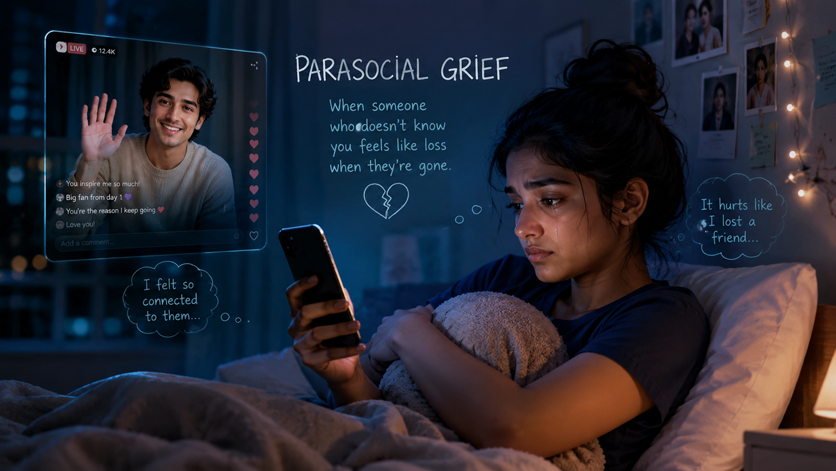
Parasocial Grief: Why Losing a Celebrity or Fictional Character Feels Like Losing a Friend
Introduction: You Didn’t Know Them. So Why Does It Hurt So Much?
Maybe it was when your favorite artist died and you cried for days. Maybe it was when a beloved fictional character was killed off and you felt genuinely bereft. Maybe it was when a YouTuber you’d watched for years stopped making content, and the absence felt surprisingly painful. And maybe you felt embarrassed about all of it.
At Prayatna Mentaverse, we want to offer something different: your grief is real. Your neurological experience of loss is identical to the grief you’d feel for someone you knew personally. Understanding why that’s true — rather than dismissing it — is the beginning of something more compassionate.
What Is a Parasocial Relationship?
The concept was first introduced by sociologists Donald Horton and Richard Wohl in 1956, observing that television audiences developed one-sided emotional bonds with TV personalities. Today, parasocial relationships — emotionally meaningful bonds with people or characters who don’t know you exist — are nearly universal. We form them with celebrities, YouTubers, podcasters, fictional characters, and social media influencers.
These relationships feel real because, in many neurologically meaningful ways, they are.
The Neuroscience: Why Your Brain Can’t Tell the Difference
The human brain’s social processing systems evolved to handle face-to-face relationships. They didn’t evolve for a world where a person’s face, voice, and emotional life can be transmitted to millions of strangers.
- Mirror neurons fire when we observe emotional experiences — when your favorite musician performs with raw vulnerability, your mirror neuron system responds whether they’re in the room or on a screen
- The medial prefrontal cortex (mPFC) activates similarly for people we know personally and people we feel parasocially connected to
- Oxytocin and dopamine are released during parasocial engagement, activating the same reward systems as a genuinely enjoyable interaction with a friend
When the relationship ends — through death, cancellation, or a show ending — the brain experiences something neurologically identical to relationship loss.
When Parasocial Grief Is a Normal Response
Mourning a celebrity death is a legitimate grief experience. Research published in OMEGA – Journal of Death and Dying found that the intensity of parasocial grief correlated with the depth of the parasocial relationship — just as real grief correlates with closeness. Genuine grief responses include shock and disbelief, sadness, difficulty concentrating, a desire to talk about the person, and a period of consuming old content.
The Complicated Grief of Fictional Character Loss
When you mourn a fictional character, you are mourning the narrative relationship you had with them, a version of yourself who was reading or watching, and the meanings you made from their story. A character who helped you understand yourself, survive something, or feel less alone has done something real for you. Their loss is real.
Healthy Ways to Process Parasocial Grief
- Name it without shame — calling your experience grief and treating it accordingly is the first step
- Find community — fan communities in grief are often remarkably healing
- Create something — fan art, writing, and playlist curation are legitimate grief rituals
- Reflect on what the relationship meant to you and what part of yourself it reflected back
When to Seek Support
At Prayatna Mentaverse, we sit with clients through grief that doesn’t fit conventional categories — gently and without judgment. If parasocial grief is significantly affecting your functioning, or you notice that your primary emotional bonds are parasocial, it may be worth exploring with a professional.
You are not embarrassing for grieving someone you never met. You are a human being with a nervous system that evolved to attach. Grieve accordingly.
#ParasocialGrief #CelebrityDeath #ParasocialRelationships #GriefAndLoss #DigitalMentalHealth #PrayatnaMentaverse
Learn More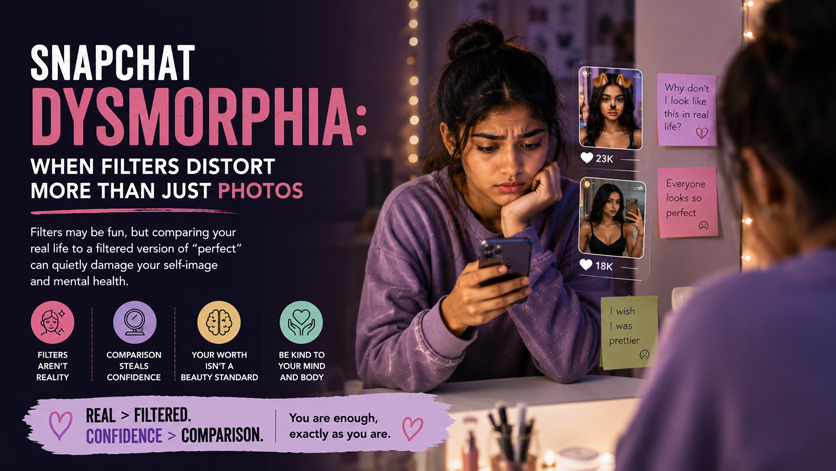
Snapchat Dysmorphia: How AR Filters Are Rewiring How Young People See Themselves
Introduction: The Face You See in the Mirror Isn’t Yours Anymore
There is a face that millions of young people are falling in love with. It has the same general features as their real face — but with softer skin, larger eyes, a slimmer jaw, a smaller nose, and the kind of symmetry that human faces almost never actually have. This face lives in the camera of their phone, constructed in real-time by an AR algorithm. And it’s slowly, fundamentally changing how they feel about their actual reflection.
What Is Snapchat Dysmorphia?
The term was coined by plastic surgeon Dr. Tijion Esho in 2018, after he noticed patients arriving at his clinic not with photos of celebrities they wanted to emulate — but with filtered photos of themselves. They wanted to look like their filtered selfie. In real life.
It exists on a spectrum — from mild preference for filtered images, to moderate avoidance of unfiltered photos, to severe distress and consideration of cosmetic procedures to ‘correct’ the gap.
The Developing Brain: Why This Matters More for Young People
Adolescence is the critical window for body image formation. During this period, the brain is actively constructing a stable self-concept — including a physical self-concept. Neural pruning, heightened social evaluation sensitivity, and extreme responsiveness to peer comparison make this the window where experiences have outsized, long-lasting effects.
If a significant portion of those experiences involve consistently seeing an altered, ‘improved’ version of your face — receiving positive reinforcement through likes and compliments — the brain begins to incorporate this altered image into its body schema. Over time, the actual unfiltered face may begin to feel foreign. Wrong. Like something that needs to be fixed.
The Personalized Impossibility Standard
When a magazine model is unattainably beautiful, there’s a psychological buffer — ‘that’s her, not me.’ When your own face, run through a beauty algorithm, looks like that, the message becomes: ‘This is what I could look like. This is what I should look like.’
The result is a personalized impossibility standard — a beauty benchmark uniquely calibrated to feel tantalizingly close and permanently out of reach. Research published in JAMA Facial Plastic Surgery found that social media filters are specifically associated with body dysmorphic disorder (BDD) symptoms.
New Forms of Body Image Distress
- Filter Withdrawal: Genuine distress when cameras don’t have filters available — at video calls, medical appointments
- Face Editing Compulsion: Spending hours editing photos before posting
- Mirror Avoidance or Overuse: Either avoiding mirrors or obsessively checking ‘problem areas’
- Cosmetic Procedure Requests at Younger Ages: Teenage patients requesting procedures based on filter aesthetics
What Parents Can Do
- Have the conversation explicitly — name what AR filters are doing
- Model unfiltered self-presentation
- Create filter-free family photo zones
- Watch for reluctance to be photographed or disproportionate appearance concerns
When to Seek Professional Help
At Prayatna Mentaverse, we work with young people experiencing body image distress driven by social media comparison and filter use. Consider reaching out if a young person is avoiding social situations due to appearance anxiety, showing interest in cosmetic procedures at a young age, or if appearance concerns are interfering with daily functioning.
Your face, as it actually is, is the face your body came with. No algorithm should be in the business of making you feel like that face isn’t enough.
Learn More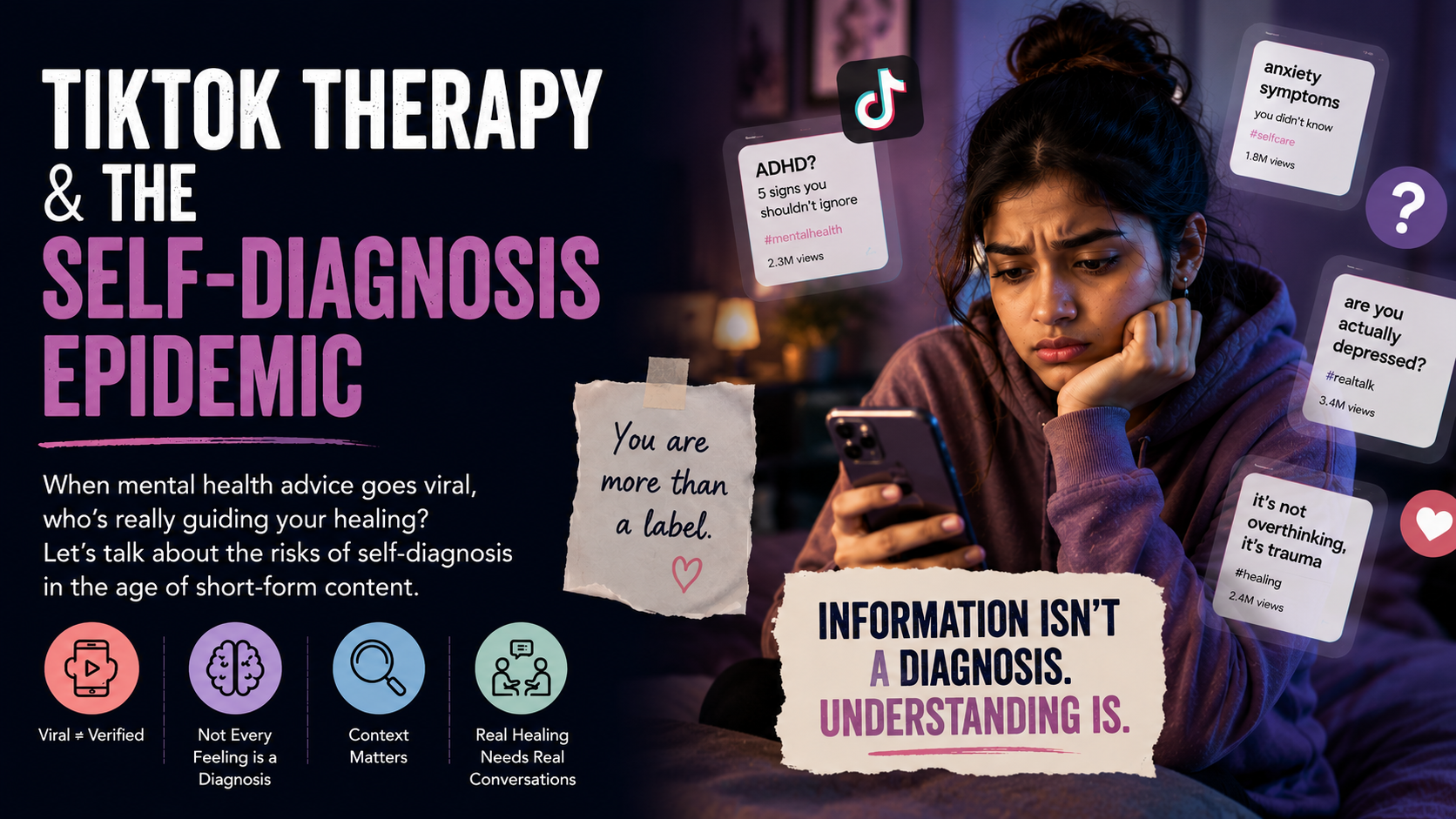
TikTok Therapy & The Self-Diagnosis Epidemic: Finding Your Label vs. Pathologizing Being Human
Introduction: When the Algorithm Becomes Your Therapist
‘Wait — that’s literally me.’ If you’ve ever watched a TikTok explaining ADHD symptoms and felt that electric recognition — the sudden, startling sense that someone finally described something you’ve lived with for years — you know the feeling. Millions of people have found language for their experiences through mental health content on social media.
This is genuinely meaningful. But Prayatna Mentaverse believes this conversation needs more nuance — because between ‘this content saved my life’ and ‘this content convinced me I have 12 disorders,’ there’s a critically important distinction worth understanding.
The Genuine Gift of Mental Health Language
Access to vocabulary is transformative. Many people — especially in communities where mental health is stigmatized — have spent years experiencing distress they couldn’t name. Finding language for what they experience can:
- Reduce shame (‘It’s not just me; this is a recognized experience’)
- Motivate seeking professional support
- Help people communicate their needs to loved ones
- Create community and reduce isolation
Where It Gets Complicated: The Pathologizing Problem
Pathologizing means interpreting normal human experiences through the lens of disorder. Mental health TikTok, for all its gifts, has a significant pathologizing problem. Consider these common framings:
- Forgetting your keys? ‘That’s your ADHD.’
- Feeling sad after a breakup? ‘That’s your anxious attachment.’
- Being introverted? ‘That’s probably autism.’
The challenge: all of these things can also just be… human. When every difficult emotion becomes a symptom and every behavioral tendency becomes a disorder, we lose the ability to tolerate the ordinary discomforts of being alive.
The Diagnostic Criteria Problem
Clinical diagnoses exist on continuums, and the criteria for most conditions involve significant impairment — meaning the symptoms interfere substantially with daily functioning. What social media often presents is a list of relatable experiences stripped of this clinical threshold.
A TikTok might show 10 signs of ADHD, most of which — losing focus sometimes, getting distracted, being disorganized occasionally — are things neurotypical people experience regularly. A licensed clinician goes through severity thresholds, duration requirements, and differential diagnosis. A 60-second video cannot.
The Identity Trap: When the Label Becomes the Self
One of the subtler risks of mental health TikTok is the way diagnostic labels can calcify into identity. When someone builds their entire self-concept around ‘I have ADHD, so I can’t do X,’ labels that were meant to explain can start to constrain. This is particularly significant for adolescents and young adults whose identities are still forming.
What Responsible Consumption Looks Like
- Follow clinicians, not just creators — look for licensed therapists sharing evidence-based content
- Treat it as a starting point, not a destination — let content lead you toward professional evaluation
- Notice the difference between resonance and diagnosis
- Be skeptical of content that pathologizes universally human experiences
When to Seek Professional Support
If you’ve been self-diagnosing online and are genuinely concerned, a professional evaluation is the most caring thing you can do for yourself. At Prayatna Mentaverse, we offer comprehensive mental health assessments and a compassionate approach to these modern challenges.
The goal isn’t a label. The goal is a life that feels livable, connected, and full.
#MentalHealthTikTok #SelfDiagnosis #ADHDTikTok #AnxietyAwareness #GenZMentalHealth #PrayatnaMentaverse
Learn More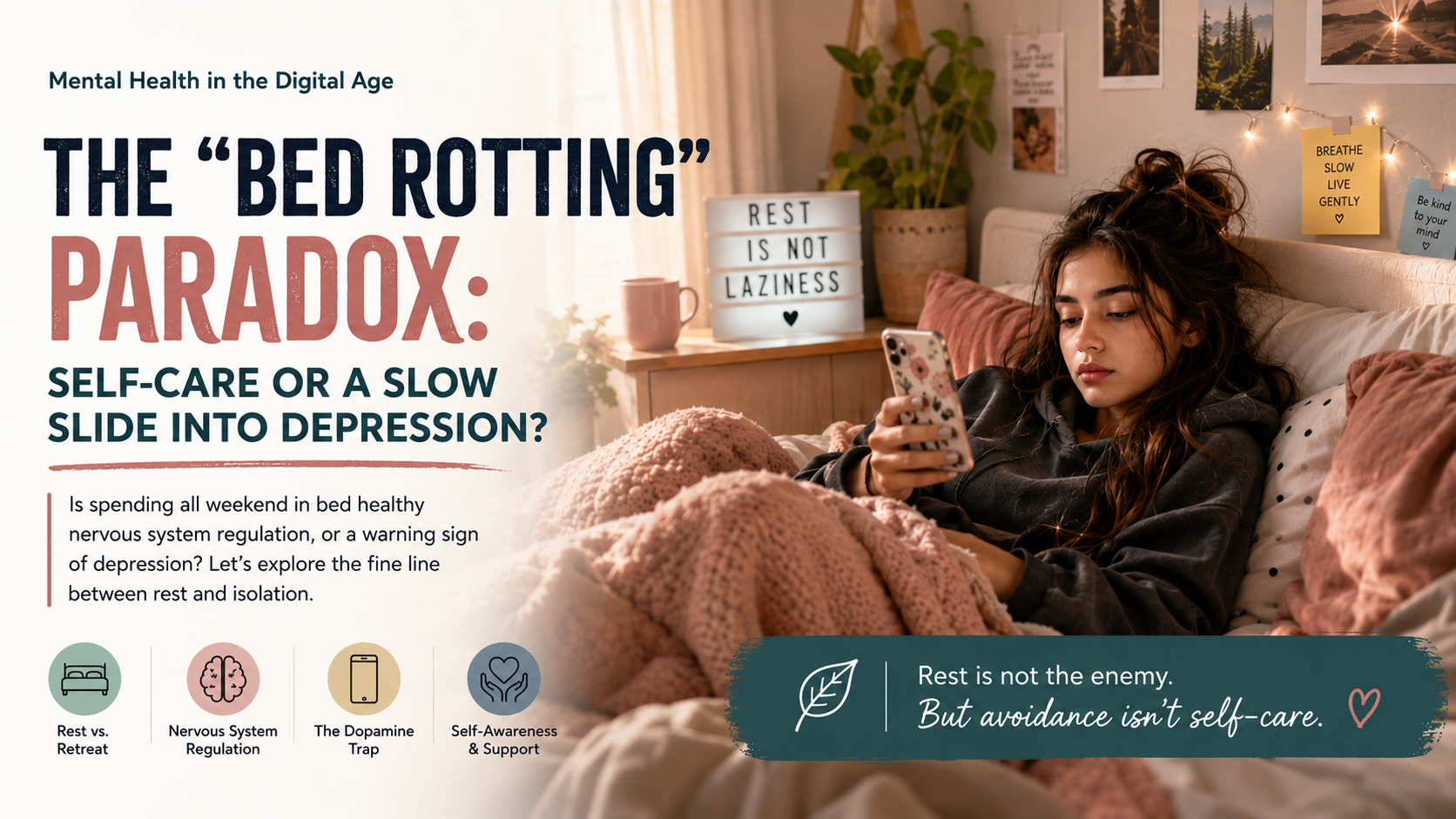
The “Bed Rotting” Paradox: Self-Care or a Slow Slide Into Depression?
When Your Bed Becomes Both Sanctuary and Trap
If you’ve scrolled TikTok in the past year, you’ve likely seen it — someone proudly declaring they spent the entire weekend in bed, unbothered, curtains drawn, doing absolutely nothing. The hashtag #BedRotting has accumulated hundreds of millions of views, and Gen Z has essentially canonized horizontal laziness as a wellness practice.
But here at Prayatna Mentaverse, we believe that between every viral trend and every lived human experience, there’s a conversation worth having. So let’s ask the real question: Is bed rotting a legitimate form of nervous system regulation — or is it a warning sign dressed up as self-care?
What Is ‘Bed Rotting,’ Exactly?
Bed rotting refers to the intentional practice of spending extended periods in bed — often an entire day or weekend — doing low-effort activities like scrolling your phone, watching shows, eating snacks, and sleeping on and off. Unlike traditional rest or sleep recovery, it’s characterized by a deliberate disengagement from productive or social obligations.
Proponents frame it as a radical act of rest in a hustle-obsessed culture. Critics call it avoidance behavior with a wellness rebrand. Both might be right.
The Science Behind Rest: When Doing Nothing Is Actually Something
To understand bed rotting, we first need to understand what genuine nervous system regulation looks like. Our autonomic nervous system operates in two primary modes:
- Sympathetic (fight-or-flight): Activated during stress, deadlines, social demands
- Parasympathetic (rest-and-digest): Activated during safety, calm, and recovery
For people running on chronic stress — and that’s most of us — dropping into parasympathetic mode is genuinely therapeutic. The body needs periods of low stimulation to repair, consolidate memory, regulate cortisol, and restore emotional resources.
Research in polyvagal theory, pioneered by Dr. Stephen Porges, confirms that the nervous system requires real downtime to regulate itself. In this context, a slow, undemanding day in bed is not laziness — it’s biology.
From Prayatna Mentaverse’s perspective: If you’ve had a week of social overwhelm, intense work pressure, or emotional strain, a day of deliberate, guilt-free rest is not just acceptable — it can be genuinely restorative.
When Rest Becomes Retreat: The Warning Signs
Here’s where the paradox deepens. For some people, bed rotting isn’t nervous system regulation — it’s nervous system avoidance. Consider the difference:
Restorative Rest
- You feel refreshed or lighter after
- It’s a choice, not a compulsion
- You re-engage with life relatively easily afterward
- It happens occasionally, typically after depletion
Depressive Withdrawal
- You feel worse, more sluggish, or guilty after
- Getting out of bed feels impossible, not optional
- The isolation is growing, not shrinking
- It’s becoming your default state, not an exception
Depression, particularly in its atypical presentations, often masquerades as fatigue, low motivation, and a desire for solitude. For young people especially, the cultural normalization of ‘not wanting to do anything’ can delay recognition of what’s actually a mood disorder requiring support.
The Dopamine Trap Hidden in the Duvet
There’s another layer to this conversation: what you’re doing in bed matters as much as being in bed. Passive scrolling, doomscrolling, and bingeing content while bed rotting activates the brain’s reward system in short, low-quality bursts. This isn’t the same as genuine rest — it keeps the nervous system slightly activated while preventing meaningful restoration.
Studies on passive social media use consistently link it to lower mood and increased anxiety. So a day of ‘bed rotting + TikTok’ may leave you more depleted than when you started, creating a cycle: you feel more tired, so you stay in bed longer, so you scroll more, so you feel worse.
Ask Yourself These 4 Questions
- Is this rest toward something (recovery, renewal), or rest away from something (life, people, responsibility)?
- Do I feel better or worse after these extended rest periods?
- Has this become my main coping mechanism?
- Am I canceling things I used to look forward to?
When to Reach Out
If bed rotting has shifted from occasional recharge to your primary way of navigating the world, it may be time to speak with a mental health professional. At Prayatna Mentaverse, our counselors specialize in exactly these kinds of nuanced, modern mental health challenges.
- Persistent low mood lasting more than two weeks
- Inability to feel pleasure in things you used to enjoy
- Increasing social withdrawal
- Difficulty meeting basic responsibilities
The goal isn’t productivity at all costs. The goal is a life you can re-enter after you’ve rested.
Learn More
Sustainable Board Prep: Study Hard Without Burning Out (Smart Strategy for Board Exams 2026)
Sustainable Board Prep: Study Hard Without Burning Out (Smart Strategy for Board Exams 2026)
Board exams are not a one-day test.
They are a 90-day mental marathon.
And marathons are not won by sprinting every day.
They are won by building sustainable systems.
If your Board Exam 2026 preparation feels intense but inconsistent — long hours, low retention, rising panic — it’s time to shift from pressure-based studying to strategy-based studying.
This guide will help you prepare effectively without burnout, anxiety, or last-minute panic.
Why Students Burn Out During Board Exam Preparation
Many students believe:
- More hours = more marks
- Less sleep = more success
- Constant studying = better results
But the reality is different.
Burnout happens when:
- Study hours are high but retention is low
- Panic increases despite preparation
- Sleep decreases
- Motivation drops suddenly
Burnout is not laziness.
It is mental exhaustion caused by poor strategy.
Sustainable board prep protects both performance and mental health.
1️⃣ Active Recall vs Passive Reading: The Smart Study Method
Most students prepare by re-reading notes repeatedly.
This creates false confidence.
When you read, your brain recognizes information.
But in exams, you need to retrieve information without seeing it.
Why Passive Reading Increases Exam Anxiety
- You feel productive while reading
- During exams, you cannot recall exact points
- Blank-outs increase panic
- Panic blocks memory access further
This cycle creates unnecessary exam stress.
What Is Active Recall?
Active recall means forcing your brain to retrieve information without looking.
Practical Active Recall Techniques:
✔ Close the book and write everything you remember
✔ Teach the topic aloud as if explaining to a friend
✔ Use flashcards
✔ Solve past year question papers without notes
✔ Practice mock tests under timed conditions
If you can recall it without seeing it, you truly know it.
Active recall improves:
- Memory retention
- Exam confidence
- Speed of writing
- Accuracy
This is one of the most powerful tools for sustainable board preparation.
2️⃣ The “Daily Three” Rule: Study Without Overwhelm
Burnout often comes from unrealistic daily targets.
Instead of saying:
“I will complete 5 chapters today.”
Use the Daily Three Goal System.
How It Works
Every day, set only three clear, achievable goals.
Example:
- Revise Electrostatics formulas
- Solve 20 Maths MCQs
- Write one English long answer
Why the Daily Three Rule Works
- Reduces overwhelm
- Builds consistency
- Creates daily achievement momentum
- Improves focus
- Prevents emotional exhaustion
Small wins daily are more powerful than rare big efforts.
Consistency beats intensity.
3️⃣ Physical Non-Negotiables: Your Brain Needs Biology
You cannot out-study a tired brain.
Board exam preparation is cognitive work.
Cognitive work requires biological support.
💤 Sleep: The Hidden Study Tool
- Memory consolidates during sleep
- Sleep deprivation reduces recall accuracy
- Late-night cramming increases anxiety
- Poor sleep reduces focus the next day
Students who sleep 7+ hours retain better than those who study late and feel exhausted.
Sleep is not wasted time.
It is memory-building time.
💧 Hydration: The Focus Booster
Even mild dehydration:
- Reduces concentration
- Slows processing speed
- Increases fatigue
Water improves alertness and mental clarity.
Think of sleep and hydration as study tools, not luxuries.
Sustainable Study vs Burnout Study
| Burnout Study | Sustainable Study |
|---|---|
| Long random hours | Structured time blocks |
| Passive reading | Active recall |
| No breaks | Planned short breaks |
| Late nights | Consistent sleep |
| Panic-based | Strategy-based |
Sustainable board prep builds:
- Confidence
- Emotional resilience
- Consistency
- Mental clarity
How to Study Like an Athlete
Athletes don’t train intensely every hour.
They follow:
- Structured practice
- Recovery time
- Nutrition
- Hydration
- Mental conditioning
Board exam preparation works the same way.
Study like an athlete.
Recover like an athlete.
Show up on exam day calm and confident.
Final Thought: Burnout Is Not a Badge of Honor
Sustainable board prep is not about studying more.
It is about studying smarter.
It is about protecting your mental energy.
It is about showing up consistently.
Burnout does not increase marks.
Consistency does.
Board exams test knowledge — not exhaustion.
Prepare with clarity.
Protect your mind.
Perform with confidence.

When Should Parents Seek Professional Help for Academic Avoidance?
When Should Parents Seek Professional Help for Academic Avoidance?
“Not every child who avoids studies is being stubborn — sometimes they are silently struggling.”
It is normal for children to occasionally resist homework or lose focus. Every child has off days.
But when academic avoidance becomes consistent, intense, or emotionally charged, it is important for parents to pause and observe more closely.
Understanding the difference between normal resistance and deeper learning or emotional challenges can prevent long-term academic stress.
What Is Academic Avoidance?
Academic avoidance happens when a child:
- Regularly delays homework
- Gets distracted within minutes
- Refuses to sit for studies
- Shows emotional reactions before study time
- Avoids school-related discussions
Occasional resistance is normal.
Persistent avoidance may signal something deeper.
First Measures to Try at Home
Before seeking professional help, parents can start with simple, structured strategies.
Consistency is key. Small changes often make a big difference.
1. Create a Fixed Study Routine
- Choose a realistic daily study time.
- Start with short blocks (20–30 minutes).
- Keep timing consistent every day.
Children feel safer and more cooperative when routines are predictable.
2. Reduce Distractions
- Turn off the TV.
- Keep mobile phones away.
- Set up a calm, clutter-free study corner.
A peaceful environment improves focus and reduces frustration.
3. Break Tasks into Small Steps
Instead of saying, “Finish everything,” try:
- Complete 3 math problems.
- Read one paragraph.
- Write 5 sentences.
Small wins build confidence.
4. Encourage Effort, Not Just Marks
Instead of asking:
“Why did you score less?”
Say:
“I noticed you tried hard today.”
Effort-based praise strengthens motivation and self-esteem.
5. Check Basic Needs
Before blaming behavior, ask:
- Is my child getting enough sleep?
- Are they eating properly?
- Do they have downtime to relax and play?
A tired or overwhelmed child cannot focus effectively.
6. Maintain Calm Communication
Avoid:
- Comparison with siblings or classmates
- Harsh criticism
- Threat-based discipline
Calm communication builds emotional safety. Emotional safety builds cooperation.
Give It Time
Implement these changes consistently for 4–6 weeks.
Many children show improvement when routine, structure, and emotional support are strengthened.
When to Seek Professional Help for Academic Avoidance
If structured home strategies do not bring improvement, or if you notice the following signs, it may be time to consult a child psychologist or learning specialist.
Warning Signs to Watch:
- Extreme anxiety or crying before study time
- Frequent stomach aches or headaches during school
- Inability to focus beyond a few minutes
- Poor memory retention despite repeated practice
- Falling grades despite visible effort
- Low self-esteem (“I am dumb,” “I can’t do anything”)
- Behavioral outbursts specifically linked to homework
These are not signs of laziness.
They may indicate:
- Attention difficulties (ADHD symptoms)
- Learning disorders (Dyslexia, Dyscalculia, Dysgraphia)
- Performance anxiety
- Emotional stress
- School-related anxiety
Early intervention leads to better outcomes.
Why Early Professional Guidance Matters
When academic avoidance is misunderstood, children may:
- Lose confidence
- Develop school anxiety
- Feel labeled as “lazy” or “careless”
- Avoid challenges long-term
Professional assessment provides clarity.
Clarity reduces frustration — for both parents and children.
Counselling and educational assessments can help:
- Identify learning challenges
- Improve attention and focus
- Strengthen emotional regulation
- Build study skills
- Restore confidence
Academic Avoidance Is Communication
When a child avoids studies, they are not rejecting education.
They are communicating:
- “This feels too hard.”
- “I am overwhelmed.”
- “I am scared of failing.”
- “I don’t understand, but I don’t know how to say it.”
Listening before reacting makes all the difference.
Final Takeaway
If structured support at home does not ease academic avoidance, seeking professional help is not a label.
It is clarity.
And clarity turns confusion into understanding — and understanding into progress.
Your child is not stubborn.
They may simply need the right support.

How to Build Study Habits Without Daily Fights: Practical Strategies for Parents
How to Build Study Habits Without Daily Fights: Practical Strategies for Parents
If homework time feels like a daily battlefield, the problem may not be your child — it may be the approach.
Many parents search for solutions to:
- “Why does my child avoid homework?”
- “How do I improve my child’s focus?”
- “Why is study time always a fight?”
The truth is:
Children rarely resist learning — they resist pressure.
Building strong study habits requires structure + emotional safety, not control.
Why Homework Turns Into a Power Struggle
When children delay homework, get distracted quickly, or argue during study time, parents naturally respond by pushing harder.
But pressure often creates:
- Resistance
- Emotional shutdown
- Reduced motivation
- Fear of failure
Instead of improving focus, strict control often increases homework battles.
Step 1: Create a Predictable Study Routine
Children thrive on routine.
Fix a simple, realistic daily study time — even 20 focused minutes is enough to start.
Consistency builds habit faster than long, forced hours.
Practical Tips:
- Same time daily (after snack or play)
- Same study space
- Clear start and end time
Predictability reduces negotiation and increases cooperation.
Step 2: Use the “Small Chunks” Method
Young brains struggle with long, uninterrupted study sessions.
Instead of:
❌ 1 hour continuous sitting
Try:
✅ 15–20 minutes study
✅ 5-minute movement break
✅ Repeat if needed
Planned breaks improve attention span and reduce mid-task arguments.
This method improves:
- Focus problems
- Homework resistance
- Emotional overwhelm
Step 3: Create a Distraction-Free Environment
Focus is environmental before it is mental.
Remove:
- TV noise
- Mobile phones
- Loud conversations
Keep:
- Clean desk
- Basic stationery ready
- Water nearby
A cluttered space creates a cluttered mind.
Step 4: Change Your Tone, Change the Outcome
Your tone influences your child’s nervous system.
Instead of:
❌ “Why are you so careless?”
❌ “How many times do I have to tell you?”
Say:
✅ “Let’s solve this together.”
✅ “What part feels difficult?”
When children feel judged, they shut down.
When they feel supported, they cooperate.
Step 5: Praise Effort, Not Just Results
Encouragement builds internal motivation.
Notice effort:
- “I saw you tried even though it was hard.”
- “You stayed focused for 15 minutes — that’s progress.”
Effort-based praise builds:
- Responsibility
- Confidence
- Growth mindset
Rewards may work short-term.
Recognition builds long-term study discipline.
Step 6: Check Emotional Readiness Before Academic Discipline
A child who is:
- Hungry
- Tired
- Overstimulated
- Emotionally overwhelmed
…cannot focus on studies.
Emotional regulation comes before academic success.
Ask yourself:
- Did they get enough rest?
- Did they eat properly?
- Have they had playtime?
Calm children learn better.
Why Structure Works Better Than Pressure
Building study habits is not about winning power struggles.
It’s about:
- Gradual responsibility
- Emotional safety
- Consistency over intensity
Small, steady steps create long-term discipline.
When to Seek Professional Guidance
Consider counselling support if:
- Homework battles happen daily
- Your child shows extreme avoidance
- There are signs of lack of focus or attention difficulty
- Emotional breakdowns happen during study time
Sometimes, underlying issues like attention challenges, learning difficulties, or emotional stress require expert guidance.
Final Takeaway
Consistency beats anger.
Calm communication beats control.
Small structured steps beat forced discipline.
Strong study habits are built slowly, respectfully, and emotionally safely.
Because the goal isn’t just good grades —
it’s raising responsible, confident learners.

The Calm Before the Boards: A Parent’s Guide to a Stress-Free Exam Week (Board Exams 2026)
The Calm Before the Boards: A Parent’s Guide to a Stress-Free Exam Week (Board Exams 2026)
For Indian parents navigating the final week of Class 10 & 12 Board Exam 2026 preparation
February and March in Indian households often feel like a pressure cooker.
The TV volume drops.
Relatives whisper.
The dining table becomes a study station.
And every conversation ends with, “Kitna syllabus baaki hai?”
Board exams are important — no doubt.
But in the final 7 days of Board Exam 2026 preparation, your role changes.
You are no longer the Chief Academic Officer checking revisions.
You become the Chief Motivation Officer.
Because in the last week, emotional stability matters more than extra chapters.
Let’s understand how to reduce exam stress at home and avoid unnecessary parental pressure during exams.
Understanding the Final Week Psychology
By the final week, most students have:
- Completed major revisions
- Solved sample papers
- Followed a structured Board Exam 2026 preparation plan
At this stage, what they need most is:
- Confidence
- Calmness
- Sleep
- Emotional safety
Not new strategies.
Not panic.
Not comparison.
When stress increases, the brain’s prefrontal cortex (responsible for logic and recall) becomes less efficient. High anxiety reduces memory retrieval during exams.
This is why supporting your child during board exams is less about “more study” and more about “less stress.”
Words That Heal vs Words That Pressure
In the final week, your communication can:
✔ Strengthen confidence
OR
❌ Create silent anxiety
Let’s start with what not to say.
❌ What NOT to Say During Board Exam Week
1. “Sharma ji’s son studies 14 hours.”
Why this increases exam stress:
- Triggers comparison anxiety
- Reduces self-worth
- Shifts focus from self-improvement to competition
Comparison increases pressure, not performance.
2. “Your whole future depends on this paper.”
Why it harms:
- Creates catastrophic thinking
- Activates fear instead of focus
- Makes failure feel life-threatening
No single exam defines a life — but repeated messaging makes the brain believe it does.
3. “If you don’t score above 95%, what will people say?”
Why it harms:
- Links love with marks
- Encourages external validation
- Builds fear of embarrassment
Children start associating acceptance with performance.
4. “Are you sure you revised properly?”
Why it harms:
- Signals doubt
- Creates last-minute panic
- Weakens confidence
In the final week, reassurance is more powerful than interrogation.
✅ What to Say Instead: Positive Phrases for Students
Language reduces cortisol (stress hormone) and builds clarity.
Here’s what works better:
✔ “I’m proud of the effort you’re putting in.”
✔ “One exam cannot define your future.”
✔ “You’ve prepared well. Trust yourself.”
✔ “Focus on doing your best. Marks will follow.”
✔ “Stay calm. Read carefully. We’re with you.”
These phrases promote emotional resilience and exam confidence.
How to Reduce Exam Stress at Home (Without Saying Much)
Sometimes actions speak louder than advice.
1️⃣ Create a Calm Environment
- Keep TV volume low
- Avoid arguments
- Delay stressful discussions
- Limit negative news
A peaceful home lowers background anxiety.
2️⃣ Maintain Routine
- Ensure balanced meals
- Encourage proper sleep (no all-night studying)
- Light evening walks if possible
Sleep improves memory consolidation and recall.
3️⃣ Keep Comfort Ready
- Favorite light snacks
- Warm milk or herbal tea
- Ironed uniform ready
- Exam kit prepared
Small gestures signal emotional support.
4️⃣ Avoid Conflict This Week
This is NOT the week to:
- Discuss discipline
- Bring up old mistakes
- Talk about career pressure
- Compare with cousins
Protect emotional stability.
Your Role in Board Exam 2026 Preparation
In this final stretch:
You are not monitoring every answer.
You are managing:
- Emotional climate
- Confidence levels
- Parental pressure during exams
If your child feels nervous → you stay calm.
If they doubt themselves → you reassure.
If they feel tired → you encourage rest.
Your stability becomes their anchor.
The Big Picture: Beyond the Marksheet
Years from now, your child may not remember:
- Exact marks
- Exact rank
- Exact percentage
But they will remember:
- Whether home felt safe
- Whether they felt supported
- Whether love felt conditional
Children who feel emotionally secure perform better — not just in exams, but in life.
A marksheet is temporary.
Your relationship is permanent.
Quick Dos and Don’ts for Parents (Exam Week Checklist)
✅ DO:
- Use positive phrases for students
- Maintain calm household energy
- Encourage healthy sleep and food
- Offer reassurance daily
- Celebrate effort
❌ DON’T:
- Compare
- Threaten consequences
- Discuss marks publicly
- Bring career pressure now
- Panic more than your child
Final Thoughts: Calm Builds Performance
Board Exam 2026 preparation is intense — but it does not have to be traumatic.
When parents reduce exam stress at home, children perform with clarity instead of fear.
Your calm presence is the greatest gift you can give your child this week.
The marksheet will last a few years.
Your words will last a lifetime.
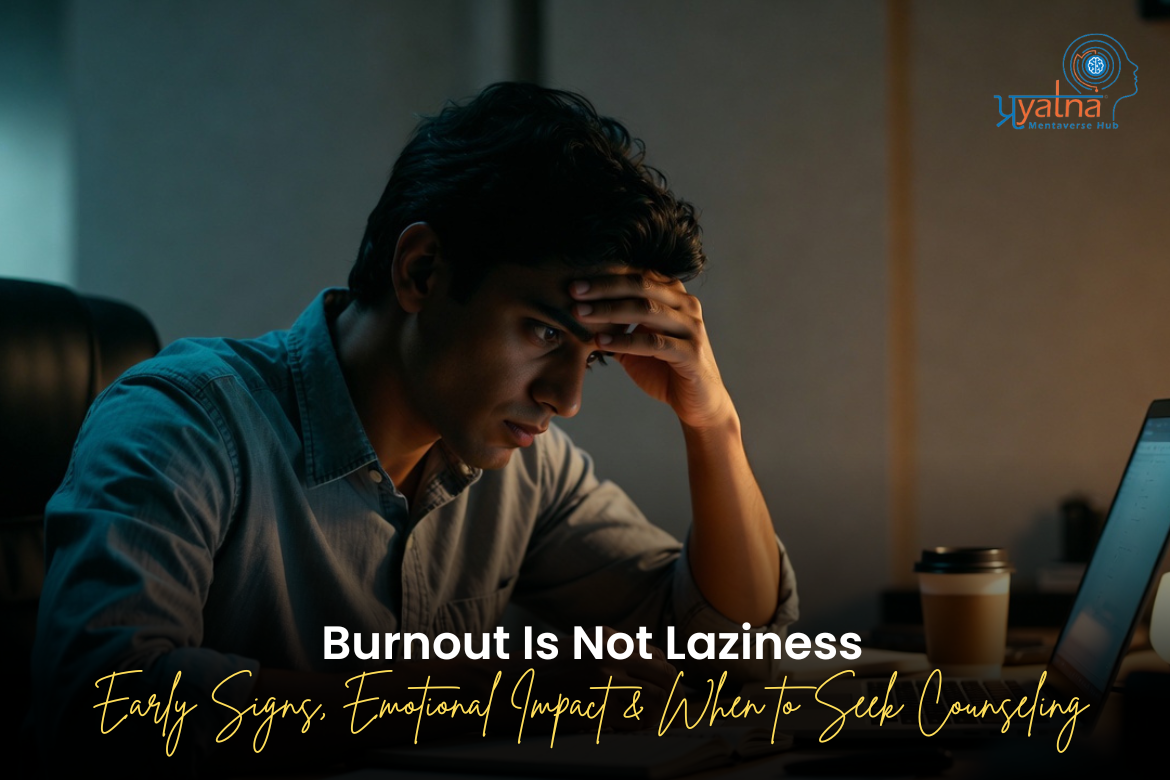
Burnout Is Not Laziness: Early Signs, Emotional Impact & When to Seek Counseling
Burnout Is Not Laziness: Early Signs, Emotional Impact & When to Seek Counseling
In today’s hustle culture, employees are taught to push harder, work longer, and stay productive at all costs.
But what happens when your mind and body can no longer keep up?
Many people mistake burnout for being lazy, unmotivated, or careless.
But burnout is not a lack of discipline — it is a stress response.
👉 Burnout is your body and mind saying:
“I’m overwhelmed, and I need help.”
What Is Burnout?
Burnout is a state of emotional, mental, and physical exhaustion caused by long-term, continuous stress — especially in workplaces where expectations are high and support is low.
It develops gradually and is often ignored until the symptoms become intense.
Unlike temporary tiredness, burnout doesn’t disappear after a weekend break.
Early Signs of Burnout (Often Confused with Laziness)
What it looks like to others vs. what’s actually happening:
| What Others Say | What’s Really Happening |
|---|---|
| “You’re losing motivation.” | You’re mentally exhausted |
| “You don’t care about work anymore.” | You’re emotionally drained |
| “You’re being lazy.” | You’re overwhelmed and depleted |
🚩 Common Early Warning Signs
-
Constant Fatigue & Low Energy
You feel tired even after adequate rest. -
Loss of Motivation
Tasks that once excited you now feel heavy or meaningless. -
Emotional Overload
Increased irritability, sensitivity, or feeling on edge without a clear reason. -
Reduced Performance
You know what needs to be done — but can’t push yourself to start. -
Withdrawal from Work or Family
Social interaction feels draining, so you isolate. -
Physical Symptoms
Headaches, stomach issues, body pain, or frequent illness.
🔍 Key distinction:
If you’re tired because you worked too much — it’s hard work.
If you’re tired even after resting — it’s burnout.
Emotional Impact of Burnout
Burnout doesn’t just affect productivity —
it affects how you see yourself.
You may start asking:
- “Why can’t I function like others?”
- “Why am I losing interest in everything?”
- “Am I failing?”
Internally, burnout can lead to:
- Emotional numbness
- Harsh negative self-talk
- Hopelessness
- Feeling disconnected from life
If left unaddressed, burnout often evolves into anxiety or depression.
Burnout vs Laziness — The Real Difference
Laziness = lack of willingness
Burnout = lack of capacity due to overload
People experiencing burnout want to perform well —
but their emotional and mental resources are already depleted.
This is why pushing harder doesn’t help.
Support does.
Workplace Stress & Employee Mental Health
Burnout is especially common in workplaces with:
- Long working hours
- Constant performance pressure
- Lack of recognition
- Poor work-life balance
That’s why many organisations now invest in Employee Assistance Programs (EAPs).
If you’re looking for EAP services in Ahmedabad, professional counselling can help:
- Reduce workplace stress
- Improve emotional resilience
- Support employee mental health
- Create healthier, sustainable work cultures
When Should You Seek Counseling?
Reach out for professional support if you experience:
- Persistent exhaustion for more than two weeks
- Sudden drop in work performance
- Emotional detachment from work or loved ones
- Difficulty getting out of bed to go to work
- Increasing guilt, self-blame, or hopelessness
How Counseling Helps with Burnout
Counselling doesn’t “push” you to do more —
it helps you recover capacity.
Through therapy, you learn:
- How to set healthy boundaries
- How to regulate emotions
- How to say no without guilt
- How to rebuild work-life balance
- How to regain focus, motivation, and purpose
You Can Recover from Burnout 🌱
Recovery is possible — and it starts with permission to pause.
Rest is not a reward.
Rest is a requirement.
Burnout doesn’t mean you’re weak.
It means you’ve been strong for too long without support.
Need Support?
Whether you are:
- An individual employee struggling with burnout
- Or an organisation looking to improve employee mental health
Prayatna Mentaverse Hub offers professional counselling and EAP services in Ahmedabad, specialising in:
- Workplace stress
- Emotional health
- Corporate mental wellness programs
📍 Prayatna Mentaverse Hub — Best Counseling Services in Ahmedabad
👉 Reach out today. Healing begins with the first conversation.