
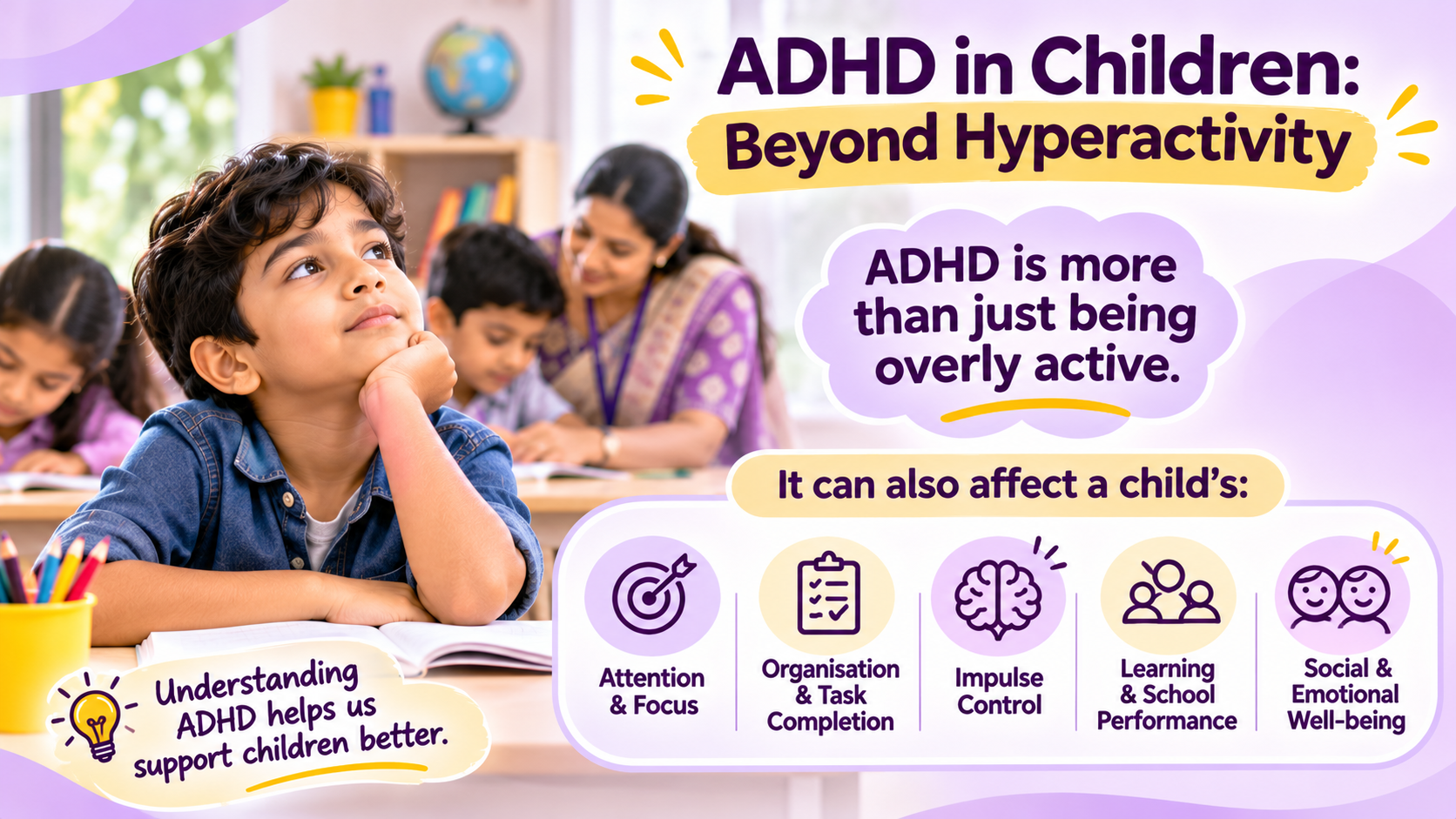
ADHD in Children: Beyond Hyperactivity
When we hear the term ADHD, many people immediately imagine a child who cannot sit still, constantly runs around, talks excessively or finds it difficult to remain quiet.
But is that what ADHD always looks like?
Not necessarily.
Some children with Attention-Deficit/Hyperactivity Disorder (ADHD) may appear extremely active and impulsive. Others may seem quiet, distracted, forgetful or lost in their thoughts. They may struggle to complete homework, follow instructions, organise their belongings or pay attention during conversations.
These children may not always be recognised as having attention-related difficulties because their challenges are less visible.
ADHD in Children is about much more than hyperactivity. It can affect attention, impulse control, organisation, learning, relationships and everyday activities.
Understanding the different ways ADHD can present itself is an important step towards recognising a child’s needs and providing appropriate support.
Let’s explore what ADHD really means, the signs parents should understand and how children can be supported at home, school and through professional guidance.
What Is ADHD in Children?
ADHD stands for Attention-Deficit/Hyperactivity Disorder. It is a neurodevelopmental condition that affects how a person regulates attention, activity levels and impulses.
Children with ADHD may experience difficulties with:
- Maintaining attention during activities.
- Controlling impulses and waiting for their turn.
- Managing activity levels and restlessness.
- Organising tasks and belongings.
- Following instructions and completing activities.
- Managing time and everyday routines.
ADHD symptoms begin during childhood and may continue into adolescence and adulthood. However, the way symptoms appear can change as a child grows and faces different developmental demands.
It is important to understand that ADHD is not simply a result of poor parenting, lack of discipline or a child not trying hard enough.
Children with ADHD may need different strategies, additional support and, in some cases, professional treatment to manage everyday challenges.
Learn more from the Centers for Disease Control and Prevention (CDC) – ADHD in Children.
ADHD Is Not Always About Being Hyperactive
One of the most common misconceptions about ADHD is that every child with the condition is physically restless or constantly moving.
In reality, ADHD can present in different ways. Some children experience more difficulties with attention, while others show more hyperactive and impulsive behaviours. Some experience a combination of both.
Understanding these differences is important because children who are not visibly hyperactive may still experience significant challenges.
The 3 Presentations of ADHD in Children
ADHD is generally described through three presentations, depending on the pattern of symptoms observed.
1. Predominantly Inattentive Presentation
Children with predominantly inattentive ADHD may not appear particularly restless or disruptive. They may often seem quiet, distracted or lost in their thoughts.
Parents and teachers may notice that the child:
- Frequently daydreams or seems to be mentally elsewhere.
- Has difficulty paying attention to details.
- Makes careless mistakes in schoolwork.
- Struggles to follow multi-step instructions.
- Frequently forgets homework, books or belongings.
- Finds it difficult to organise tasks and activities.
- Starts activities but struggles to complete them.
- Gets distracted easily during conversations or classroom lessons.
- Appears not to listen when spoken to directly.
For example, a child may understand a lesson but forget to complete the homework. Another child may spend a long time looking at a worksheet without knowing where to begin.
Because these children may not create visible classroom disruptions, their difficulties can sometimes be overlooked or mistaken for carelessness, lack of interest or low motivation.
However, inattention can affect learning, confidence and everyday functioning.
2. Predominantly Hyperactive-Impulsive Presentation
This presentation is more commonly associated with the behaviours people traditionally connect with ADHD.
Children may have difficulty regulating their activity levels and controlling immediate responses.
Parents and teachers may notice that the child:
- Frequently moves, fidgets or taps their hands and feet.
- Finds it difficult to remain seated when expected.
- Runs, jumps or climbs in situations where it is inappropriate.
- Talks excessively.
- Interrupts conversations or activities.
- Struggles to wait for their turn.
- Answers questions before they are completed.
- Acts quickly without considering possible consequences.
- Finds quiet activities difficult to maintain.
For example, a child may frequently interrupt classroom discussions, struggle to wait during group games or leave their seat repeatedly during lessons.
These behaviours are not necessarily deliberate attempts to disobey adults. They may reflect difficulties with impulse control and activity regulation.
3. Combined Presentation
Some children experience significant symptoms of both inattention and hyperactivity-impulsivity.
This is known as the combined presentation of ADHD.
For example, a child may:
- Frequently lose books and school materials.
- Struggle to complete classroom activities.
- Become distracted during instructions.
- Move around frequently.
- Interrupt others during conversations.
- Find it difficult to wait for their turn.
The combination of these difficulties may affect the child’s participation at home, school and during social activities.
It is important to remember that ADHD presentations are determined through a professional assessment. A child’s behaviour on its own is not enough to identify a particular presentation.
Read more about the different presentations on the CDC’s ADHD Signs and Symptoms page.
What Are the Common Signs of ADHD in Children?
ADHD can affect different aspects of a child’s everyday life. Some signs may be noticed during classroom activities, while others may become more apparent during homework, family interactions or play.
Common signs may include:
Attention and Concentration
- Difficulty sustaining attention during tasks.
- Being easily distracted by surrounding activities.
- Frequently switching between activities.
- Difficulty following conversations or instructions.
Organisation and Task Completion
- Frequently forgetting everyday responsibilities.
- Losing books, stationery or personal belongings.
- Difficulty planning and organising tasks.
- Struggling to complete homework or daily routines.
Activity and Impulse Control
- Frequent fidgeting or restlessness.
- Difficulty waiting patiently.
- Interrupting others.
- Acting before thinking through a situation.
Emotional and Social Experiences
- Becoming frustrated when tasks feel difficult.
- Finding it challenging to manage disappointment.
- Experiencing difficulties during group activities.
- Feeling misunderstood by peers or adults.
- Developing low confidence after repeated negative feedback.
Not every child with ADHD experiences all these difficulties. Their presentation, strengths and support needs can vary.
How ADHD Can Affect a Child’s Everyday Life
ADHD is not limited to classroom behaviour or academic performance. Its effects may be seen across several areas of a child’s life.
1. Academic Challenges
A child may understand a topic but struggle to complete assignments, remember instructions or organise their schoolwork.
They may take longer to finish tasks, forget to submit homework or make mistakes because they miss important details.
These difficulties can sometimes be misunderstood as a lack of effort or interest in studies.
2. Difficulties with Everyday Routines
Activities such as getting ready for school, packing a school bag, organising belongings and completing personal routines involve attention, planning and sequencing.
Children with ADHD may need additional reminders, structured routines or visual support to complete these activities.
3. Social and Peer Relationships
Some children may interrupt conversations, struggle to wait for their turn or find it difficult to follow the rules of group games.
Others may become withdrawn when they repeatedly feel left out or misunderstood.
Supportive guidance can help children develop communication, social interaction and self-regulation skills.
4. Emotional Well-Being and Self-Confidence
Children who frequently hear comments such as “You never listen”, “Why are you so careless?” or “Why can’t you sit quietly?” may begin to believe that something is wrong with them.
Repeated negative feedback can affect their confidence and emotional well-being.
Instead of focusing only on what the child is doing incorrectly, adults can recognise their strengths and help them develop strategies to manage challenges.
Why Is ADHD Sometimes Overlooked in Children?
ADHD does not look the same in every child. Some children may display noticeable hyperactivity, while others may experience difficulties that are less visible.
There are several reasons why ADHD may sometimes go unrecognised.
1. The Child Appears Quiet
Children with predominantly inattentive symptoms may not interrupt classroom activities or display excessive movement. Their difficulties may be mistaken for daydreaming or being naturally quiet.
2. The Child Performs Well Academically
Some children may achieve good academic results but still struggle with organisation, attention, time management or completing everyday tasks.
Good academic performance alone does not rule out ADHD.
3. Difficulties Are Mistaken for Behavioural Problems
Frequent interruptions, incomplete work or difficulty following instructions may be interpreted as disobedience or a lack of discipline.
Understanding the possible reasons behind these behaviours is important.
4. Symptoms Become More Noticeable as Demands Increase
As children progress through school, they may face greater expectations involving independent work, organisation, planning and time management.
Some difficulties may become more apparent when these demands increase.
What Causes ADHD in Children?
The exact causes of ADHD are not fully understood. Research suggests that genetics play an important role, along with other biological and environmental factors that may influence development.
Some important points to understand include:
- ADHD can run in families.
- It is associated with differences in brain development and functioning.
- Several factors may influence the likelihood of developing ADHD.
- ADHD is not caused simply by poor parenting, excessive screen time or a lack of discipline.
Parents should avoid blaming themselves or their child. Understanding ADHD as a neurodevelopmental condition can help families focus on appropriate assessment and support.
For further information, visit the CDC’s overview of ADHD.
How Is ADHD Diagnosed in Children?
Recognising possible signs is an important first step, but observing a few behaviours does not automatically mean that a child has ADHD.
Children may occasionally become distracted, restless or forgetful. These behaviours can also occur due to sleep difficulties, anxiety, learning challenges, stress or other developmental factors.
ADHD diagnosis involves a comprehensive assessment by an appropriately qualified healthcare professional with expertise in evaluating ADHD.
What Does an ADHD Assessment Involve?
The assessment may include:
- A detailed developmental and medical history.
- Information about the child’s behaviour at home and school.
- Observations and reports from parents, teachers and caregivers.
- Standardised rating scales where appropriate.
- Assessment of attention, activity levels and impulse control.
- Consideration of other conditions that may cause similar difficulties or occur alongside ADHD.
ADHD symptoms generally need to be persistent, inappropriate for the child’s developmental level, present in more than one setting and associated with meaningful difficulties in everyday functioning.
There is no single test that can independently confirm ADHD. A qualified professional considers the overall developmental and clinical picture.
If you have concerns, consult a paediatrician, child psychiatrist or another appropriately qualified professional for guidance.
Learn more through the CDC’s guide to diagnosing ADHD.
How Can Parents Support a Child with ADHD?
Parents play an important role in helping children manage everyday challenges and develop confidence.
Instead of focusing only on correcting behaviour, it is helpful to understand what the child finds difficult and provide practical support.
1. Create Predictable Daily Routines
Children may benefit from predictable routines for waking up, getting ready, studying, playing and sleeping.
Visual schedules and simple reminders can help children understand what comes next.
2. Break Large Tasks into Smaller Steps
Instead of giving several instructions at once, break activities into smaller and manageable steps.
For example, rather than saying “Get ready for school”, guide the child through individual steps such as brushing teeth, changing clothes and packing their bag.
3. Use Positive Reinforcement
Recognise effort, progress and positive behaviours.
Encouragement can help children feel motivated and develop confidence in their abilities.
4. Reduce Unnecessary Distractions
When your child is completing homework or another focused activity, try to create a comfortable environment with fewer distractions.
5. Encourage Physical Activity
Age-appropriate physical activity can support overall health and well-being. Encourage activities your child enjoys, such as cycling, dancing, swimming or outdoor games.
6. Maintain Healthy Sleep and Eating Routines
Consistent sleep schedules and balanced meals support children’s general health and daily functioning.
7. Communicate with Teachers and Professionals
Share relevant observations with teachers and healthcare professionals. Working together can help identify strategies that support the child’s needs across home and school.
How Schools and Teachers Can Support Children with ADHD
School is an important environment where children learn, interact and develop social skills. Teachers can play a valuable role in supporting children with ADHD.
Depending on the child’s needs, useful classroom strategies may include:
- Giving clear and concise instructions.
- Breaking longer assignments into smaller tasks.
- Using visual reminders and structured routines.
- Providing appropriate movement breaks.
- Reducing unnecessary classroom distractions where possible.
- Offering additional time or organisational support when appropriate.
- Recognising effort and progress instead of focusing only on mistakes.
- Maintaining communication with parents and relevant professionals.
Teachers should also avoid labelling children as lazy, careless or disruptive. Understanding individual needs can help create a more supportive classroom environment.
Explore the CDC’s ADHD resources for schools and educators for additional information.
What Professional Support Is Available for Children with ADHD?
ADHD support is individualised. The right approach depends on the child’s age, symptoms, developmental needs, coexisting conditions and everyday challenges.
Depending on the assessment and recommendations of qualified professionals, support may involve different interventions.
1. Behavioural Therapy and Parent Training
Behavioural approaches can help children develop self-regulation, coping and everyday skills.
Parent training can also help caregivers understand how to use positive reinforcement, consistent routines and practical strategies to support their child.
2. Occupational Therapy
Occupational therapy may support children who experience difficulties with everyday functional activities, organisation, self-care, coordination or sensory experiences.
Intervention goals are based on the child’s individual assessment and participation needs.
3. Remedial Education and Learning Support
Some children with ADHD may also experience learning difficulties. Remedial education can help address specific academic challenges and strengthen foundational learning skills.
Support may include structured learning activities, task breakdown, repetition and individualised teaching strategies.
4. Counselling and Emotional Support
Children with ADHD may sometimes experience frustration, low confidence, social challenges or emotional difficulties.
Appropriate counselling or psychological support can help address emotional well-being and develop suitable coping strategies.
5. Medication When Clinically Appropriate
Medication may be recommended for some children with ADHD as part of an individualised treatment plan.
Decisions about medication should always be made by an appropriately qualified medical professional after considering the child’s needs, age, symptoms and overall health.
Parents should not start, stop or change medication without professional medical guidance.
For further information about treatment approaches, visit the CDC’s ADHD Treatment Guide.
ADHD Is Not a Lack of Intelligence or Potential
One of the most important things parents and educators should remember is that ADHD does not define a child’s intelligence, personality or potential.
Children with ADHD have individual strengths, interests, abilities and ways of approaching the world.
Some may be creative thinkers, curious learners, enthusiastic problem-solvers or passionate about activities that interest them.
They may also experience genuine challenges with attention, organisation, impulse control or everyday routines.
Recognising both strengths and difficulties helps adults provide balanced support.
Instead of comparing a child with others, focus on understanding their individual needs, celebrating progress and helping them develop strategies that work for them.
When Should Parents Seek Professional Guidance?
Consider speaking with a qualified healthcare professional if your child consistently experiences difficulties such as:
- Struggling to pay attention during age-appropriate activities.
- Frequently forgetting instructions or everyday responsibilities.
- Finding it difficult to complete schoolwork or daily tasks.
- Displaying persistent restlessness or impulsive behaviour.
- Experiencing difficulties with friendships or group activities.
- Having challenges with organisation and routines.
- Showing difficulties that affect participation at home and school.
These signs do not automatically mean that a child has ADHD. They indicate that it may be helpful to understand what is contributing to the difficulties.
Seeking guidance can help families explore appropriate assessment and support options.
How Prayatna Mentaverse Can Support Your Child’s Development
At Prayatna Mentaverse, we believe that every child deserves to be understood, supported and encouraged to reach their individual potential.
Understanding a child’s developmental needs is an important step towards providing appropriate support.
Depending on the child’s individual requirements, support may involve:
- Occupational Therapy.
- Speech and Language Therapy.
- Behavioural Therapy.
- Remedial Education.
- Counselling and developmental support.
For children experiencing attention, learning, behavioural or developmental challenges, a coordinated approach involving parents, educators and relevant professionals can help create more consistent support.
We encourage parents to seek professional guidance when they have concerns about their child’s attention, behaviour, learning or everyday functioning.
Remember, a child does not need to be constantly hyperactive to experience ADHD-related difficulties. Sometimes, the child who appears quiet, distracted or forgetful may also need understanding and support.
Connect with Prayatna Mentaverse to explore the support that may be appropriate for your child’s developmental journey.
Every Mind Deserves Care.
Frequently Asked Questions (FAQs)
1. Can a child have ADHD without being hyperactive?
Yes. Some children have predominantly inattentive ADHD. They may appear quiet, distracted or forgetful rather than physically restless. They can still experience significant difficulties with attention, organisation and task completion.
2. What are the three types of ADHD in children?
ADHD is described through three presentations: predominantly inattentive, predominantly hyperactive-impulsive and combined presentation. The presentation depends on the pattern of symptoms identified during a professional assessment.
3. At what age can ADHD be identified in children?
ADHD symptoms begin during childhood. Assessment may be considered when persistent attention, hyperactivity or impulsivity difficulties affect a child’s functioning. A qualified professional determines whether the diagnostic criteria are met.
4. Is ADHD caused by poor parenting?
No. ADHD is a neurodevelopmental condition and is not simply caused by poor parenting or a lack of discipline. Genetics and other developmental factors are believed to play a role.
5. Can children with ADHD perform well academically?
Yes. Some children with ADHD perform well academically but may still experience challenges with attention, organisation, time management, homework completion or classroom participation.
6. How can parents help a child with ADHD at home?
Parents can provide predictable routines, break tasks into smaller steps, use visual reminders, encourage healthy habits and recognise the child’s efforts. Professional guidance can help families choose strategies suited to their child’s needs.
7. Does every child with ADHD need medication?
No. Treatment is individualised. Depending on the child’s age, symptoms and needs, support may involve behavioural interventions, parent training, school-based strategies and medication when clinically appropriate. Treatment decisions should be made with qualified healthcare professionals.
8. Can occupational therapy help children with ADHD?
Occupational therapy may support children with ADHD when they experience difficulties with everyday functional activities, organisation, self-care, coordination or sensory experiences. The need for therapy and its goals should be determined through an individual assessment.
9. Is ADHD the same as a learning disability?
No. ADHD and specific learning disorders are different conditions, although they can occur together. A child with ADHD may also experience difficulties with reading, writing or mathematics, which may require separate assessment and support.
10. When should parents consult a professional about ADHD?
Parents should consider seeking professional guidance when attention, activity or impulse-control difficulties are persistent and affect the child’s learning, relationships or everyday functioning across different settings.
Disclaimer
This article is intended for general educational purposes only. It does not replace professional assessment, diagnosis or individualised medical advice. ADHD can only be diagnosed by an appropriately qualified healthcare professional following a comprehensive assessment. Treatment and support should be planned according to the child’s individual needs.