Dyslexia, Dysgraphia and Dyscalculia: Understanding Learning Difficulties in Children
Every child learns differently. While some children pick up reading, writing and mathematical concepts with ease, others may need more time, practice and individualised support. A child may understand a lesson perfectly when it is explained verbally but struggle to read the same information, write it down or solve a basic mathematical problem.
When these difficulties persist despite appropriate teaching and practice, they may be associated with specific learning difficulties such as dyslexia, dysgraphia and dyscalculia.
These learning differences can affect how children process written language, express their thoughts through writing and understand numbers. They are not signs of laziness, low intelligence or a lack of effort. With appropriate identification, specialised teaching strategies and a supportive environment, children can develop effective ways to learn and participate confidently.
In this guide, we explore what dyslexia, dysgraphia and dyscalculia mean, their common signs, how they differ, when parents should seek guidance and how children can be supported at home and school.
What Are Dyslexia, Dysgraphia and Dyscalculia?
Dyslexia, dysgraphia and dyscalculia are terms used to describe persistent difficulties in specific areas of learning.
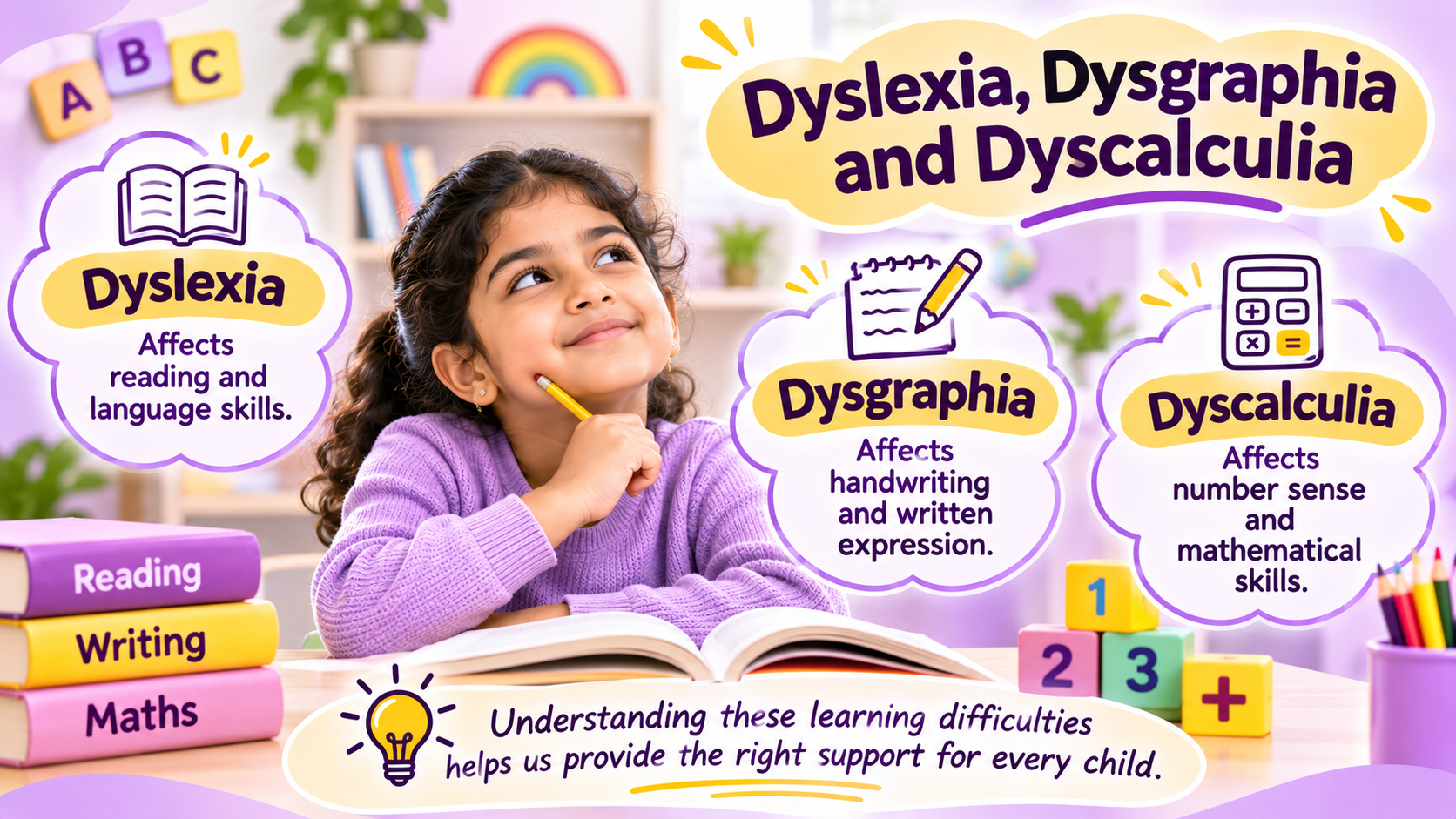
- Dyslexia: Primarily affects reading-related skills, including word recognition, decoding, reading fluency and spelling.
- Dysgraphia: Affects written expression and may involve handwriting, spelling, written organisation and the ability to put thoughts into written words.
- Dyscalculia: Affects mathematical learning, including number sense, understanding quantities, calculations and mathematical reasoning.
In clinical settings, these difficulties may be assessed under the broader category of Specific Learning Disorder (SLD), with the area of impairment specified as reading, written expression or mathematics.
It is important to understand that these difficulties do not reflect a child’s overall intelligence. A child may have strong creativity, problem-solving abilities, communication skills or other talents while experiencing challenges in one or more academic areas.
1. What Is Dyslexia?
Dyslexia is a learning difficulty that primarily affects reading and language-related skills. Children with dyslexia may find it challenging to connect letters with their corresponding sounds, recognise familiar words, decode unfamiliar words or read fluently.
Reading may require considerable effort and time. A child might understand a story when someone reads it aloud but struggle to read the same story independently.
Common Signs of Dyslexia in Children
Signs can vary depending on a child’s age, language exposure and learning experiences. Some common indicators include:
- Difficulty recognising letters and connecting them with their sounds.
- Struggling to sound out unfamiliar words.
- Reading slowly or hesitantly, even after regular practice.
- Frequently confusing similar-looking or similar-sounding words.
- Difficulty remembering spellings of familiar words.
- Finding it challenging to read aloud with fluency.
- Difficulty identifying rhyming words or breaking words into sounds.
- Avoiding activities that involve reading or spelling.
- Needing more time to understand written instructions.
Some children may also experience difficulty with written expression, vocabulary retrieval or remembering sequences. However, these experiences are not unique to dyslexia and should be understood in the context of the child’s overall learning profile.
How Can Dyslexia Affect Everyday Learning?
Reading is involved in almost every school subject. When a child finds reading difficult, it may affect more than language lessons.
- Understanding questions in examinations.
- Reading instructions independently.
- Completing written assignments within the expected time.
- Learning new vocabulary and spelling patterns.
- Reading textbooks and study material.
- Developing confidence in classroom participation.
A child may know the correct answer but struggle to demonstrate that knowledge through reading-based activities. This is why it is important to look beyond marks and academic performance alone.
2. What Is Dysgraphia?
Dysgraphia is a learning difficulty that affects handwriting and/or written expression. Children may find it challenging to form letters, organise their thoughts on paper, spell words accurately or write at a speed that allows them to keep up with classroom activities.
Writing involves several skills working together, including language processing, spelling, planning, organisation, fine motor coordination and the ability to translate thoughts into written words.
For a child experiencing dysgraphia, writing can require so much effort that it becomes difficult to focus on the actual content of the assignment.
Common Signs of Dysgraphia in Children
Some possible signs include:
- Handwriting that is difficult to read or inconsistent.
- Irregular spacing between letters and words.
- Difficulty maintaining letter size, shape or alignment.
- Taking significantly longer to complete written tasks.
- Difficulty copying information from the board.
- Frequent spelling, punctuation or grammar errors.
- Difficulty organising thoughts into sentences and paragraphs.
- Discomfort, fatigue or frustration during writing activities.
- Avoiding drawing, writing or other paper-based tasks.
- Difficulty completing written work despite understanding the subject.
Not every child with messy handwriting has dysgraphia. Handwriting difficulties can have different causes, and a professional assessment may be needed to understand what is contributing to them.
How Can Dysgraphia Affect Everyday Learning?
Writing is a major part of school life. Children experiencing difficulties with written expression may face challenges such as:
- Completing classwork and homework on time.
- Taking notes during lessons.
- Writing answers in examinations.
- Expressing ideas in essays and paragraphs.
- Copying notes, diagrams and assignments.
- Keeping written work organised.
Sometimes, a child’s written work may not reflect their actual understanding of a subject. Providing alternative ways to demonstrate learning can help educators recognise the child’s abilities more accurately.
3. What Is Dyscalculia?
Dyscalculia is a learning difficulty that affects the understanding and use of numbers and mathematical concepts. Children may struggle to understand quantities, recognise number relationships, remember arithmetic facts or apply mathematical reasoning.
For some children, even basic mathematical concepts that seem straightforward to their peers may require repeated explanation and practical examples.
Common Signs of Dyscalculia in Children
Some possible indicators include:
- Difficulty recognising numbers or understanding their values.
- Struggling to compare quantities, such as more, less, bigger or smaller.
- Difficulty remembering basic addition, subtraction, multiplication or division facts.
- Confusing mathematical symbols such as plus, minus and multiplication.
- Difficulty understanding place value.
- Struggling to follow the steps involved in solving mathematical problems.
- Difficulty understanding fractions, measurements or number sequences.
- Finding it challenging to estimate quantities or calculate mentally.
- Difficulty understanding time, money or numerical information in everyday situations.
- Feeling anxious or frustrated during mathematics activities.
How Can Dyscalculia Affect Everyday Learning?
Mathematical understanding is used in many everyday activities. A child experiencing difficulties with number concepts may find it challenging to:
- Understand mathematical instructions and word problems.
- Calculate totals or make simple comparisons.
- Understand time, calendars and schedules.
- Work with measurements and quantities.
- Remember mathematical procedures.
- Apply mathematical concepts to real-life situations.
These difficulties can vary considerably from child to child. Some children may struggle with number sense but perform better in other areas of mathematics.
Understanding the Difference Between Dyslexia, Dysgraphia and Dyscalculia
Although these three learning difficulties may overlap, they primarily affect different academic skill areas.
| Learning Difficulty | Primary Area Affected | Common Challenges |
|---|---|---|
| Dyslexia | Reading and language-related skills | Word recognition, decoding, reading fluency and spelling |
| Dysgraphia | Writing and written expression | Handwriting, spelling, organising thoughts and written output |
| Dyscalculia | Mathematical learning | Number sense, calculations, quantities and mathematical reasoning |
A child may experience one of these difficulties independently or have overlapping learning challenges. For example, a child may experience both dyslexia and dysgraphia. A comprehensive assessment helps identify the specific areas in which the child needs support.
Can a Child Have Dyslexia, Dysgraphia and Dyscalculia Together?
Yes. Some children experience difficulties across more than one academic area. For example, a child may struggle with reading and spelling while also finding written expression challenging. Another child may have difficulties with reading as well as mathematical reasoning.
Specific learning difficulties can also occur alongside other developmental or attention-related conditions. However, the presence of one difficulty does not automatically mean that a child has another.
This is why it is important not to make assumptions based on a single behaviour, school report or academic result. Each child’s learning profile should be considered individually.
What Causes Dyslexia, Dysgraphia and Dyscalculia?
Specific learning difficulties are associated with differences in how the brain processes particular types of information. They are neurodevelopmental in nature and are not caused simply by poor parenting, laziness or a lack of intelligence.
Genetic and developmental factors may contribute to a child’s learning profile. Learning difficulties can also be influenced by a combination of individual and environmental factors.
It is important to distinguish a persistent learning difficulty from challenges caused by insufficient learning opportunities, interrupted schooling, language differences, hearing or vision concerns, or other factors that may affect academic progress.
A qualified professional considers these possibilities during assessment rather than assuming that every child who struggles academically has a specific learning disorder.
When Should Parents Consider an Assessment?
Children develop academic skills at different rates. Occasional spelling mistakes, difficulty with a new mathematical concept or messy handwriting do not automatically indicate a learning disorder.
However, parents may consider seeking professional guidance when a child consistently experiences difficulties such as:
- Struggling with reading, writing or mathematics over an extended period.
- Making limited progress despite appropriate teaching and additional practice.
- Finding age-appropriate academic tasks unusually difficult.
- Taking significantly longer than expected to complete schoolwork.
- Showing persistent frustration, avoidance or anxiety around learning.
- Having difficulty demonstrating knowledge despite understanding concepts verbally.
- Experiencing a noticeable impact on school performance or everyday activities.
Early identification can help children receive suitable teaching approaches and support before repeated learning difficulties affect their confidence and motivation.
How Are Dyslexia, Dysgraphia and Dyscalculia Identified?
There is no single observation or informal checklist that can confirm a specific learning disorder. Identification usually involves a comprehensive evaluation of a child’s developmental history, educational experiences, academic skills and individual strengths and challenges.
Depending on the child’s needs and the assessment process, professionals may consider:
- Developmental history: Early milestones, language development and family history.
- Educational history: School progress, teaching opportunities and previous interventions.
- Reading assessment: Word recognition, decoding, spelling, reading accuracy and fluency.
- Writing assessment: Handwriting, spelling, grammar, sentence construction and written expression.
- Mathematical assessment: Number sense, calculations, mathematical concepts and reasoning.
- Other relevant assessments: Language, attention, cognitive abilities, vision or hearing, where appropriate.
Educational psychologists, clinical psychologists, qualified specialists and other relevant professionals may contribute to the assessment depending on the child’s needs and local professional scope of practice.
Parents should discuss concerns with the child’s school and seek guidance from an appropriately qualified professional. The purpose of assessment is not simply to assign a label, but to understand how the child learns and what support may be helpful.
How Can Parents Support a Child with Learning Difficulties?
Parents play an important role in helping children develop confidence and positive learning experiences. A supportive home environment can make everyday learning less stressful.
1. Understand Your Child’s Individual Learning Needs
Observe which activities your child enjoys, where they experience difficulty and what kinds of explanations help them understand concepts. Avoid comparing their progress with siblings or classmates.
2. Break Learning into Smaller Steps
Large tasks can feel overwhelming. Divide reading, writing and mathematics activities into smaller, achievable steps. Give children time to understand and practise each step before moving forward.
3. Use Multisensory Learning Activities
Combine visual, auditory and hands-on learning experiences wherever appropriate.
- Use letter cards, sounds and word-building activities for reading.
- Practise letter formation using different writing surfaces and materials.
- Use objects, counters, blocks and number lines to explain mathematical concepts.
These approaches can make abstract concepts easier to explore. They should complement structured, evidence-informed teaching rather than replace it.
4. Encourage Practice Without Pressure
Regular practice can help children strengthen skills, but excessive repetition, criticism or pressure may increase frustration. Keep activities manageable, engaging and appropriate to the child’s learning level.
5. Celebrate Effort and Progress
Recognise small achievements, such as reading a new word, completing a sentence independently or understanding a mathematical concept. Positive encouragement helps children recognise their progress.
6. Communicate with Teachers
Maintain regular communication with your child’s teachers. Share observations from home and discuss classroom strategies, learning goals and adjustments that may help your child participate more comfortably.
7. Protect Your Child’s Confidence
Avoid calling a child careless, slow, lazy or weak because of academic difficulties. Explain that people learn in different ways and that asking for support is a positive step.
What Support and Interventions Can Help?
Support should be based on the child’s individual assessment and learning needs. A combination of specialised teaching, classroom adjustments and relevant developmental support may be recommended.
Remedial Education and Specialised Learning Support
Remedial education focuses on strengthening specific academic skills through structured, individualised teaching.
Depending on the child’s learning profile, support may include:
- Phonological awareness, letter-sound relationships and structured reading instruction.
- Word recognition, decoding, reading fluency and spelling practice.
- Handwriting, letter formation and written expression activities.
- Sentence construction, planning and organising written ideas.
- Number recognition, number sense and mathematical concepts.
- Step-by-step calculation and mathematical reasoning strategies.
The teaching approach, pace and learning materials should be adapted to the child’s strengths and areas of difficulty.
Occupational Therapy
Occupational Therapy may be helpful when a child has functional difficulties related to fine motor skills, pencil control, visual-motor integration, posture or the coordination needed for everyday school tasks.
An occupational therapist can assess relevant functional skills and suggest appropriate activities, strategies or tools. Occupational Therapy is not a replacement for specialised reading or mathematics instruction.
Speech and Language Therapy
Some children may also have language-related difficulties that affect understanding instructions, vocabulary, phonological awareness or expressing ideas. When these needs are identified, a speech and language therapist may support relevant communication and language skills.
Counselling and Emotional Support
Repeated academic struggles can sometimes affect a child’s confidence, motivation and emotional well-being. Counselling may help children develop coping strategies, manage frustration and build a healthier relationship with learning.
Parents may also benefit from guidance on supporting their child’s emotional needs at home.
How Can Schools Support Children with Specific Learning Difficulties?
Schools play an important role in creating learning environments where children with different learning needs can participate and demonstrate their abilities.
Depending on the child’s assessment and educational requirements, helpful adjustments may include:
- Providing additional time for reading, writing or mathematics tasks.
- Giving clear, simple and step-by-step instructions.
- Using visual aids, diagrams and practical demonstrations.
- Breaking longer assignments into smaller sections.
- Providing printed notes or structured worksheets where appropriate.
- Allowing suitable assistive technology, such as text-to-speech or speech-to-text tools.
- Offering alternative ways to demonstrate understanding when appropriate.
- Maintaining regular communication between parents, teachers and relevant professionals.
These adjustments should be based on the child’s needs and coordinated with the school. The objective is to reduce unnecessary barriers while continuing to support skill development.
Common Myths About Dyslexia, Dysgraphia and Dyscalculia
Myth 1: Children with learning difficulties are not intelligent.
Fact: Specific learning difficulties do not determine a child’s overall intelligence. Children have different strengths and abilities, and academic challenges do not define their potential.
Myth 2: Children will automatically outgrow these difficulties.
Fact: Persistent learning difficulties may continue without appropriate support. Early identification, specialised instruction and suitable strategies can help children develop important skills.
Myth 3: Dyslexia is only about reversing letters.
Fact: Dyslexia primarily involves difficulties with reading-related processes such as decoding, word recognition and reading fluency. Letter reversals alone do not establish dyslexia.
Myth 4: Dysgraphia only means bad handwriting.
Fact: Dysgraphia can involve handwriting as well as spelling, written expression and organising thoughts on paper. The difficulties may vary between children.
Myth 5: Dyscalculia means a child is simply weak in mathematics.
Fact: Dyscalculia involves persistent difficulties with mathematical learning, such as number sense, calculations or mathematical reasoning. A child struggling with mathematics for other reasons does not automatically have dyscalculia.
Myth 6: More homework and repeated practice will solve every learning difficulty.
Fact: Practice is useful when it is appropriate and structured. Children may need specific teaching methods, individualised support and reasonable adjustments rather than simply more work.
How Prayatna Mentaverse Supports Children’s Learning and Development
At Prayatna Mentaverse, we believe every child deserves to be understood, encouraged and supported according to their individual needs.
Learning difficulties can affect more than academic performance. They may also influence a child’s confidence, motivation, classroom participation and emotional well-being.
Our child-focused services include support through areas such as:
- Remedial Education: Supporting the development of foundational reading, writing and mathematical skills through individualised learning strategies.
- Occupational Therapy: Supporting relevant fine motor, coordination and functional skills where these are affecting everyday activities.
- Speech and Language Therapy: Supporting communication and language development when needed.
- Counselling: Supporting children’s emotional well-being and helping parents navigate developmental and learning-related concerns.
The appropriate support plan depends on the child’s individual assessment and goals. Not every child needs every service, and progress should be understood in terms of meaningful individual milestones rather than comparison with others.
If you have concerns about your child’s reading, writing or mathematical development, seeking guidance can be a valuable first step.
Learn more about our child development and support services.
Visit Prayatna Mentaverse to learn more about our approach to child development and family support.
Frequently Asked Questions (FAQs)
1. What is the main difference between dyslexia, dysgraphia and dyscalculia?
Dyslexia primarily affects reading-related skills, dysgraphia affects handwriting and written expression, and dyscalculia affects mathematical learning and number-related skills. They may occur individually or together.
2. Can a child have dyslexia and dysgraphia at the same time?
Yes. Some children experience overlapping learning difficulties. A comprehensive assessment can help identify the areas affected and guide appropriate support.
3. Are dyslexia, dysgraphia and dyscalculia signs of low intelligence?
No. These are specific learning difficulties and do not, by themselves, indicate low intelligence. A child may have many strengths while experiencing challenges in particular academic areas.
4. At what age can learning difficulties be identified?
Concerns may become noticeable when children begin developing reading, writing and mathematical skills. The timing of assessment depends on the child’s developmental stage, learning history and the nature of the difficulties.
5. Can dyslexia, dysgraphia and dyscalculia be treated?
These are not simply temporary academic weaknesses. Children can, however, make meaningful progress through appropriate specialised instruction, individualised strategies, assistive tools and relevant support. The approach depends on each child’s needs.
6. Does every child with dyslexia need Occupational Therapy?
No. Occupational Therapy is recommended when assessment identifies relevant functional needs, such as fine motor, coordination or other everyday activity challenges. Reading difficulties generally require specialised reading instruction.
7. How can parents help a child who struggles with reading, writing or mathematics?
Parents can provide encouragement, establish manageable routines, use practical learning activities, communicate with teachers and seek professional guidance when difficulties persist. Avoid comparisons and focus on individual progress.
8. Can a child with specific learning difficulties succeed academically?
Yes. With appropriate teaching, reasonable adjustments and support that recognises their strengths, children with specific learning difficulties can develop skills, demonstrate their knowledge and work towards their individual academic goals.
Final Thoughts
Dyslexia, dysgraphia and dyscalculia can make certain aspects of learning challenging, but they do not define a child’s intelligence, personality or future.
Understanding the difference between these learning difficulties helps parents and educators recognise when a child may need additional support. With appropriate assessment, specialised teaching, collaboration and encouragement, children can develop strategies that make learning more accessible and meaningful.
Remember, the goal is not to make every child learn in exactly the same way. It is to create opportunities for every child to learn, grow and feel confident in their own abilities.
Every child learns differently. Every child deserves the right support.
Disclaimer: This article is intended for general educational awareness and does not replace professional assessment, diagnosis or individualised educational or clinical advice. If you have concerns about your child’s learning development, consult an appropriately qualified professional.