

Why Am I Attracting Narcissistic Partners?
If You Keep Ending Up With Narcissistic Partners, It’s Not a Coincidence
Many people quietly wonder:
- “Why do I always attract the same kind of partner?”
- “Why am I drawn to emotionally unavailable or narcissistic people?”
- “Why do I ignore red flags even when I see them?”
Let’s clear something important first:
👉 You are not weak.
👉 You are not desperate.
You are emotionally wired to repeat what feels familiar — even when it hurts.
This is not a flaw in your character.
It’s a sign of unhealed relationship trauma.
What Is Narcissism?
A narcissistic partner often appears:
- Charming
- Confident
- Magnetic
- Emotionally intense
But over time, that charm turns into:
- Gaslighting
- Emotional manipulation
- Blame shifting
- Lack of empathy
Their constant need for admiration and control slowly makes you feel:
“No matter what I do… I’m never enough.”
This is a classic pattern of emotional abuse.
Why You Keep Attracting Narcissists (The Psychology Behind It)
1️⃣ You Are Empathetic — And They Sense It
Narcissists are instinctively drawn to:
- Empathetic people
- Givers and fixers
- People who believe in second chances
Your kindness feels safe to you —
but to a narcissist, it becomes a source of supply.
2️⃣ You Confuse Intensity With Love
Narcissistic relationships are often marked by:
- Fast bonding
- Love bombing
- Deep emotional connection very early
- Extreme highs followed by painful lows
This intensity feels like passion, but it’s not intimacy.
It’s emotional dependency disguised as love.
3️⃣ You Are Caught in a Trauma Bond
A trauma bond sounds like:
“I know this relationship is hurting me… but I can’t leave.”
Why?
Because your nervous system becomes addicted to a cycle:
- Love Bombing → you feel special
- Devaluation → criticism, emotional abuse
- Discarding → silent treatment, breakup threats
- Hoovering → “I promise I’ll change”
You stay attached not to who they are —
but to the hope of who they could be.
Early Red Flags Most People Ignore
| Narcissistic Pattern | How It Shows Up |
|---|---|
| Love bombing | “You’re the only one who understands me.” |
| Gaslighting | “You’re imagining things. You’re too sensitive.” |
| Emotional manipulation | Silent treatment, guilt-tripping |
| Lack of accountability | “You made me do this.” |
| Control as love | “Why do you need friends? You have me.” |
If you find yourself:
- Constantly apologizing
- Walking on eggshells
- Doubting your reality
You are likely experiencing relationship trauma, not a “communication issue.”
How Narcissists Trap You Emotionally
Narcissists study your vulnerabilities carefully.
They say things like:
- “You’re so different from others.”
- “I’ve never felt this way before.”
Once you’re emotionally invested, the switch flips:
- Affection reduces
- Criticism increases
- Your emotions are dismissed
You go from feeling like a priority to feeling like a problem.
Why Leaving a Narcissistic Relationship Is So Hard
Leaving is difficult because:
- You crave closure
- You want to prove your worth
- You believe you can fix them
- You are addicted to their validation
Neurologically:
- The “good phase” releases dopamine
- The abusive phase creates fear and anxiety
This push-pull cycle creates emotional addiction, not love.
How to Break the Cycle and Heal
✔ Step 1: Acknowledge the Truth
Stop waiting for change.
Stop romanticizing potential.
Love does not hurt. Manipulation does.
✔ Step 2: No Contact (or Low Contact)
If possible:
- Block calls and messages
- Mute social media
- Don’t respond to emotional bait
Silence is not punishment.
Silence is protection.
✔ Step 3: Heal the Root Trauma
Narcissists don’t choose you because you’re weak.
They choose you because you’re strong — and unaware of your own power.
To stop attracting them, you must heal:
- Fear of abandonment
- Need for validation
- Childhood emotional wounds
This healing requires counselling with an expert psychologist, not willpower alone.
Take the First Step Toward Breakup Recovery
A therapist can help you:
- Understand narcissistic patterns
- Break trauma bonds
- Rebuild self-worth
- Create healthy boundaries
- Heal emotional abuse
You deserve a relationship where you feel:
✔ Seen
✔ Heard
✔ Valued
✔ Safe
You were never “too emotional.”
You were with someone who lacked empathy.
Looking for Help?
If you’re struggling with:
- Narcissism in relationships
- Gaslighting trauma
- Emotional abuse
- Breakup recovery
Prayatna Mentaverse Hub offers confidential counselling with an expert psychologist trained in narcissistic relationship recovery.
If you’re searching online for:
- best psychologist for narcissistic counselling
- help for emotional abuse
You’re already taking the right step.
Final Thought
You cannot change a narcissist.
But you can change why you are attracted to them.
Healing isn’t about fixing the relationship.
It’s about fixing the pattern.
✨ You deserve peace — not exhaustion.
Learn More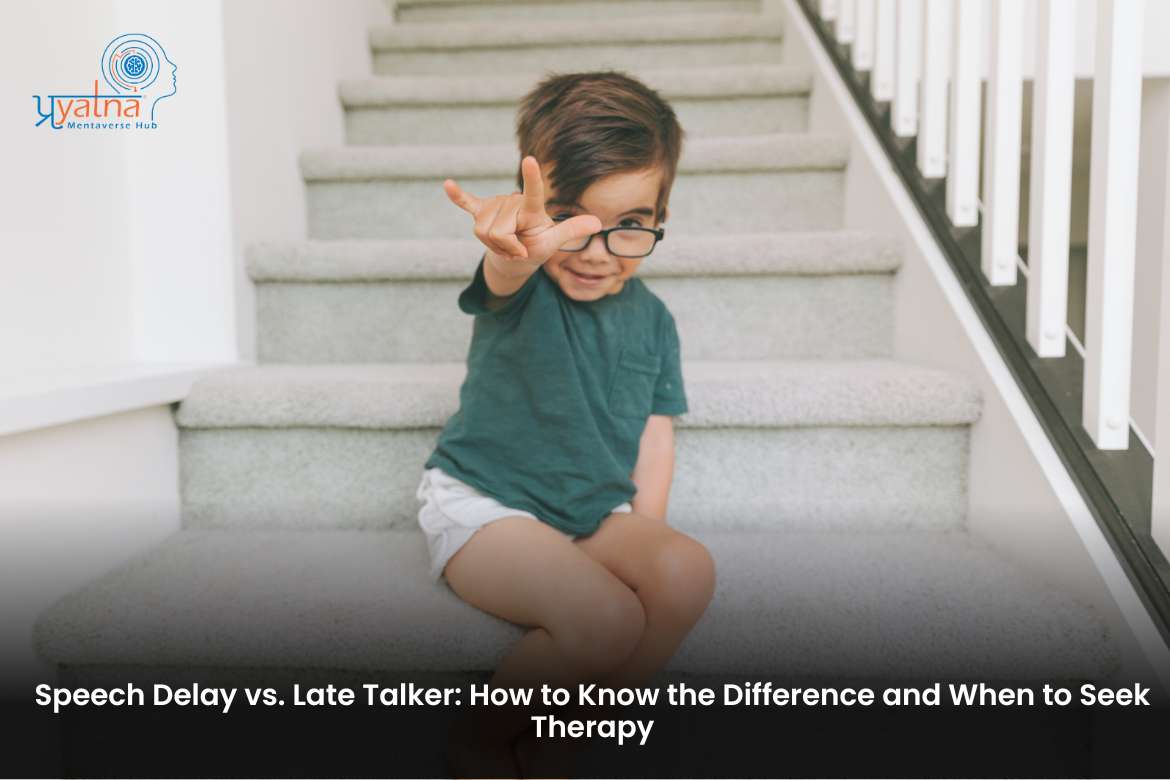
Speech Delay vs. Late Talker: How to Know the Difference and When to Seek Therapy
🌱 Why Your Child’s Speech Milestones Matter
Every child develops at their own pace — some talk early, some take time, and some communicate beautifully without using many words at first.
But as a parent, it’s natural to worry:
-
“Why isn’t my child talking yet?”
-
“Other kids speak in sentences… why not mine?”
Understanding whether your child is simply a late talker or showing signs of a speech delay can help you take the right steps early on.
Speech is one of the most important markers of child development, and early support ensures better communication, reduced frustration, and stronger learning skills.
Speech Delay vs. Late Talker — What’s the Difference?
🟢 Late Talker: Slow but Gradual Development
A late talker is a child who speaks fewer words than expected for their age but otherwise shows healthy communication behaviors.
Signs your child may be a late talker:
-
Good eye contact
-
Responds to instructions
-
Points, gestures, or pulls your hand to communicate
-
Shows interest in people
-
Uses non-verbal communication to express needs
📌 Example:
You say, “Bring your shoes,” and your child follows the command — even if they don’t say anything back.
Late talkers usually develop speech with time, stimulation, and the right environment.
🔴 Speech Delay: Communication Difficulty that Needs Intervention
A speech delay means a child struggles to express themselves through words — and may also have difficulty understanding language.
Signs of speech delay:
-
Does not respond when name is called
-
Limited or no pointing/gestures
-
Uses tantrums instead of words
-
Rarely learns new words
-
Limited eye contact
-
Poor imitation of sounds or actions
These are signs of child communication concerns and should not be ignored.
🚨 Speech delay requires professional support such as speech therapy and occupational therapy.
🧠 Speech Milestone Checklist (0–3 Years)
| Age | Expected Milestone | Possible Concern |
|---|---|---|
| 12 months | Says mama/papa intentionally, waves bye | No babbling, no gestures |
| 18 months | Uses 10–20 meaningful words | No words at all |
| 24 months | Combines 2 words (“mama water”) | Only gestures, very slow vocabulary |
| 36 months | Speaks simple sentences | Speech unclear or not understandable |
❗ If your child is 2 years old and not using words yet, do NOT wait.
Early intervention gives the best results.
🎤 When to Seek Speech Therapy
Search for a trusted child development center or speech therapy near me if your child:
-
Prefers pointing instead of speaking
-
Has frequent tantrums due to frustration
-
Does not imitate sounds or actions
-
Has difficulty focusing during play
-
Shows slow progress even after home efforts
-
Doesn’t try to use new words
Early speech therapy helps build vocabulary, improve speech clarity, and boosts confidence.
🤲 How Occupational Therapy Helps Speech
Most parents think speech is only about the mouth —
But the truth is: speech is brain work.
A child who cannot sit, focus, or process sensory input will struggle to speak fluently.
Occupational Therapy (OT) improves:
-
Attention span
-
Sensory processing
-
Sitting tolerance
-
Oral-motor strength (tongue, lips, jaw)
-
Behaviour regulation
💡 OT areas and how they support speech:
| OT Support | How It Helps Speech |
|---|---|
| Sensory Integration | Child stays calm and focused during speech practice |
| Oral Motor Exercises | Better tongue + lip strength → clearer speech |
| Attention Building | Child can follow speech instructions |
| Behaviour Regulation | Reduces tantrums from communication frustration |
✨ Speech Therapy + Occupational Therapy = Faster, Stronger Results
🏥 How Therapy Works at Prayatna Mentaverse Hub
We follow a One Child – One Room – One Center approach, designed to make therapy comfortable and effective:
✔️ No shifting children from room to room
✔️ Strong therapist–child connection
✔️ Reduced sensory overload
✔️ Faster and more consistent progress
With multiple branches across Ahmedabad (South Bopal, LM School, Riverside, and more), parents can choose a center close to home or school.
We provide:
-
Speech Therapy
-
Occupational Therapy
-
Behavioral Intervention
-
Parent Guidance Programs
-
Child Development Assessments
We are your trusted therapy center near me for holistic child development.
🏡 What Parents Can Do at Home
Here are simple, practical activities to support your child’s speech:
👉 Talk slowly, clearly, and at eye level
👉 Reduce screen time (excessive screens delay speech)
👉 Label everything your child uses (cup, ball, water, car)
👉 Encourage them to use words before giving the item
👉 Read picture books together
👉 Celebrate every small effort
Small, consistent daily interactions create big developmental changes.
🌈 Final Thought for Parents
You are not overreacting by seeking help early —
You are giving your child the best start in life.
A child who receives support early builds:
💚 Better communication
💚 Stronger confidence
💚 Fewer behavior issues
💚 Higher emotional security
Early therapy transforms the entire developmental journey.
And at Prayatna Mentaverse Hub, we walk that journey with you — one word, one milestone, one breakthrough at a time.