

Sustainable Board Prep: Study Hard Without Burning Out (Smart Strategy for Board Exams 2026)
Sustainable Board Prep: Study Hard Without Burning Out (Smart Strategy for Board Exams 2026)
Board exams are not a one-day test.
They are a 90-day mental marathon.
And marathons are not won by sprinting every day.
They are won by building sustainable systems.
If your Board Exam 2026 preparation feels intense but inconsistent — long hours, low retention, rising panic — it’s time to shift from pressure-based studying to strategy-based studying.
This guide will help you prepare effectively without burnout, anxiety, or last-minute panic.
Why Students Burn Out During Board Exam Preparation
Many students believe:
- More hours = more marks
- Less sleep = more success
- Constant studying = better results
But the reality is different.
Burnout happens when:
- Study hours are high but retention is low
- Panic increases despite preparation
- Sleep decreases
- Motivation drops suddenly
Burnout is not laziness.
It is mental exhaustion caused by poor strategy.
Sustainable board prep protects both performance and mental health.
1️⃣ Active Recall vs Passive Reading: The Smart Study Method
Most students prepare by re-reading notes repeatedly.
This creates false confidence.
When you read, your brain recognizes information.
But in exams, you need to retrieve information without seeing it.
Why Passive Reading Increases Exam Anxiety
- You feel productive while reading
- During exams, you cannot recall exact points
- Blank-outs increase panic
- Panic blocks memory access further
This cycle creates unnecessary exam stress.
What Is Active Recall?
Active recall means forcing your brain to retrieve information without looking.
Practical Active Recall Techniques:
✔ Close the book and write everything you remember
✔ Teach the topic aloud as if explaining to a friend
✔ Use flashcards
✔ Solve past year question papers without notes
✔ Practice mock tests under timed conditions
If you can recall it without seeing it, you truly know it.
Active recall improves:
- Memory retention
- Exam confidence
- Speed of writing
- Accuracy
This is one of the most powerful tools for sustainable board preparation.
2️⃣ The “Daily Three” Rule: Study Without Overwhelm
Burnout often comes from unrealistic daily targets.
Instead of saying:
“I will complete 5 chapters today.”
Use the Daily Three Goal System.
How It Works
Every day, set only three clear, achievable goals.
Example:
- Revise Electrostatics formulas
- Solve 20 Maths MCQs
- Write one English long answer
Why the Daily Three Rule Works
- Reduces overwhelm
- Builds consistency
- Creates daily achievement momentum
- Improves focus
- Prevents emotional exhaustion
Small wins daily are more powerful than rare big efforts.
Consistency beats intensity.
3️⃣ Physical Non-Negotiables: Your Brain Needs Biology
You cannot out-study a tired brain.
Board exam preparation is cognitive work.
Cognitive work requires biological support.
💤 Sleep: The Hidden Study Tool
- Memory consolidates during sleep
- Sleep deprivation reduces recall accuracy
- Late-night cramming increases anxiety
- Poor sleep reduces focus the next day
Students who sleep 7+ hours retain better than those who study late and feel exhausted.
Sleep is not wasted time.
It is memory-building time.
💧 Hydration: The Focus Booster
Even mild dehydration:
- Reduces concentration
- Slows processing speed
- Increases fatigue
Water improves alertness and mental clarity.
Think of sleep and hydration as study tools, not luxuries.
Sustainable Study vs Burnout Study
| Burnout Study | Sustainable Study |
|---|---|
| Long random hours | Structured time blocks |
| Passive reading | Active recall |
| No breaks | Planned short breaks |
| Late nights | Consistent sleep |
| Panic-based | Strategy-based |
Sustainable board prep builds:
- Confidence
- Emotional resilience
- Consistency
- Mental clarity
How to Study Like an Athlete
Athletes don’t train intensely every hour.
They follow:
- Structured practice
- Recovery time
- Nutrition
- Hydration
- Mental conditioning
Board exam preparation works the same way.
Study like an athlete.
Recover like an athlete.
Show up on exam day calm and confident.
Final Thought: Burnout Is Not a Badge of Honor
Sustainable board prep is not about studying more.
It is about studying smarter.
It is about protecting your mental energy.
It is about showing up consistently.
Burnout does not increase marks.
Consistency does.
Board exams test knowledge — not exhaustion.
Prepare with clarity.
Protect your mind.
Perform with confidence.

How to Build Study Habits Without Daily Fights: Practical Strategies for Parents
How to Build Study Habits Without Daily Fights: Practical Strategies for Parents
If homework time feels like a daily battlefield, the problem may not be your child — it may be the approach.
Many parents search for solutions to:
- “Why does my child avoid homework?”
- “How do I improve my child’s focus?”
- “Why is study time always a fight?”
The truth is:
Children rarely resist learning — they resist pressure.
Building strong study habits requires structure + emotional safety, not control.
Why Homework Turns Into a Power Struggle
When children delay homework, get distracted quickly, or argue during study time, parents naturally respond by pushing harder.
But pressure often creates:
- Resistance
- Emotional shutdown
- Reduced motivation
- Fear of failure
Instead of improving focus, strict control often increases homework battles.
Step 1: Create a Predictable Study Routine
Children thrive on routine.
Fix a simple, realistic daily study time — even 20 focused minutes is enough to start.
Consistency builds habit faster than long, forced hours.
Practical Tips:
- Same time daily (after snack or play)
- Same study space
- Clear start and end time
Predictability reduces negotiation and increases cooperation.
Step 2: Use the “Small Chunks” Method
Young brains struggle with long, uninterrupted study sessions.
Instead of:
❌ 1 hour continuous sitting
Try:
✅ 15–20 minutes study
✅ 5-minute movement break
✅ Repeat if needed
Planned breaks improve attention span and reduce mid-task arguments.
This method improves:
- Focus problems
- Homework resistance
- Emotional overwhelm
Step 3: Create a Distraction-Free Environment
Focus is environmental before it is mental.
Remove:
- TV noise
- Mobile phones
- Loud conversations
Keep:
- Clean desk
- Basic stationery ready
- Water nearby
A cluttered space creates a cluttered mind.
Step 4: Change Your Tone, Change the Outcome
Your tone influences your child’s nervous system.
Instead of:
❌ “Why are you so careless?”
❌ “How many times do I have to tell you?”
Say:
✅ “Let’s solve this together.”
✅ “What part feels difficult?”
When children feel judged, they shut down.
When they feel supported, they cooperate.
Step 5: Praise Effort, Not Just Results
Encouragement builds internal motivation.
Notice effort:
- “I saw you tried even though it was hard.”
- “You stayed focused for 15 minutes — that’s progress.”
Effort-based praise builds:
- Responsibility
- Confidence
- Growth mindset
Rewards may work short-term.
Recognition builds long-term study discipline.
Step 6: Check Emotional Readiness Before Academic Discipline
A child who is:
- Hungry
- Tired
- Overstimulated
- Emotionally overwhelmed
…cannot focus on studies.
Emotional regulation comes before academic success.
Ask yourself:
- Did they get enough rest?
- Did they eat properly?
- Have they had playtime?
Calm children learn better.
Why Structure Works Better Than Pressure
Building study habits is not about winning power struggles.
It’s about:
- Gradual responsibility
- Emotional safety
- Consistency over intensity
Small, steady steps create long-term discipline.
When to Seek Professional Guidance
Consider counselling support if:
- Homework battles happen daily
- Your child shows extreme avoidance
- There are signs of lack of focus or attention difficulty
- Emotional breakdowns happen during study time
Sometimes, underlying issues like attention challenges, learning difficulties, or emotional stress require expert guidance.
Final Takeaway
Consistency beats anger.
Calm communication beats control.
Small structured steps beat forced discipline.
Strong study habits are built slowly, respectfully, and emotionally safely.
Because the goal isn’t just good grades —
it’s raising responsible, confident learners.

The Calm Before the Boards: A Parent’s Guide to a Stress-Free Exam Week (Board Exams 2026)
The Calm Before the Boards: A Parent’s Guide to a Stress-Free Exam Week (Board Exams 2026)
For Indian parents navigating the final week of Class 10 & 12 Board Exam 2026 preparation
February and March in Indian households often feel like a pressure cooker.
The TV volume drops.
Relatives whisper.
The dining table becomes a study station.
And every conversation ends with, “Kitna syllabus baaki hai?”
Board exams are important — no doubt.
But in the final 7 days of Board Exam 2026 preparation, your role changes.
You are no longer the Chief Academic Officer checking revisions.
You become the Chief Motivation Officer.
Because in the last week, emotional stability matters more than extra chapters.
Let’s understand how to reduce exam stress at home and avoid unnecessary parental pressure during exams.
Understanding the Final Week Psychology
By the final week, most students have:
- Completed major revisions
- Solved sample papers
- Followed a structured Board Exam 2026 preparation plan
At this stage, what they need most is:
- Confidence
- Calmness
- Sleep
- Emotional safety
Not new strategies.
Not panic.
Not comparison.
When stress increases, the brain’s prefrontal cortex (responsible for logic and recall) becomes less efficient. High anxiety reduces memory retrieval during exams.
This is why supporting your child during board exams is less about “more study” and more about “less stress.”
Words That Heal vs Words That Pressure
In the final week, your communication can:
✔ Strengthen confidence
OR
❌ Create silent anxiety
Let’s start with what not to say.
❌ What NOT to Say During Board Exam Week
1. “Sharma ji’s son studies 14 hours.”
Why this increases exam stress:
- Triggers comparison anxiety
- Reduces self-worth
- Shifts focus from self-improvement to competition
Comparison increases pressure, not performance.
2. “Your whole future depends on this paper.”
Why it harms:
- Creates catastrophic thinking
- Activates fear instead of focus
- Makes failure feel life-threatening
No single exam defines a life — but repeated messaging makes the brain believe it does.
3. “If you don’t score above 95%, what will people say?”
Why it harms:
- Links love with marks
- Encourages external validation
- Builds fear of embarrassment
Children start associating acceptance with performance.
4. “Are you sure you revised properly?”
Why it harms:
- Signals doubt
- Creates last-minute panic
- Weakens confidence
In the final week, reassurance is more powerful than interrogation.
✅ What to Say Instead: Positive Phrases for Students
Language reduces cortisol (stress hormone) and builds clarity.
Here’s what works better:
✔ “I’m proud of the effort you’re putting in.”
✔ “One exam cannot define your future.”
✔ “You’ve prepared well. Trust yourself.”
✔ “Focus on doing your best. Marks will follow.”
✔ “Stay calm. Read carefully. We’re with you.”
These phrases promote emotional resilience and exam confidence.
How to Reduce Exam Stress at Home (Without Saying Much)
Sometimes actions speak louder than advice.
1️⃣ Create a Calm Environment
- Keep TV volume low
- Avoid arguments
- Delay stressful discussions
- Limit negative news
A peaceful home lowers background anxiety.
2️⃣ Maintain Routine
- Ensure balanced meals
- Encourage proper sleep (no all-night studying)
- Light evening walks if possible
Sleep improves memory consolidation and recall.
3️⃣ Keep Comfort Ready
- Favorite light snacks
- Warm milk or herbal tea
- Ironed uniform ready
- Exam kit prepared
Small gestures signal emotional support.
4️⃣ Avoid Conflict This Week
This is NOT the week to:
- Discuss discipline
- Bring up old mistakes
- Talk about career pressure
- Compare with cousins
Protect emotional stability.
Your Role in Board Exam 2026 Preparation
In this final stretch:
You are not monitoring every answer.
You are managing:
- Emotional climate
- Confidence levels
- Parental pressure during exams
If your child feels nervous → you stay calm.
If they doubt themselves → you reassure.
If they feel tired → you encourage rest.
Your stability becomes their anchor.
The Big Picture: Beyond the Marksheet
Years from now, your child may not remember:
- Exact marks
- Exact rank
- Exact percentage
But they will remember:
- Whether home felt safe
- Whether they felt supported
- Whether love felt conditional
Children who feel emotionally secure perform better — not just in exams, but in life.
A marksheet is temporary.
Your relationship is permanent.
Quick Dos and Don’ts for Parents (Exam Week Checklist)
✅ DO:
- Use positive phrases for students
- Maintain calm household energy
- Encourage healthy sleep and food
- Offer reassurance daily
- Celebrate effort
❌ DON’T:
- Compare
- Threaten consequences
- Discuss marks publicly
- Bring career pressure now
- Panic more than your child
Final Thoughts: Calm Builds Performance
Board Exam 2026 preparation is intense — but it does not have to be traumatic.
When parents reduce exam stress at home, children perform with clarity instead of fear.
Your calm presence is the greatest gift you can give your child this week.
The marksheet will last a few years.
Your words will last a lifetime.
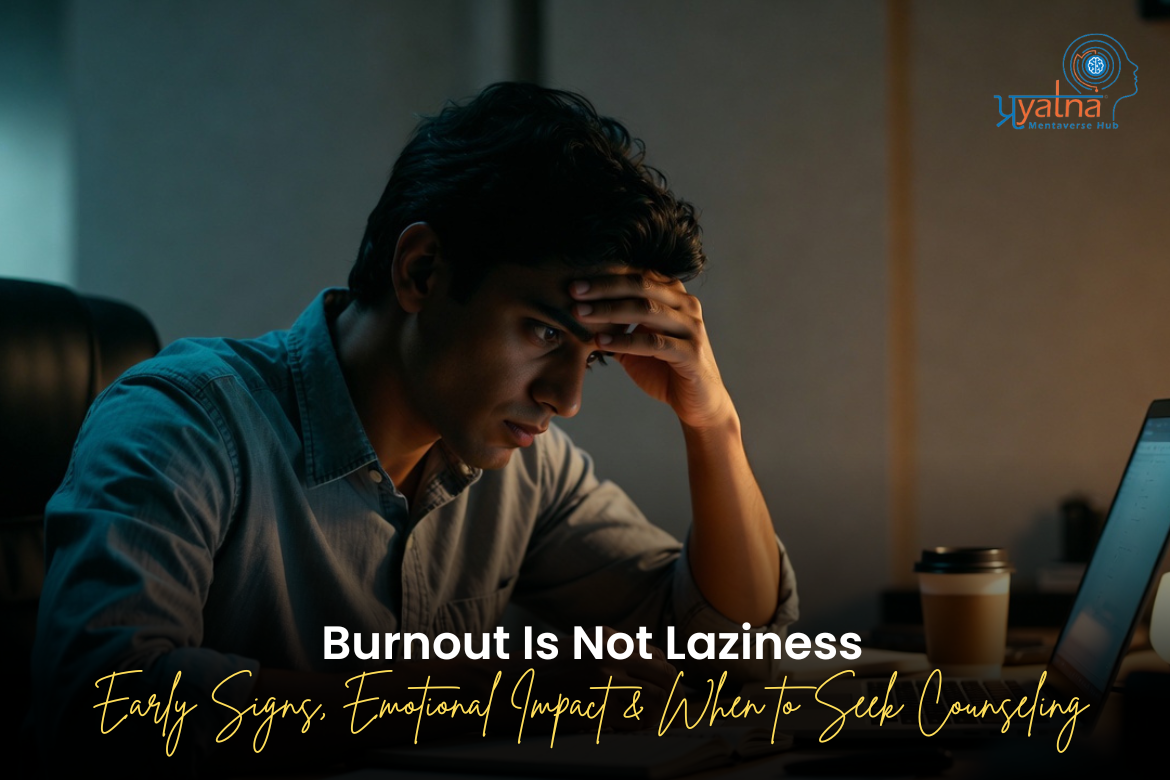
Burnout Is Not Laziness: Early Signs, Emotional Impact & When to Seek Counseling
Burnout Is Not Laziness: Early Signs, Emotional Impact & When to Seek Counseling
In today’s hustle culture, employees are taught to push harder, work longer, and stay productive at all costs.
But what happens when your mind and body can no longer keep up?
Many people mistake burnout for being lazy, unmotivated, or careless.
But burnout is not a lack of discipline — it is a stress response.
👉 Burnout is your body and mind saying:
“I’m overwhelmed, and I need help.”
What Is Burnout?
Burnout is a state of emotional, mental, and physical exhaustion caused by long-term, continuous stress — especially in workplaces where expectations are high and support is low.
It develops gradually and is often ignored until the symptoms become intense.
Unlike temporary tiredness, burnout doesn’t disappear after a weekend break.
Early Signs of Burnout (Often Confused with Laziness)
What it looks like to others vs. what’s actually happening:
| What Others Say | What’s Really Happening |
|---|---|
| “You’re losing motivation.” | You’re mentally exhausted |
| “You don’t care about work anymore.” | You’re emotionally drained |
| “You’re being lazy.” | You’re overwhelmed and depleted |
🚩 Common Early Warning Signs
-
Constant Fatigue & Low Energy
You feel tired even after adequate rest. -
Loss of Motivation
Tasks that once excited you now feel heavy or meaningless. -
Emotional Overload
Increased irritability, sensitivity, or feeling on edge without a clear reason. -
Reduced Performance
You know what needs to be done — but can’t push yourself to start. -
Withdrawal from Work or Family
Social interaction feels draining, so you isolate. -
Physical Symptoms
Headaches, stomach issues, body pain, or frequent illness.
🔍 Key distinction:
If you’re tired because you worked too much — it’s hard work.
If you’re tired even after resting — it’s burnout.
Emotional Impact of Burnout
Burnout doesn’t just affect productivity —
it affects how you see yourself.
You may start asking:
- “Why can’t I function like others?”
- “Why am I losing interest in everything?”
- “Am I failing?”
Internally, burnout can lead to:
- Emotional numbness
- Harsh negative self-talk
- Hopelessness
- Feeling disconnected from life
If left unaddressed, burnout often evolves into anxiety or depression.
Burnout vs Laziness — The Real Difference
Laziness = lack of willingness
Burnout = lack of capacity due to overload
People experiencing burnout want to perform well —
but their emotional and mental resources are already depleted.
This is why pushing harder doesn’t help.
Support does.
Workplace Stress & Employee Mental Health
Burnout is especially common in workplaces with:
- Long working hours
- Constant performance pressure
- Lack of recognition
- Poor work-life balance
That’s why many organisations now invest in Employee Assistance Programs (EAPs).
If you’re looking for EAP services in Ahmedabad, professional counselling can help:
- Reduce workplace stress
- Improve emotional resilience
- Support employee mental health
- Create healthier, sustainable work cultures
When Should You Seek Counseling?
Reach out for professional support if you experience:
- Persistent exhaustion for more than two weeks
- Sudden drop in work performance
- Emotional detachment from work or loved ones
- Difficulty getting out of bed to go to work
- Increasing guilt, self-blame, or hopelessness
How Counseling Helps with Burnout
Counselling doesn’t “push” you to do more —
it helps you recover capacity.
Through therapy, you learn:
- How to set healthy boundaries
- How to regulate emotions
- How to say no without guilt
- How to rebuild work-life balance
- How to regain focus, motivation, and purpose
You Can Recover from Burnout 🌱
Recovery is possible — and it starts with permission to pause.
Rest is not a reward.
Rest is a requirement.
Burnout doesn’t mean you’re weak.
It means you’ve been strong for too long without support.
Need Support?
Whether you are:
- An individual employee struggling with burnout
- Or an organisation looking to improve employee mental health
Prayatna Mentaverse Hub offers professional counselling and EAP services in Ahmedabad, specialising in:
- Workplace stress
- Emotional health
- Corporate mental wellness programs
📍 Prayatna Mentaverse Hub — Best Counseling Services in Ahmedabad
👉 Reach out today. Healing begins with the first conversation.

Why Am I Attracting Narcissistic Partners?
If You Keep Ending Up With Narcissistic Partners, It’s Not a Coincidence
Many people quietly wonder:
- “Why do I always attract the same kind of partner?”
- “Why am I drawn to emotionally unavailable or narcissistic people?”
- “Why do I ignore red flags even when I see them?”
Let’s clear something important first:
👉 You are not weak.
👉 You are not desperate.
You are emotionally wired to repeat what feels familiar — even when it hurts.
This is not a flaw in your character.
It’s a sign of unhealed relationship trauma.
What Is Narcissism?
A narcissistic partner often appears:
- Charming
- Confident
- Magnetic
- Emotionally intense
But over time, that charm turns into:
- Gaslighting
- Emotional manipulation
- Blame shifting
- Lack of empathy
Their constant need for admiration and control slowly makes you feel:
“No matter what I do… I’m never enough.”
This is a classic pattern of emotional abuse.
Why You Keep Attracting Narcissists (The Psychology Behind It)
1️⃣ You Are Empathetic — And They Sense It
Narcissists are instinctively drawn to:
- Empathetic people
- Givers and fixers
- People who believe in second chances
Your kindness feels safe to you —
but to a narcissist, it becomes a source of supply.
2️⃣ You Confuse Intensity With Love
Narcissistic relationships are often marked by:
- Fast bonding
- Love bombing
- Deep emotional connection very early
- Extreme highs followed by painful lows
This intensity feels like passion, but it’s not intimacy.
It’s emotional dependency disguised as love.
3️⃣ You Are Caught in a Trauma Bond
A trauma bond sounds like:
“I know this relationship is hurting me… but I can’t leave.”
Why?
Because your nervous system becomes addicted to a cycle:
- Love Bombing → you feel special
- Devaluation → criticism, emotional abuse
- Discarding → silent treatment, breakup threats
- Hoovering → “I promise I’ll change”
You stay attached not to who they are —
but to the hope of who they could be.
Early Red Flags Most People Ignore
| Narcissistic Pattern | How It Shows Up |
|---|---|
| Love bombing | “You’re the only one who understands me.” |
| Gaslighting | “You’re imagining things. You’re too sensitive.” |
| Emotional manipulation | Silent treatment, guilt-tripping |
| Lack of accountability | “You made me do this.” |
| Control as love | “Why do you need friends? You have me.” |
If you find yourself:
- Constantly apologizing
- Walking on eggshells
- Doubting your reality
You are likely experiencing relationship trauma, not a “communication issue.”
How Narcissists Trap You Emotionally
Narcissists study your vulnerabilities carefully.
They say things like:
- “You’re so different from others.”
- “I’ve never felt this way before.”
Once you’re emotionally invested, the switch flips:
- Affection reduces
- Criticism increases
- Your emotions are dismissed
You go from feeling like a priority to feeling like a problem.
Why Leaving a Narcissistic Relationship Is So Hard
Leaving is difficult because:
- You crave closure
- You want to prove your worth
- You believe you can fix them
- You are addicted to their validation
Neurologically:
- The “good phase” releases dopamine
- The abusive phase creates fear and anxiety
This push-pull cycle creates emotional addiction, not love.
How to Break the Cycle and Heal
✔ Step 1: Acknowledge the Truth
Stop waiting for change.
Stop romanticizing potential.
Love does not hurt. Manipulation does.
✔ Step 2: No Contact (or Low Contact)
If possible:
- Block calls and messages
- Mute social media
- Don’t respond to emotional bait
Silence is not punishment.
Silence is protection.
✔ Step 3: Heal the Root Trauma
Narcissists don’t choose you because you’re weak.
They choose you because you’re strong — and unaware of your own power.
To stop attracting them, you must heal:
- Fear of abandonment
- Need for validation
- Childhood emotional wounds
This healing requires counselling with an expert psychologist, not willpower alone.
Take the First Step Toward Breakup Recovery
A therapist can help you:
- Understand narcissistic patterns
- Break trauma bonds
- Rebuild self-worth
- Create healthy boundaries
- Heal emotional abuse
You deserve a relationship where you feel:
✔ Seen
✔ Heard
✔ Valued
✔ Safe
You were never “too emotional.”
You were with someone who lacked empathy.
Looking for Help?
If you’re struggling with:
- Narcissism in relationships
- Gaslighting trauma
- Emotional abuse
- Breakup recovery
Prayatna Mentaverse Hub offers confidential counselling with an expert psychologist trained in narcissistic relationship recovery.
If you’re searching online for:
- best psychologist for narcissistic counselling
- help for emotional abuse
You’re already taking the right step.
Final Thought
You cannot change a narcissist.
But you can change why you are attracted to them.
Healing isn’t about fixing the relationship.
It’s about fixing the pattern.
✨ You deserve peace — not exhaustion.
Learn More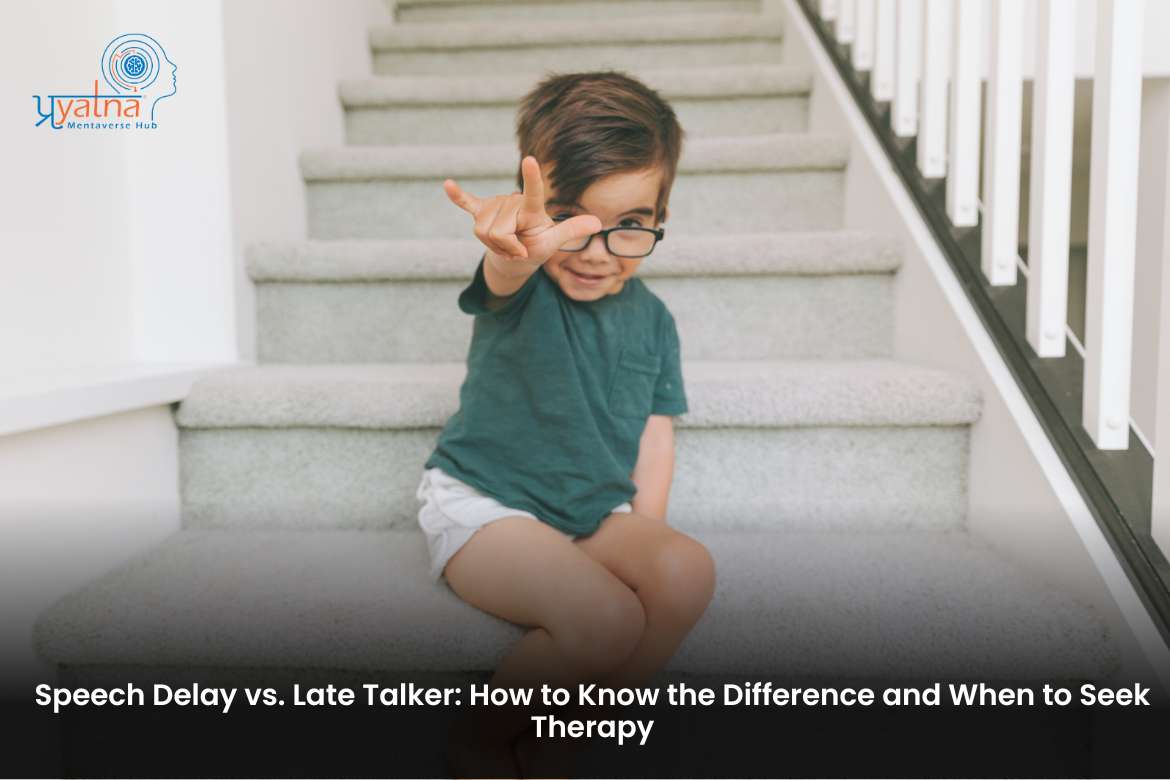
Speech Delay vs. Late Talker: How to Know the Difference and When to Seek Therapy
🌱 Why Your Child’s Speech Milestones Matter
Every child develops at their own pace — some talk early, some take time, and some communicate beautifully without using many words at first.
But as a parent, it’s natural to worry:
-
“Why isn’t my child talking yet?”
-
“Other kids speak in sentences… why not mine?”
Understanding whether your child is simply a late talker or showing signs of a speech delay can help you take the right steps early on.
Speech is one of the most important markers of child development, and early support ensures better communication, reduced frustration, and stronger learning skills.
Speech Delay vs. Late Talker — What’s the Difference?
🟢 Late Talker: Slow but Gradual Development
A late talker is a child who speaks fewer words than expected for their age but otherwise shows healthy communication behaviors.
Signs your child may be a late talker:
-
Good eye contact
-
Responds to instructions
-
Points, gestures, or pulls your hand to communicate
-
Shows interest in people
-
Uses non-verbal communication to express needs
📌 Example:
You say, “Bring your shoes,” and your child follows the command — even if they don’t say anything back.
Late talkers usually develop speech with time, stimulation, and the right environment.
🔴 Speech Delay: Communication Difficulty that Needs Intervention
A speech delay means a child struggles to express themselves through words — and may also have difficulty understanding language.
Signs of speech delay:
-
Does not respond when name is called
-
Limited or no pointing/gestures
-
Uses tantrums instead of words
-
Rarely learns new words
-
Limited eye contact
-
Poor imitation of sounds or actions
These are signs of child communication concerns and should not be ignored.
🚨 Speech delay requires professional support such as speech therapy and occupational therapy.
🧠 Speech Milestone Checklist (0–3 Years)
| Age | Expected Milestone | Possible Concern |
|---|---|---|
| 12 months | Says mama/papa intentionally, waves bye | No babbling, no gestures |
| 18 months | Uses 10–20 meaningful words | No words at all |
| 24 months | Combines 2 words (“mama water”) | Only gestures, very slow vocabulary |
| 36 months | Speaks simple sentences | Speech unclear or not understandable |
❗ If your child is 2 years old and not using words yet, do NOT wait.
Early intervention gives the best results.
🎤 When to Seek Speech Therapy
Search for a trusted child development center or speech therapy near me if your child:
-
Prefers pointing instead of speaking
-
Has frequent tantrums due to frustration
-
Does not imitate sounds or actions
-
Has difficulty focusing during play
-
Shows slow progress even after home efforts
-
Doesn’t try to use new words
Early speech therapy helps build vocabulary, improve speech clarity, and boosts confidence.
🤲 How Occupational Therapy Helps Speech
Most parents think speech is only about the mouth —
But the truth is: speech is brain work.
A child who cannot sit, focus, or process sensory input will struggle to speak fluently.
Occupational Therapy (OT) improves:
-
Attention span
-
Sensory processing
-
Sitting tolerance
-
Oral-motor strength (tongue, lips, jaw)
-
Behaviour regulation
💡 OT areas and how they support speech:
| OT Support | How It Helps Speech |
|---|---|
| Sensory Integration | Child stays calm and focused during speech practice |
| Oral Motor Exercises | Better tongue + lip strength → clearer speech |
| Attention Building | Child can follow speech instructions |
| Behaviour Regulation | Reduces tantrums from communication frustration |
✨ Speech Therapy + Occupational Therapy = Faster, Stronger Results
🏥 How Therapy Works at Prayatna Mentaverse Hub
We follow a One Child – One Room – One Center approach, designed to make therapy comfortable and effective:
✔️ No shifting children from room to room
✔️ Strong therapist–child connection
✔️ Reduced sensory overload
✔️ Faster and more consistent progress
With multiple branches across Ahmedabad (South Bopal, LM School, Riverside, and more), parents can choose a center close to home or school.
We provide:
-
Speech Therapy
-
Occupational Therapy
-
Behavioral Intervention
-
Parent Guidance Programs
-
Child Development Assessments
We are your trusted therapy center near me for holistic child development.
🏡 What Parents Can Do at Home
Here are simple, practical activities to support your child’s speech:
👉 Talk slowly, clearly, and at eye level
👉 Reduce screen time (excessive screens delay speech)
👉 Label everything your child uses (cup, ball, water, car)
👉 Encourage them to use words before giving the item
👉 Read picture books together
👉 Celebrate every small effort
Small, consistent daily interactions create big developmental changes.
🌈 Final Thought for Parents
You are not overreacting by seeking help early —
You are giving your child the best start in life.
A child who receives support early builds:
💚 Better communication
💚 Stronger confidence
💚 Fewer behavior issues
💚 Higher emotional security
Early therapy transforms the entire developmental journey.
And at Prayatna Mentaverse Hub, we walk that journey with you — one word, one milestone, one breakthrough at a time.