

Sustainable Board Prep: Study Hard Without Burning Out (Smart Strategy for Board Exams 2026)
Sustainable Board Prep: Study Hard Without Burning Out (Smart Strategy for Board Exams 2026)
Board exams are not a one-day test.
They are a 90-day mental marathon.
And marathons are not won by sprinting every day.
They are won by building sustainable systems.
If your Board Exam 2026 preparation feels intense but inconsistent — long hours, low retention, rising panic — it’s time to shift from pressure-based studying to strategy-based studying.
This guide will help you prepare effectively without burnout, anxiety, or last-minute panic.
Why Students Burn Out During Board Exam Preparation
Many students believe:
- More hours = more marks
- Less sleep = more success
- Constant studying = better results
But the reality is different.
Burnout happens when:
- Study hours are high but retention is low
- Panic increases despite preparation
- Sleep decreases
- Motivation drops suddenly
Burnout is not laziness.
It is mental exhaustion caused by poor strategy.
Sustainable board prep protects both performance and mental health.
1️⃣ Active Recall vs Passive Reading: The Smart Study Method
Most students prepare by re-reading notes repeatedly.
This creates false confidence.
When you read, your brain recognizes information.
But in exams, you need to retrieve information without seeing it.
Why Passive Reading Increases Exam Anxiety
- You feel productive while reading
- During exams, you cannot recall exact points
- Blank-outs increase panic
- Panic blocks memory access further
This cycle creates unnecessary exam stress.
What Is Active Recall?
Active recall means forcing your brain to retrieve information without looking.
Practical Active Recall Techniques:
✔ Close the book and write everything you remember
✔ Teach the topic aloud as if explaining to a friend
✔ Use flashcards
✔ Solve past year question papers without notes
✔ Practice mock tests under timed conditions
If you can recall it without seeing it, you truly know it.
Active recall improves:
- Memory retention
- Exam confidence
- Speed of writing
- Accuracy
This is one of the most powerful tools for sustainable board preparation.
2️⃣ The “Daily Three” Rule: Study Without Overwhelm
Burnout often comes from unrealistic daily targets.
Instead of saying:
“I will complete 5 chapters today.”
Use the Daily Three Goal System.
How It Works
Every day, set only three clear, achievable goals.
Example:
- Revise Electrostatics formulas
- Solve 20 Maths MCQs
- Write one English long answer
Why the Daily Three Rule Works
- Reduces overwhelm
- Builds consistency
- Creates daily achievement momentum
- Improves focus
- Prevents emotional exhaustion
Small wins daily are more powerful than rare big efforts.
Consistency beats intensity.
3️⃣ Physical Non-Negotiables: Your Brain Needs Biology
You cannot out-study a tired brain.
Board exam preparation is cognitive work.
Cognitive work requires biological support.
💤 Sleep: The Hidden Study Tool
- Memory consolidates during sleep
- Sleep deprivation reduces recall accuracy
- Late-night cramming increases anxiety
- Poor sleep reduces focus the next day
Students who sleep 7+ hours retain better than those who study late and feel exhausted.
Sleep is not wasted time.
It is memory-building time.
💧 Hydration: The Focus Booster
Even mild dehydration:
- Reduces concentration
- Slows processing speed
- Increases fatigue
Water improves alertness and mental clarity.
Think of sleep and hydration as study tools, not luxuries.
Sustainable Study vs Burnout Study
| Burnout Study | Sustainable Study |
|---|---|
| Long random hours | Structured time blocks |
| Passive reading | Active recall |
| No breaks | Planned short breaks |
| Late nights | Consistent sleep |
| Panic-based | Strategy-based |
Sustainable board prep builds:
- Confidence
- Emotional resilience
- Consistency
- Mental clarity
How to Study Like an Athlete
Athletes don’t train intensely every hour.
They follow:
- Structured practice
- Recovery time
- Nutrition
- Hydration
- Mental conditioning
Board exam preparation works the same way.
Study like an athlete.
Recover like an athlete.
Show up on exam day calm and confident.
Final Thought: Burnout Is Not a Badge of Honor
Sustainable board prep is not about studying more.
It is about studying smarter.
It is about protecting your mental energy.
It is about showing up consistently.
Burnout does not increase marks.
Consistency does.
Board exams test knowledge — not exhaustion.
Prepare with clarity.
Protect your mind.
Perform with confidence.

When Should Parents Seek Professional Help for Academic Avoidance?
When Should Parents Seek Professional Help for Academic Avoidance?
“Not every child who avoids studies is being stubborn — sometimes they are silently struggling.”
It is normal for children to occasionally resist homework or lose focus. Every child has off days.
But when academic avoidance becomes consistent, intense, or emotionally charged, it is important for parents to pause and observe more closely.
Understanding the difference between normal resistance and deeper learning or emotional challenges can prevent long-term academic stress.
What Is Academic Avoidance?
Academic avoidance happens when a child:
- Regularly delays homework
- Gets distracted within minutes
- Refuses to sit for studies
- Shows emotional reactions before study time
- Avoids school-related discussions
Occasional resistance is normal.
Persistent avoidance may signal something deeper.
First Measures to Try at Home
Before seeking professional help, parents can start with simple, structured strategies.
Consistency is key. Small changes often make a big difference.
1. Create a Fixed Study Routine
- Choose a realistic daily study time.
- Start with short blocks (20–30 minutes).
- Keep timing consistent every day.
Children feel safer and more cooperative when routines are predictable.
2. Reduce Distractions
- Turn off the TV.
- Keep mobile phones away.
- Set up a calm, clutter-free study corner.
A peaceful environment improves focus and reduces frustration.
3. Break Tasks into Small Steps
Instead of saying, “Finish everything,” try:
- Complete 3 math problems.
- Read one paragraph.
- Write 5 sentences.
Small wins build confidence.
4. Encourage Effort, Not Just Marks
Instead of asking:
“Why did you score less?”
Say:
“I noticed you tried hard today.”
Effort-based praise strengthens motivation and self-esteem.
5. Check Basic Needs
Before blaming behavior, ask:
- Is my child getting enough sleep?
- Are they eating properly?
- Do they have downtime to relax and play?
A tired or overwhelmed child cannot focus effectively.
6. Maintain Calm Communication
Avoid:
- Comparison with siblings or classmates
- Harsh criticism
- Threat-based discipline
Calm communication builds emotional safety. Emotional safety builds cooperation.
Give It Time
Implement these changes consistently for 4–6 weeks.
Many children show improvement when routine, structure, and emotional support are strengthened.
When to Seek Professional Help for Academic Avoidance
If structured home strategies do not bring improvement, or if you notice the following signs, it may be time to consult a child psychologist or learning specialist.
Warning Signs to Watch:
- Extreme anxiety or crying before study time
- Frequent stomach aches or headaches during school
- Inability to focus beyond a few minutes
- Poor memory retention despite repeated practice
- Falling grades despite visible effort
- Low self-esteem (“I am dumb,” “I can’t do anything”)
- Behavioral outbursts specifically linked to homework
These are not signs of laziness.
They may indicate:
- Attention difficulties (ADHD symptoms)
- Learning disorders (Dyslexia, Dyscalculia, Dysgraphia)
- Performance anxiety
- Emotional stress
- School-related anxiety
Early intervention leads to better outcomes.
Why Early Professional Guidance Matters
When academic avoidance is misunderstood, children may:
- Lose confidence
- Develop school anxiety
- Feel labeled as “lazy” or “careless”
- Avoid challenges long-term
Professional assessment provides clarity.
Clarity reduces frustration — for both parents and children.
Counselling and educational assessments can help:
- Identify learning challenges
- Improve attention and focus
- Strengthen emotional regulation
- Build study skills
- Restore confidence
Academic Avoidance Is Communication
When a child avoids studies, they are not rejecting education.
They are communicating:
- “This feels too hard.”
- “I am overwhelmed.”
- “I am scared of failing.”
- “I don’t understand, but I don’t know how to say it.”
Listening before reacting makes all the difference.
Final Takeaway
If structured support at home does not ease academic avoidance, seeking professional help is not a label.
It is clarity.
And clarity turns confusion into understanding — and understanding into progress.
Your child is not stubborn.
They may simply need the right support.
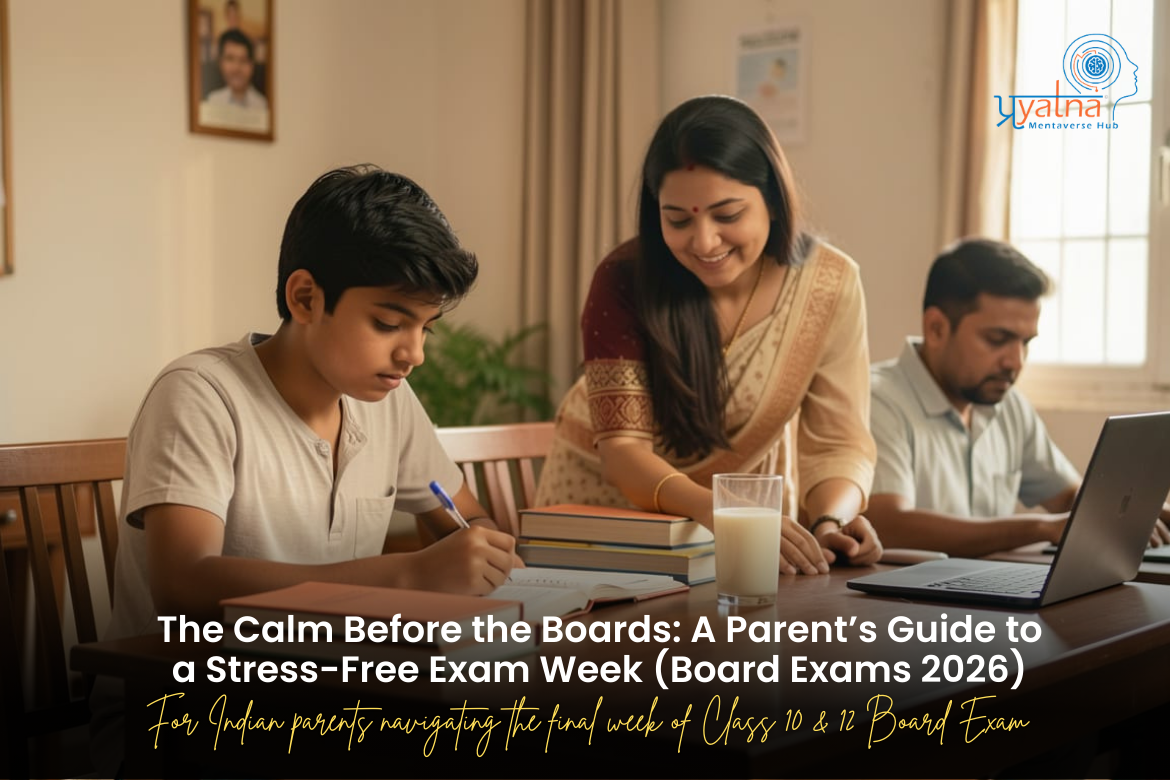
The Calm Before the Boards: A Parent’s Guide to a Stress-Free Exam Week (Board Exams 2026)
The Calm Before the Boards: A Parent’s Guide to a Stress-Free Exam Week (Board Exams 2026)
For Indian parents navigating the final week of Class 10 & 12 Board Exam 2026 preparation
February and March in Indian households often feel like a pressure cooker.
The TV volume drops.
Relatives whisper.
The dining table becomes a study station.
And every conversation ends with, “Kitna syllabus baaki hai?”
Board exams are important — no doubt.
But in the final 7 days of Board Exam 2026 preparation, your role changes.
You are no longer the Chief Academic Officer checking revisions.
You become the Chief Motivation Officer.
Because in the last week, emotional stability matters more than extra chapters.
Let’s understand how to reduce exam stress at home and avoid unnecessary parental pressure during exams.
Understanding the Final Week Psychology
By the final week, most students have:
- Completed major revisions
- Solved sample papers
- Followed a structured Board Exam 2026 preparation plan
At this stage, what they need most is:
- Confidence
- Calmness
- Sleep
- Emotional safety
Not new strategies.
Not panic.
Not comparison.
When stress increases, the brain’s prefrontal cortex (responsible for logic and recall) becomes less efficient. High anxiety reduces memory retrieval during exams.
This is why supporting your child during board exams is less about “more study” and more about “less stress.”
Words That Heal vs Words That Pressure
In the final week, your communication can:
✔ Strengthen confidence
OR
❌ Create silent anxiety
Let’s start with what not to say.
❌ What NOT to Say During Board Exam Week
1. “Sharma ji’s son studies 14 hours.”
Why this increases exam stress:
- Triggers comparison anxiety
- Reduces self-worth
- Shifts focus from self-improvement to competition
Comparison increases pressure, not performance.
2. “Your whole future depends on this paper.”
Why it harms:
- Creates catastrophic thinking
- Activates fear instead of focus
- Makes failure feel life-threatening
No single exam defines a life — but repeated messaging makes the brain believe it does.
3. “If you don’t score above 95%, what will people say?”
Why it harms:
- Links love with marks
- Encourages external validation
- Builds fear of embarrassment
Children start associating acceptance with performance.
4. “Are you sure you revised properly?”
Why it harms:
- Signals doubt
- Creates last-minute panic
- Weakens confidence
In the final week, reassurance is more powerful than interrogation.
✅ What to Say Instead: Positive Phrases for Students
Language reduces cortisol (stress hormone) and builds clarity.
Here’s what works better:
✔ “I’m proud of the effort you’re putting in.”
✔ “One exam cannot define your future.”
✔ “You’ve prepared well. Trust yourself.”
✔ “Focus on doing your best. Marks will follow.”
✔ “Stay calm. Read carefully. We’re with you.”
These phrases promote emotional resilience and exam confidence.
How to Reduce Exam Stress at Home (Without Saying Much)
Sometimes actions speak louder than advice.
1️⃣ Create a Calm Environment
- Keep TV volume low
- Avoid arguments
- Delay stressful discussions
- Limit negative news
A peaceful home lowers background anxiety.
2️⃣ Maintain Routine
- Ensure balanced meals
- Encourage proper sleep (no all-night studying)
- Light evening walks if possible
Sleep improves memory consolidation and recall.
3️⃣ Keep Comfort Ready
- Favorite light snacks
- Warm milk or herbal tea
- Ironed uniform ready
- Exam kit prepared
Small gestures signal emotional support.
4️⃣ Avoid Conflict This Week
This is NOT the week to:
- Discuss discipline
- Bring up old mistakes
- Talk about career pressure
- Compare with cousins
Protect emotional stability.
Your Role in Board Exam 2026 Preparation
In this final stretch:
You are not monitoring every answer.
You are managing:
- Emotional climate
- Confidence levels
- Parental pressure during exams
If your child feels nervous → you stay calm.
If they doubt themselves → you reassure.
If they feel tired → you encourage rest.
Your stability becomes their anchor.
The Big Picture: Beyond the Marksheet
Years from now, your child may not remember:
- Exact marks
- Exact rank
- Exact percentage
But they will remember:
- Whether home felt safe
- Whether they felt supported
- Whether love felt conditional
Children who feel emotionally secure perform better — not just in exams, but in life.
A marksheet is temporary.
Your relationship is permanent.
Quick Dos and Don’ts for Parents (Exam Week Checklist)
✅ DO:
- Use positive phrases for students
- Maintain calm household energy
- Encourage healthy sleep and food
- Offer reassurance daily
- Celebrate effort
❌ DON’T:
- Compare
- Threaten consequences
- Discuss marks publicly
- Bring career pressure now
- Panic more than your child
Final Thoughts: Calm Builds Performance
Board Exam 2026 preparation is intense — but it does not have to be traumatic.
When parents reduce exam stress at home, children perform with clarity instead of fear.
Your calm presence is the greatest gift you can give your child this week.
The marksheet will last a few years.
Your words will last a lifetime.