
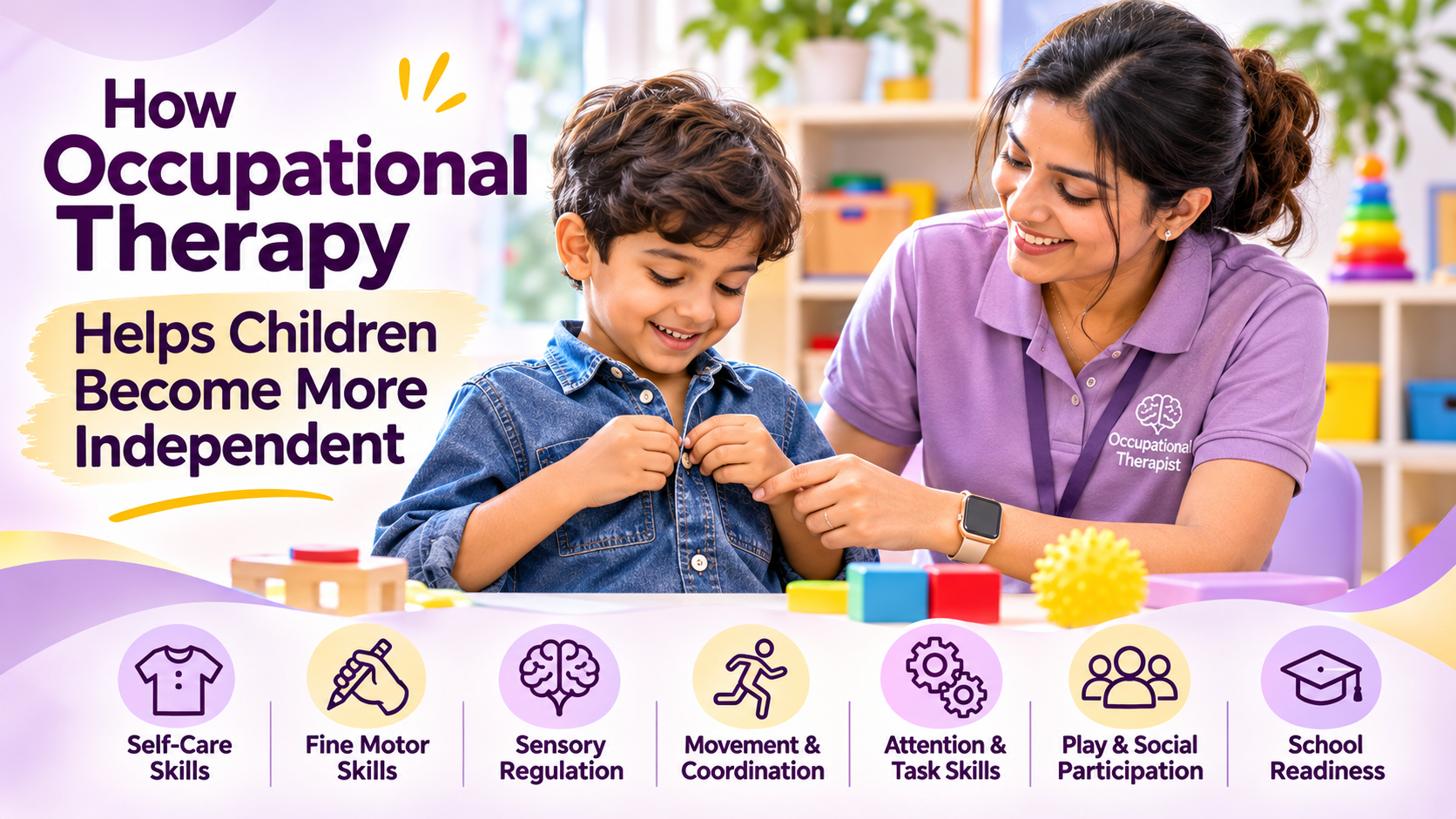
How Occupational Therapy Helps Children Become More Independent
Every parent wants to see their child become confident, capable and independent. From eating without assistance and getting dressed to holding a pencil, playing with friends and managing everyday routines, these little milestones are important parts of a child’s development.
However, not every child develops these skills at the same pace.
Some children may find it difficult to hold a spoon, button their clothes, manage sensory experiences, maintain balance or complete simple daily activities. Others may need additional support with coordination, attention, motor planning or self-regulation.
This is where Occupational Therapy for Children can make a meaningful difference.
Occupational Therapy (OT) helps children develop the practical skills they need to participate more comfortably and independently in everyday life. It focuses on what a child wants and needs to do, whether at home, school or during play.
But occupational therapy is not simply about completing exercises or playing with toys. It is about helping children build abilities that they can use in real-life situations.
Let’s understand how occupational therapy supports children’s independence and why everyday milestones matter.
What Is Occupational Therapy for Children?
Occupational Therapy is a specialised healthcare service that helps individuals develop, improve or adapt the skills required to participate in meaningful everyday activities.
For children, these activities include:
- Eating and drinking independently.
- Dressing and undressing.
- Brushing teeth and maintaining personal hygiene.
- Holding a pencil and developing handwriting skills.
- Playing with toys and interacting with other children.
- Participating in classroom activities.
- Following daily routines.
- Managing sensory experiences and emotions.
An occupational therapist evaluates a child’s individual abilities, developmental needs, strengths and challenges before creating an appropriate intervention plan.
The goal is not to make every child perform tasks in exactly the same way. Instead, it is to help each child develop the skills, strategies and confidence needed to participate in daily life as independently as possible.
According to the American Occupational Therapy Association (AOTA), occupational therapy enables people of all ages to participate in meaningful everyday activities.
Why Is Independence Important in Child Development?
Independence is an important part of a child’s overall development. It allows children to explore their surroundings, make choices, develop confidence and gradually take responsibility for age-appropriate activities.
When children learn to perform everyday tasks independently, they also develop several supporting abilities.
1. Builds Confidence and Self-Esteem
When a child successfully completes a task, even a small one, it creates a sense of achievement.
Learning to wear shoes, eat independently or complete a simple puzzle can help children feel more confident about trying new activities.
2. Encourages Decision-Making
Everyday activities provide opportunities for children to make choices.
Choosing clothes, selecting toys or deciding which activity to complete first helps develop decision-making and problem-solving abilities.
3. Develops Responsibility
Simple responsibilities such as putting toys away, carrying their school bag or washing their hands help children understand routines and gradually take ownership of their activities.
4. Supports Social Participation
Children who develop everyday functional skills may find it easier to participate in group activities, classroom routines, playground games and social interactions.
5. Promotes Lifelong Learning
Independence is not developed overnight. It grows through repeated opportunities to practise, explore, make mistakes and try again.
Occupational therapy supports this process by helping children develop the foundational skills needed for everyday participation.
7 Ways Occupational Therapy Helps Children Become More Independent
Occupational therapy addresses different areas of development depending on each child’s individual requirements.
Here are seven important ways it can support independence.
1. Developing Self-Care and Daily Living Skills
Self-care is one of the most important areas of independence during childhood.
Activities such as eating, dressing, brushing teeth, washing hands and using the toilet may seem simple to adults. However, these activities involve multiple physical, sensory and cognitive skills.
For example, getting dressed requires a child to:
- Recognise different clothing items.
- Understand the sequence of dressing.
- Coordinate both hands.
- Maintain balance while putting on clothes.
- Manage buttons, zippers and other fasteners.
An occupational therapist may break these activities into smaller, manageable steps and help children practise them gradually.
Depending on the child’s needs, therapy may involve practising spoon use, handling buttons, managing zippers, putting on shoes or following a handwashing routine.
The goal: Help children participate more actively in their own daily care instead of relying entirely on adult assistance.
2. Improving Fine Motor Skills and Hand Coordination
Fine motor skills involve the small muscles of the hands and fingers. These skills are essential for many everyday activities.
Children use fine motor abilities when they:
- Hold a pencil or crayon.
- Turn pages of a book.
- Pick up small objects.
- Use scissors.
- Button and unbutton clothes.
- Open containers.
- Handle food and cutlery.
Some children may struggle with pencil grip, hand strength, finger coordination or controlling their movements.
Occupational therapists may use activities such as threading beads, playing with clay, stacking blocks, drawing, using age-appropriate puzzles and practising everyday hand movements.
These activities can help children develop hand strength, coordination and control.
The goal: Make activities such as writing, drawing, eating and dressing easier to perform.
3. Supporting Sensory Processing and Regulation
Children experience the world through different sensory systems.
Apart from the five commonly known senses, they also receive information through the vestibular system, proprioception and interoception.
Some children may be particularly sensitive to certain sounds, lights, textures, smells or movements. Others may seek additional sensory input or find it difficult to recognise internal body signals.
These differences can sometimes affect their participation in everyday activities.
For example:
- A child may avoid wearing certain clothes because of their texture.
- Loud classroom noises may make it difficult to concentrate.
- A child may resist messy play or touching certain materials.
- Some children may seek constant movement.
- A child may find transitions between activities challenging.
An occupational therapist assesses how sensory experiences affect the child’s daily functioning and may recommend individualised strategies and activities.
These could include environmental adjustments, structured routines, movement opportunities and appropriate sensory-based activities.
The goal: Help children manage everyday sensory experiences and participate more comfortably in activities at home and school.
4. Building Gross Motor Skills, Balance and Coordination
Gross motor skills involve the larger muscles of the body and help children move, maintain posture and coordinate their movements.
These skills are important for activities such as walking, running, jumping, climbing, playing and participating in sports.
Some children may experience difficulty with:
- Maintaining balance.
- Coordinating both sides of the body.
- Catching or throwing a ball.
- Climbing stairs.
- Maintaining a stable sitting posture.
- Participating in playground activities.
Occupational therapy may include age-appropriate movement activities, obstacle courses, balancing tasks, ball games and other structured play experiences.
The activities are selected according to the child’s abilities and developmental goals.
The goal: Help children develop the movement and coordination skills needed to participate in everyday activities, play and learning.
5. Improving Attention, Motor Planning and Task Completion
Independence is not only about physical abilities. Children also need to understand instructions, organise actions and complete activities.
For example, packing a school bag involves several steps:
- Identifying the books required.
- Finding the correct materials.
- Organising items.
- Placing everything inside the bag.
- Checking whether anything is missing.
Some children may find it difficult to plan, organise or complete tasks independently.
Occupational therapy may support these abilities through structured activities, visual schedules, sequencing tasks, puzzles and age-appropriate problem-solving experiences.
Motor planning, also known as praxis, is another important area. It involves thinking about, planning and carrying out unfamiliar movements.
A child who struggles with motor planning may find activities such as learning a new game, copying movements or completing a multi-step physical task challenging.
The goal: Help children organise their actions, follow routines and complete everyday tasks with increasing confidence.
6. Encouraging Independence Through Play and Social Participation
Play is one of the most natural ways children learn.
Through play, children develop movement, communication, imagination, problem-solving and social interaction skills.
However, some children may find it difficult to participate in group games, share toys, take turns or explore unfamiliar activities.
Occupational therapists may use structured and child-centred play activities to encourage:
- Turn-taking and sharing.
- Following simple game rules.
- Exploring different toys and materials.
- Coordinating movements.
- Playing independently.
- Participating in group activities.
- Managing frustration during play.
Play-based activities can provide children with opportunities to practise skills in an enjoyable and meaningful way.
The goal: Help children participate more confidently in play, social interactions and recreational activities.
7. Preparing Children for School and Classroom Activities
School readiness involves more than knowing alphabets, numbers or colours.
Children also need functional skills that help them participate in classroom routines.
These may include:
- Sitting comfortably during classroom activities.
- Holding pencils and using stationery.
- Opening lunch boxes and water bottles.
- Managing school bags and personal belongings.
- Following visual or verbal instructions.
- Participating in group activities.
- Managing transitions between tasks.
An occupational therapist may identify areas where a child needs additional support and work on practical strategies that can be used in the school environment.
Therapists may also collaborate with parents, teachers and other professionals to support the child’s participation.
The goal: Help children become more comfortable, confident and independent in their school routines.
What Does an Occupational Therapy Session Look Like?
Many parents imagine occupational therapy as a series of exercises or activities performed inside a therapy room.
However, occupational therapy is much more individualised than that.
A session is generally planned according to the child’s developmental needs, strengths, interests and functional goals.
Depending on the child, a session may include:
- Fine motor activities such as puzzles, drawing and threading.
- Sensory-based activities using different textures and materials.
- Movement activities that support balance and coordination.
- Self-care practice involving dressing, feeding or personal hygiene.
- Play-based activities that encourage interaction and problem-solving.
- Visual supports and structured routines.
- Activities that encourage attention, sequencing and motor planning.
The therapist observes how the child responds and adapts activities according to their progress.
Importantly, therapy should not remain limited to the clinic. Parents and caregivers can practise appropriate strategies at home, while teachers may support relevant goals in the classroom.
This helps children apply the skills they develop during therapy to their everyday lives.
Learn more about how occupational therapy supports children at the Royal College of Occupational Therapists.
How Can Parents Support Independence at Home?
Parents play an important role in helping children practise and maintain their developing skills.
You do not need to turn every activity into a formal learning session. Everyday routines can provide meaningful opportunities for children to practise independence.
1. Give Your Child Time to Try
Avoid completing every task for your child immediately. Allow them time to attempt age-appropriate activities, even if they take longer or make mistakes.
2. Break Activities into Smaller Steps
If your child struggles with getting dressed, teach the activity one step at a time. Start with manageable actions and gradually introduce the next step.
3. Encourage Choices
Offer simple choices, such as selecting between two outfits or choosing which toy to put away first. This encourages decision-making and participation.
4. Create Predictable Routines
Consistent routines can help children understand what is expected. Visual schedules, picture cards and simple reminders may be useful for children who benefit from additional structure.
5. Make Everyday Activities Fun
Use play-based opportunities to practise skills. Building blocks, puzzles, pretend cooking, sorting objects and age-appropriate household activities can support learning.
6. Celebrate Small Achievements
Every attempt matters. Recognise your child’s effort rather than focusing only on whether the task was completed perfectly.
7. Work with Your Occupational Therapist
Discuss your child’s progress and ask which activities can be practised safely at home. Following consistent strategies across therapy, home and school can help children use their developing skills in different environments.
Remember, every child is different. Activities should be appropriate for the child’s age, abilities and individual therapy plan.
When Should Parents Consider Occupational Therapy?
Children develop at different rates, and occasional difficulty with a new activity does not automatically indicate a developmental concern.
However, parents may consider consulting a qualified occupational therapist or their child’s healthcare professional if they consistently notice difficulties such as:
- Struggling with age-appropriate self-care activities.
- Difficulty holding crayons, pencils or cutlery.
- Avoiding certain textures, sounds or everyday sensory experiences.
- Difficulty coordinating movements or maintaining balance.
- Struggling with play activities involving hand coordination.
- Difficulty following daily routines or completing multi-step tasks.
- Challenges participating in classroom or group activities.
- Needing significantly more assistance than expected for everyday activities.
An occupational therapy assessment can help identify the child’s strengths, areas of difficulty and possible support requirements.
Early identification and appropriate intervention can help children access support when they need it.
It is important to remember that occupational therapy is not only for children with a particular diagnosis. It may be useful whenever functional difficulties affect a child’s participation in everyday activities.
Every Little Milestone Is a Step Towards Independence
Learning to hold a spoon, button a shirt, tie shoelaces, hold a pencil or play with friends may appear to be small achievements.
But for a child who has been working towards these skills, every milestone can represent meaningful progress.
Occupational Therapy helps children build the functional abilities they need to participate in daily life. It focuses on their strengths, supports their individual challenges and creates opportunities for greater confidence and independence.
At Prayatna Mentaverse, we believe that every child deserves the opportunity to learn, grow and participate in the world around them.
If you have concerns about your child’s everyday skills, sensory experiences, coordination or independence, seeking professional guidance can be a valuable first step.
Connect with Prayatna Mentaverse to understand how Occupational Therapy can support your child’s developmental journey.
Every Mind Deserves Care.
Frequently Asked Questions (FAQs)
1. What is the main goal of occupational therapy for children?
The main goal is to help children develop the functional skills needed to participate in everyday activities. These may include eating, dressing, personal hygiene, playing, learning and participating in school routines.
2. At what age can a child start occupational therapy?
Occupational therapy can support children from early childhood onwards, depending on their developmental needs. If parents have concerns about their child’s functional abilities, they can consult a qualified occupational therapist for an assessment.
3. Does occupational therapy help children become independent?
Yes. Occupational therapy can help children develop self-care, fine motor, sensory processing, coordination and daily living skills. Individual goals depend on the child’s abilities and support requirements.
4. How does occupational therapy help with handwriting?
Occupational therapists may work on the foundational skills required for handwriting, including hand strength, finger coordination, pencil control, visual-motor integration and posture.
5. Can occupational therapy help children with sensory difficulties?
Occupational therapy may help children understand and manage sensory experiences that affect their everyday participation. Strategies are selected according to an individual assessment and the child’s functional needs.
6. How can parents support occupational therapy at home?
Parents can encourage age-appropriate self-care activities, create predictable routines, offer opportunities for play and practise therapist-recommended strategies during everyday activities.
7. Is occupational therapy only for children with developmental disorders?
No. Occupational therapy may support children experiencing functional difficulties with everyday activities, coordination, sensory processing, motor skills or self-care, whether or not they have a specific diagnosis.
8. How long does occupational therapy take to show results?
Progress varies depending on the child’s needs, goals, developmental profile, consistency of practice and other factors. The occupational therapist reviews progress and adjusts goals and strategies accordingly.
Disclaimer
This article is for general educational purposes and is not a substitute for professional assessment, diagnosis or individualised healthcare advice. Occupational therapy goals and interventions should be determined by a qualified professional based on the child’s needs.